
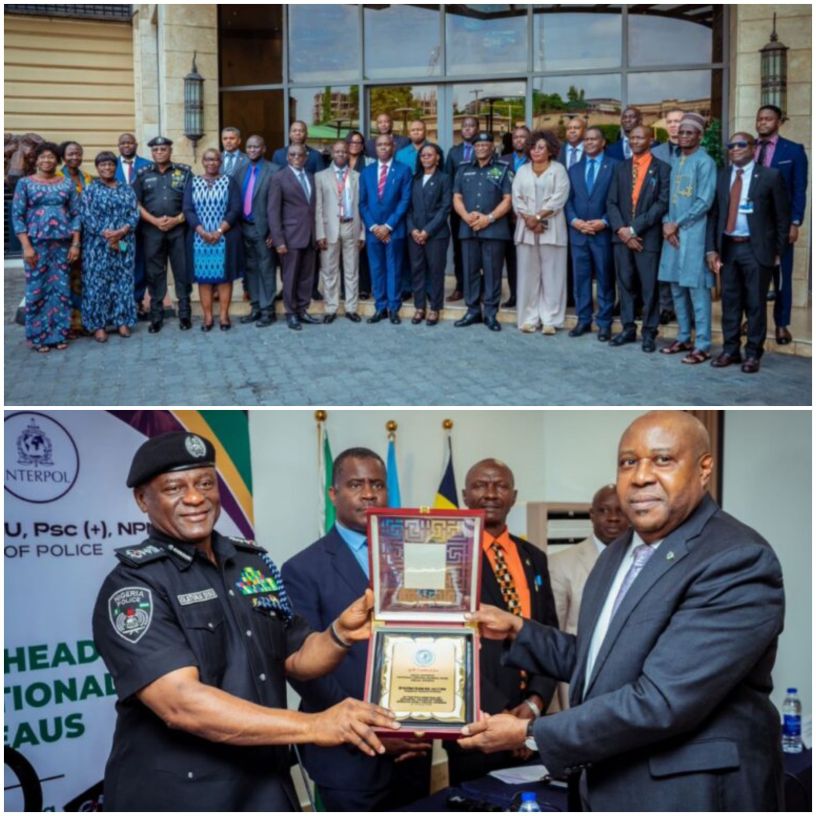
The Inspector-General of Police, IGP Olatunji Disu, has called for stronger regional collaboration among West African nations to combat transnational crimes.
IGP Disu warns that criminal networks are increasingly exploiting porous borders and weak coordination mechanisms across the sub-region.
Disu made the call while presiding over the 11th Meeting of Heads of INTERPOL National Central Bureaus (NCBs) for West Africa, in Abuja.
The high-level gathering brought together heads of NCBs from 16 West African countries, alongside senior officials of the INTERPOL General Secretariat and representatives of regional security organisations, to deliberate on emerging security threats and strengthen cross-border law enforcement cooperation.
Addressing participants, Disu painted a stark picture of the region’s security landscape, citing human trafficking syndicates, arms dealers, drug cartels, cybercriminals, money laundering networks, terrorist financiers and violent extremist groups as major threats confronting West Africa.
According to him, the criminal organisations operate across national boundaries and can only be effectively tackled through robust partnerships, intelligence sharing and coordinated law enforcement actions among member states.
According to him, the success of our region depends not on the efforts of any single country but on the speed and quality of partnerships forged across all member states.
The IGP highlighted several measures already being implemented by Nigeria to strengthen international policing and intelligence exchange.
He disclosed that the Nigeria Police Force is extending INTERPOL’s I-24/7 secure global communications network to border control points and law enforcement institutions nationwide, ensuring that officers at remote border crossings have real-time access to critical intelligence.
He also reaffirmed Nigeria’s commitment to Project GEMINI, INTERPOL’s initiative aimed at strengthening the verification and uploading of stolen and lost travel documents into its global database.
Disu further pointed to the West African Police Information System (WAPIS) as a practical example of how regional data integration can enhance crime-fighting efforts and improve security outcomes across borders.
Looking ahead, the police chief outlined three key priorities for Nigeria and the region: expanding universal access to INTERPOL databases across African border architecture, developing coordination mechanisms capable of facilitating joint law enforcement responses within hours rather than weeks, and deepening trust and transparency among National Central Bureaus to promote seamless intelligence sharing.
He stressed that even the most sophisticated security systems would be ineffective without mutual trust among participating agencies.
The INTERPOL delegation commended Nigeria for hosting the meeting and acknowledged the country’s investment in regional security cooperation.
The delegation noted that the attendance of all 16 NCB heads underscored a shared commitment to collective action against organised crime and security threats in West Africa.
Participants were urged to move beyond declarations and translate discussions into measurable commitments capable of improving operational effectiveness across the region.
The meeting reaffirmed Nigeria’s strategic role in regional security architecture and highlighted the growing importance of collaborative policing in addressing the increasingly transnational nature of crime in the 21st century.

