
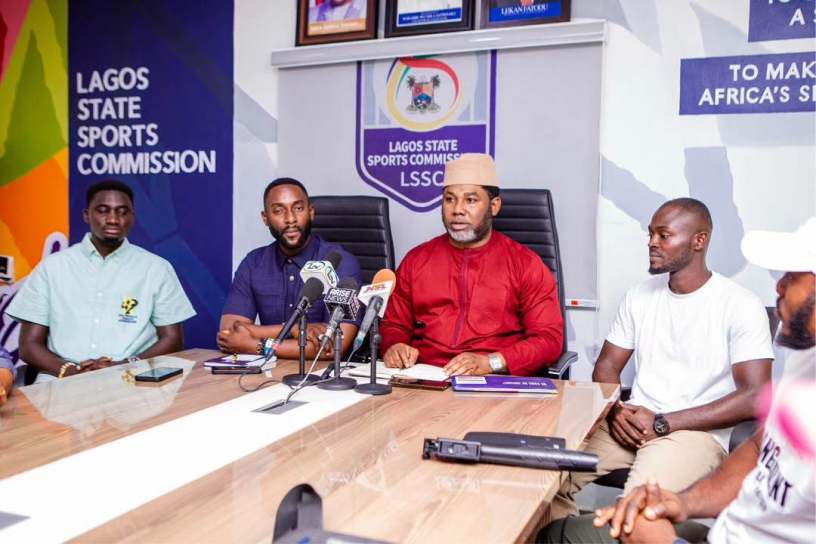
The Lagos State Sports Commission, LSSC, is lending a helping hand to the promotion of public health among the populace, leveraging grassroots sporting events to combat social vices in the drive to achieve social development.
The Commissioner for Youth and Social Development, Mobolaji Ogunlende and the Director-General of the Lagos State Sports Commission, Lekan Fatodu, disclosed this at a joint news briefing at the Teslim Balogun Stadium office of the Sports Commission.
The briefing was organised to formally announce the State Government’s support, empowerment and the staging of two sporting events of Project 226, comprising an extreme triathlon from Osun State to Lagos State by Coach Dreh to promote mental wellbeing and the Run Against Drug Abuse from Abuja to Lagos State by Olufemi Oshinubi.
The briefing also featured presentations by two sports enthusiasts and advocates, Dare Akinrodoye, popularly known as Coach Dreh, and Olufemi Oshinubi, who are pursuing separate endurance challenges designed to promote youth engagement, healthy living, mental wellbeing and the campaign against drug abuse.
While Akinrodoye Dare announced plans for an Extreme Triathlon Challenge from Osun State to Lagos, Olufemi disclosed his intention to undertake a long-distance run from Abuja to Lagos as part of his advocacy against drug abuse.
Speaking at the event, Fatodu said the Lagos State Government remained committed to identifying, encouraging and supporting sporting talents.
He stressed that young people with exceptional abilities deserved opportunities to develop their potential.
Fatodu noted that sports could serve as a powerful instrument for youth empowerment, social mobilisation and national development.
He added that the government would not take the sporting abilities of young people for granted.
According to him, the experiences of athletes such as Akinrodoye and Olufemi demonstrate how individual sporting ambitions can be channelled into initiatives capable of inspiring others and promoting positive change in society.
Similarly, Ogunlende expressed delight at the abilities demonstrated by young people in various sporting disciplines.
He noted that the government had a responsibility to encourage their talents and create opportunities for them to excel.
The Commissioner recalled meeting Akinrodoye more than a year ago after his swimming feat at the Third Mainland Bridge and subsequently introducing him to Governor Babajide Sanwo-Olu, to bring his sporting achievements and advocacy initiatives to the attention of the state government.
Ogunlende reiterated the government’s willingness to support promising talents and encourage young people to become worthy ambassadors of Lagos State and Nigeria through their chosen vocations.
He also emphasised the importance of mental health awareness and providing appropriate support to people experiencing emotional difficulties, while underscoring the need for sustained advocacy against drug abuse.
Project 226 – the Extreme Triathlon event by Coach Dreh campaign is billed to commence on the 15th of November 2026.
It will start from Oshogbo and end at JJT Park, Alausa, Ikeja, Lagos.
It’s a swim, bike and run event. It will be a 3.8 km swim in Owan Dam, Oshogbo, and a 180 km cycling from Owan Dam all the way to Shagamu interchange.
And then from Shagamu interchange, there will be a 42.2 km run down to J.J.T Park, Alausa.
The event is expected to cover around 17 to 18 hours.
Akinrodoye said the initiative was not merely about achieving an individual sporting milestone but also about using athletics to communicate important messages to young people and encourage healthier lifestyle choices.
On his part, Olufemi highlighted the use of long-distance running as a platform for raising awareness about the dangers of drug abuse and encouraging young people to make informed and responsible choices.
He disclosed that his drug-abuse advocacy initiative began in 2024 and included a sensitisation run from Ibadan to Lagos.
Building on that experience, he announced plans for a new 21-day running campaign from Abuja to Lagos, aimed at sustaining public awareness and expanding conversations about drug abuse and its consequences for individuals, families and communities.
Olufemi said the proposed initiative was intended to demonstrate how sporting activities could be deployed to communicate social messages, engage communities and encourage young people to embrace productive pursuits.
The two initiatives underscore the growing use of sports-based advocacy to connect physical activity with broader social concerns, including substance abuse, emotional wellbeing and youth empowerment.

