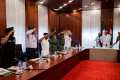

President Bola Tinubu has challenged medical professionals across West Africa to develop practical, sustainable solutions to the persistent migration of skilled healthcare workers.
Tinubu warns that the growing exodus is putting enormous pressure on healthcare systems and denying millions access to essential medical services.
He also expresses concern about the threat posed by Ebola and other infectious diseases, urging medical experts to intensify preventive measures and strengthen the subregion’s capacity to respond to emerging public health emergencies.
Tinubu spoke at the State House, Abuja, shortly after being conferred with the prestigious Fellowship of the West African College of Physicians, becoming only the second Nigerian leader to receive the honour in the institution’s 50-year history.
The President, who took the fellowship oath during the ceremony, tasked the college’s leadership with making medical brain drain a major priority at its forthcoming scientific conference, stressing the need for workable strategies to retain skilled healthcare personnel within the subregion.
According to a statement from his Special Adviser on Information and Strategy, Bayo Onanuga, the President observed that the continued movement of doctors and other medical professionals to developed countries has compounded existing weaknesses in healthcare delivery, increased the workload on available personnel, and limited access to quality medical services.
Tinubu said the situation demanded collective action by governments, medical institutions, and healthcare professionals to strengthen health systems and improve the subregion’s capacity to meet its populations’ medical needs.
Drawing attention to the renewed threat of Ebola, the President called for greater emphasis on preventive healthcare and improved preparedness against infectious diseases.
The President reaffirmed his administration’s determination to deepen ongoing health sector reforms aimed at making healthcare delivery more accessible, affordable and efficient for Nigerians.
He particularly commended the Coordinating Minister of Health and Social Welfare, Professor Muhammad Pate, for leading the administration’s healthcare transformation agenda.
He also acknowledged medical professionals’ contributions to humanity through research, disease prevention, life-saving interventions, and the development of resilient healthcare systems capable of responding to emerging health challenges.
Expressing appreciation to the WACP leadership for considering him worthy of the fellowship, the President pledged continued support for the medical profession and initiatives aimed at strengthening healthcare delivery across Nigeria and the wider West African region.
Earlier, the President of the West African College of Physicians and Chairman of its Board of Trustees, Dr Mamadou Mourtala Ka, explained that the fellowship was reserved for outstanding presidents who had demonstrated exceptional commitment to healthcare development within the subregion.
He said the decision to honour Tinubu followed an assessment of his administration’s policies and interventions to strengthen healthcare infrastructure and improve access to medical services.
Also speaking, the college’s Secretary-General and spokesperson for the delegation, Professor Musa Dankyau, said the institution had awarded the fellowship only eight times since it was established 50 years ago.
He explained that the first recipient was former President Dawda Jawara of The Gambia, while former Nigerian military President, General Ibrahim Babangida, received the honour in 1991.
According to him, Tinubu’s selection marked only the second time the institution would confer the fellowship on a Nigerian leader, underscoring the recognition’s significance.
The college’s recognition comes amid the Federal Government’s intensified response to the recent detection of an Ebola case in Abuja, which has prompted heightened surveillance, contact tracing and other containment measures by health authorities.
The Presidential Task Force on Ebola Preparedness and Emerging Public Health Threats assured Nigerians on Wednesday that the country has the institutional capacity and response mechanisms to manage the situation and prevent further transmission.
During Thursday’s ceremony, the WACP leadership also formally informed the President of its forthcoming 50th anniversary celebration and Annual General Scientific Meeting, scheduled to hold from October 26 to 28, 2026, at the Bola Tinubu International Conference Centre, Abuja.
The meeting is expected to give medical professionals and other healthcare stakeholders across West Africa an opportunity to examine pressing health challenges, exchange scientific knowledge, and develop strategies to improve healthcare delivery within the subregion.
Those present at the investiture included the Secretary to the Government of the Federation, Senator George Akume; Chief of Staff to the President, Femi Gbajabiamila; Coordinating Minister of Health and Social Welfare, Professor Muhammad Pate; Minister of Information and National Orientation, Mohammed Idris; and Special Adviser to the President on Health Matters, Dr Salma Anas.

