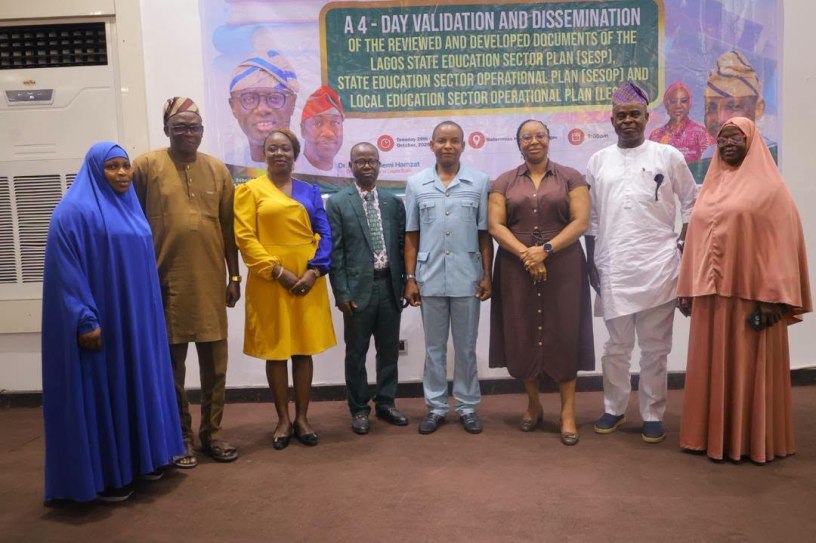
The Lagos State Government, through the Ministry of Basic and Secondary Education, has commenced a four-day validation and dissemination workshop on the reviewed and proposed Lagos State Education Sector Plan (SESP), State Education Sector Operational Plan (SESOP) and Local Education Sector Operational Plan (LESOP). The venue of the exercise, which began on Tuesday, 20th October, and will come to a close on Friday, 23rd October, 2026, is Watercress Hotels, Ikeja.
The workshop, organised in collaboration with the United Nations Children’s Fund (UNICEF) and the National Institute for Educational Planning and Administration (NIEPA), brings together key stakeholders in the education sector to review, validate and harmonise the documents to ensure their relevance, feasibility and alignment with the educational priorities of Lagos State.
The opening ceremony marked the commencement of the workshop, which is designed to strengthen education planning, improve coordination among relevant institutions and establish a shared framework for the effective implementation of education policies, programmes and interventions across the State.
Speaking at the opening of the workshop, the Honourable Commissioner for Basic and Secondary Education, Mr. Jamiu Tolani Adedeji Alli-Balogun, emphasised the importance of strategic planning, stakeholder collaboration and a shared commitment to achieving the State’s educational goals.
The Commissioner stressed that the documents would provide a clear direction for planning, resource allocation, implementation, monitoring and evaluation across the education sector. He further underscored the need for all relevant institutions and stakeholders to take ownership of the plans and work collectively towards their effective implementation.
“I sincerely appreciate UNICEF and NIEPA for their collaboration and continued commitment to strengthening education planning and improving educational outcomes in Lagos State. These documents must go beyond planning. They must serve as practical instruments for action, accountability and measurable improvements in our schools”, he said.
Speaking earlier in her welcome address, the Permanent Secretary, Ministry of Basic and Secondary Education, Abisola Dokunmu- Adegbite advised all participants to make judicious use of the four days.
“I look forward to fruitful deliberations and outcomes that would further advance our collective vision for a more inclusive, equitable and excellent education system. Let our deliberations produce robust, practical and implementable plans that would strengthen the delivery of basic and secondary education in Lagos State”.
Participants included the Registrar of the Lagos State Examinations Board, Mr. Adebayo Oransolu; representatives of UNICEF, led by Mr. Adebayo Ibrahim and the National Institute for Educational Planning (NIEPA), led by Dr. Lara Ogunsola; representatives of the Ministry of Economic Planning and Budget; the Office of Education Quality Assurance (OEQA); the Ministry of Tertiary Education; the Ministry of Finance; Education Districts; all Education Secretaries across the State and other relevant education stakeholders.
In their respective contributions, stakeholders emphasised the importance of collaborative planning, evidence-based decision-making and collective responsibility in addressing challenges within the education sector and improving learning outcomes across the State.
The technical session commenced immediately after the opening ceremony, with participants engaging in detailed discussions and reviews of the proposed documents. The sessions are expected to provide an opportunity for stakeholders to examine key priorities, identify gaps, make necessary recommendations and build consensus on the strategies and implementation frameworks outlined in the plans.
The four-day exercise is expected to culminate in the validation and dissemination of the documents, with stakeholders working towards a common understanding and commitment to their adoption and implementation, subject to the necessary approvals.
The initiative further underscores the Lagos State Government’s commitment to strengthening education governance, promoting effective resource utilisation and ensuring that education policies and programmes are guided by a coordinated, sustainable and results-oriented planning framework.
The Ministry reaffirmed the importance of sustained collaboration among government institutions, development partners and other stakeholders in achieving the State’s vision of an inclusive, responsive and quality education system that meets the needs of learners and supports the State’s overall development objectives.

