President Bola Tinubu has backed a 20-year development plan for the North Central region, saying long-term regional planning is critical to unlocking economic potential and accelerating development across the country.
President Tinubu says the plan, being developed by the North Central Development Commission, NCDC, would help address longstanding development gaps and create stronger connections between regional economies.
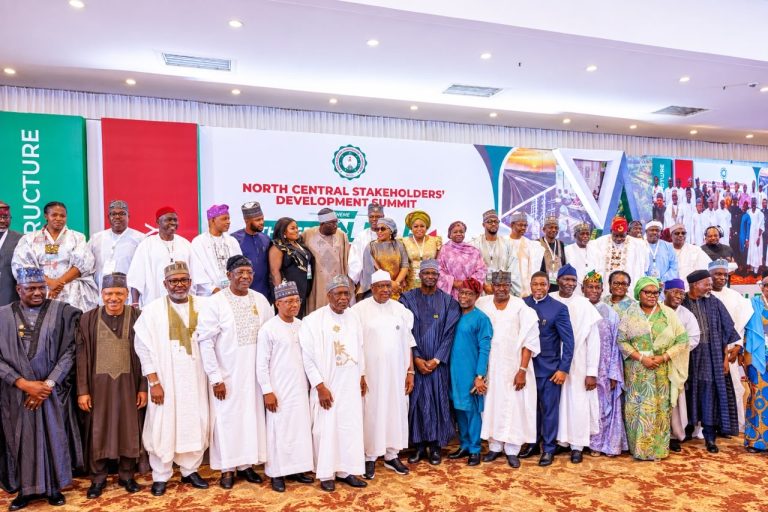
The President spoke through the Secretary to the Government of the Federation George Akume spoke at the First North Central Stakeholders Development Summit in Abuja.
Tinubu described the establishment of Regional Development Commissions as part of his administration’s Renewed Hope Agenda.
He said the commissions were expected to focus on major projects capable of unlocking regional potential and improving national connectivity.
The President said the North Central has significant opportunities in agriculture, food production, agro-processing, solid minerals and industrial development, but has not fully realised its potential.
The President also urged the NCDC to ensure that the 20-year plan translates into practical development outcomes rather than remaining a policy document and called on stakeholders to scrutinise the plan and ensure it reflects the aspirations of the people aligning with the Renewed Hope Agenda.
President Tinubu pledged continued political and financial support for the NCDC and other Regional Development Commissions and directed the Secretary to the Government of the Federation to ensure that funds accruable to the commissions are released as and when due.
Minister of Information and National Orientation, Mohammed Idris, said the North Central region possesses enormous agricultural, mineral, energy and human resources capable of transforming it into a major economic hub and contributing significantly to Nigeria’s sustainable prosperity.
The Information Minister called for the development of a practical 20-year roadmap to harness the region’s potential and accelerate economic growth.
Idris while describing the North Central as Nigeria’s “geographical heartland” and a critical bridge between the northern and southern parts of the country, said the region had vast agricultural land, solid minerals, water and energy resources, tourism potential and a large population.
Idris disclosed that the Nigerian Government had already commenced interventions aimed at increasing agricultural productivity, including a programme to deploy 10,000 tractors over five years under President Bola Ahmed Tinubu’s Renewed Hope Agenda.
Idris said the Calabar-Ebonyi-Nasarawa-Abuja Superhighway would further strengthen the connection between the North Central and southern Nigeria, facilitating the movement of agricultural produce alongside minerals, manufactured goods and people.
The Minister also pointed to the Government’s broader investment in economic corridors, noting that major highways should create opportunities for agriculture, power generation, manufacturing and other businesses to flourish along their routes.
He said the region’s agricultural potential must therefore be viewed not simply as a means of producing food but as the foundation for a wider industrial economy.
The minister said security efforts must also be complemented by economic opportunities capable of engaging young people in productive activities.
Minister of Regional Development, Engr. Abubakar Momoh, said the proposed plan would provide a common development vision capable of transcending individual states, projects and political administrations.
He stressed that “transformational development requires long-term planning,” adding that major regions are built through sustained implementation of clear visions, strong institutions, consistent policies and partnerships.
The Minister urged that the North Central Development Commission should serve as an instrument for strategic regional transformation rather than merely another federal intervention agency.
The Minister of State for Regional Development, Uba Ahmadu said the policy, being harmonised by the Ministry in collaboration with the National Economic Council, Regional Development Commissions and development partners, is at an advanced stage ahead of submission to the Federal Executive Council.
He noted that the North Central region, comprising Benue, Kogi, Kwara, Nasarawa, Niger, Plateau and the Federal Capital Territory, remains critical to Nigeria’s economy but faces insecurity, infrastructure deficits and displacement of communities.
He urged stakeholders to identify priorities in infrastructure, agriculture, human capital, security and investment, stressing that “Government alone cannot deliver the scale of transformation this zone deserves.”
The Managing Director of NCDC Dr Cyril Tsenyil called for greater regional collaboration in agriculture, mining and infrastructure, saying the region must move from the production of raw materials to value addition and industrialisation.
He said discussions had already commenced on major projects including a regional railway network, revival of Ajaokuta Steel, dredging of the Rivers Benue and Niger, Baro Port and the Jos Dry Inland Port.
The Managing Director said the summit would move beyond speeches to investment opportunities and concrete commitments through structured Deal Rooms, where projects would be classified according to their readiness for investment.

