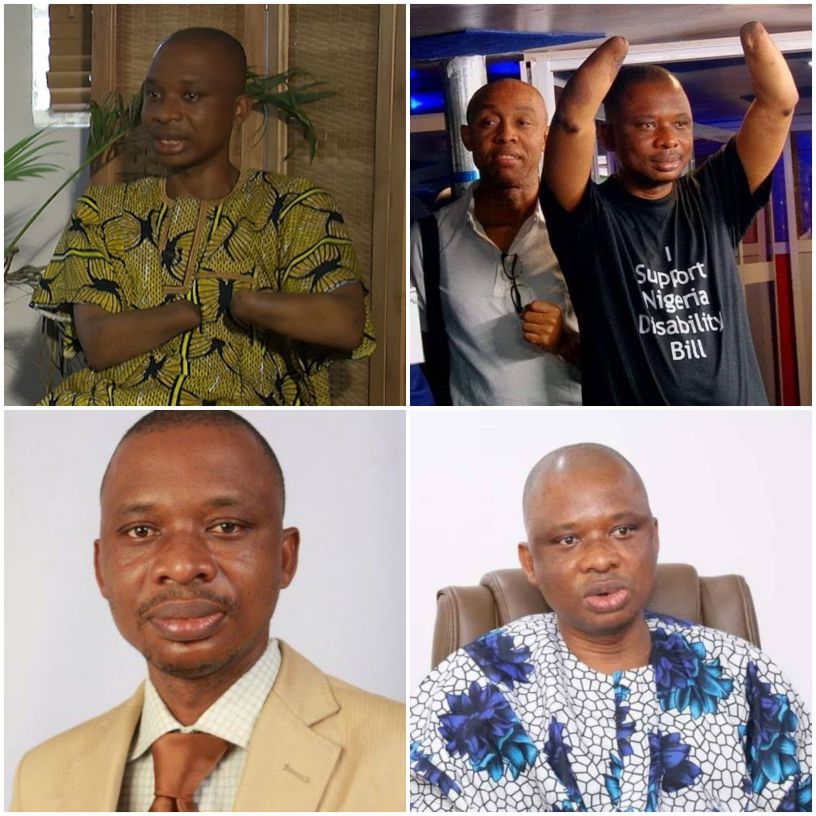
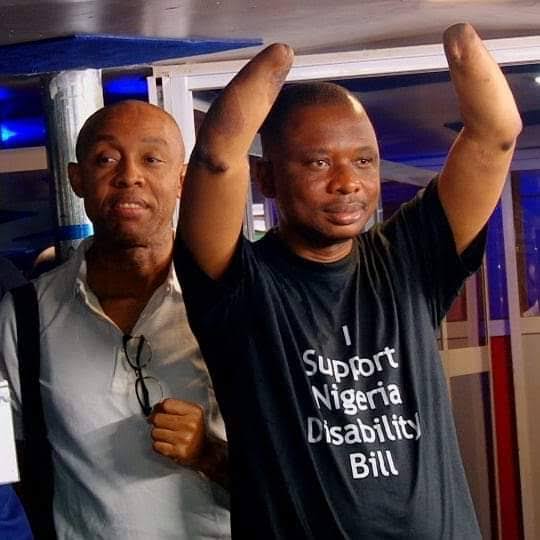
The Executive Director of the Centre for Citizens with Disabilities, CCD, David Anyaele, has revealed how President Bola Tinubu rehabilitated him after Sierra Leone rebels amputated his hands in 1999.
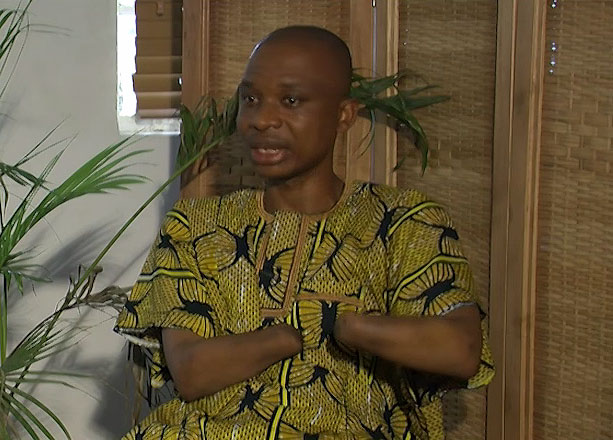
Anyaele said he wrote to various governments, including Southeast governors, seeking support after his ordeal was televised, but his requests were rejected.
He spoke during the Nkata Umuibe, a monthly speakers’ series organised by the Centre for Memories, CFM, Enugu, themed ‘Onye Aghana Nwanne Ya’.
According to him, the assailants were fighters of the Revolutionary United Front, RUF, which waged war in Sierra Leone between 1991 and 2002.
In his words, after his request to Southeast governors and others were rejected, he later sent the same appeal to then Lagos Governor Bola Tinubu, who directed doctors to examine him.
According to him, Medical reports recommended overseas treatment, leading to his rehabilitation in Germany, where artificial hands were fitted.
Anyaele thanked the Tinubu administration and the good people of Lagos State for their hospitality.
He lamented that living with disability in Igboland often meant enduring discrimination and neglect.
Recounting his ordeal, Anyaele said he was on a business trip to Freetown when he was attacked solely because he was Nigerian.
He recalled that his pleas not to be mutilated were ignored, stressing that many Nigerians faced similar inhuman treatment during Sierra Leone’s civil war.
Anyaele said Nigerian-led ECOMOG troops rescued him while he lay in pain and rushed him to hospital, saving his life.
According to him, that experience changed his world as he suddenly found himself in the disability community, without knowing what the future held.
He added that he was subjected to stigma, discrimination, isolation, and exclusion because of his disability.
Appealing to Igbos, Anyaele urged them not to discriminate against persons with disabilities but to embrace inclusion, noting disability could happen to anyone anytime.
He commended Governor Alex Otti for establishing the Abia State Disability Commission and urged Governor Peter Mbah to replicate it in Enugu State.
The journey of David Anyaele’s survivor into the world of disability began in 1999.
That year, David Anyaele was a victim of the Civil War in Sierra Leone where he had his fore limbs cut off by rebels. This was the beginning of his challenges.
Prior to that tragic loss of limbs, Anyaele, a typical Aba man, was into business and things were going smoothly.
Then it happened!
How did David respond?
THE MAN, HIS ATTITUDE, AND HIS ALTITUDE
It is said that attitude determines altitude. Even before he speaks, Anyaele’s story proclaims the message loud and clear: “ Never underestimate the power of maintaining a positive attitude in the face of the biggest obstacles”. And Keith Harrell reaffirms this truth in his book, “Attitude is Everything”.
Indeed, the strongest antidote to coping favorably with disability remains having a right attitude.
David responded to the unexpected with an uncommon Positive Mental Attitude. He says that’s the most important key to rising above his disability. Even while in hospital he demonstrated HOPE, for the one who was supposed to receive succor turned out to be the succor giver. Hear his response during an interview on how he felt about life without limbs while in the hospital: “Yes, I had no doubt. I told my mother who was crying over my situation that she should not worry. I spent seven months in the hospital and in all that period, I never feared or troubled myself about anything.
The only thing I was asking God was to heal me. I needed spiritual healing as well as physical. The understanding was that if I healed spiritually I wouldn’t be lost. I would be able to interact with myself and my environment. I would be able to see things only positively”.
This mindset served David well. He refused to allow his lack of limbs put a limit on his possibilities for successful achievement as a human being. This mindset was key to surmounting the challenges that came with his condition. And anyone can draw hope and inspiration from Anyaele.
STRUGGLE FOR A PROSTHESIS: THE TRIUMPH OF TENACITY
A survivor who knew what he needed to achieve what he wanted… And he went all out for it.
On his discharge from hospital, Anyaele needed artificial limbs (prosthesis) to maintain a decent level of independent living. The cost of acquiring this was put at #5 million.
Despite not being able to afford the sum, David remained resolute in his determination for an independent life. He recalls: I wanted to be able to do things for myself. Things like eating, dressing, using the restroom, writing driving, etc. I didn’t want my privacy intruded. I needed artificial limbs to efficiently do these things.
He approached the then Governor of Abia State, Dr. Orji Uzor Kalu for help but got none. Turned down by Government officials and Ministries, this marked the beginning of stigma and discrimination.
Anyaele recalls being deserted by friends and acquaintances during those early days. They distanced him on the grounds that he was going to be a liability.
These disappointments were enough to break the weak-willed, but not the fighting spirit in this champion. David the giant-killer instead drew motivation from these.
Emotionally devastated, yet unshaken in his determination to make something of himself, this disability war veteran picked up the broken pieces and relocated to Lagos to start life afresh. His fighting spirit eventually paid off when kind hearted individuals, moved by his doggedness offered help, and he got a pair of artificial limbs from Germany in 2003.
Here’s one of his Overcomers nugget for folks living with disabilities:
Never let your disability make you a liability. By striving with a Positive Mental Attitude for independent living, you not only retain your dignity, you command respect in due course. And David did command respect with his achievements over the years.
DEALING WITH STIGMATIZATION AND ISOLATION.
David reminds his fellow travelers on the highland of affliction of the realities of stigmatization and isolation. These are major barriers faced by Persons with Disabilities, noted the disability war veteran. We will all experience it in various shades at one point or the other.
When asked to comment on his struggles to rise to where he is today and gain recognition by society, David highlights overcoming stigma and isolation as the turning point.
“We have little control over the tendency of society to stigmatize us, he observed. However, we can determine our response” – and it shouldn’t be self-isolation. For me, these two barriers were the biggest to my advancement in life. Fortunately for me, I rose above them.
To succeed, you have to walk right through the society with all its stigmatization.
IN RETROSPECT
David further gives credit for his ability to cope with the challenges of his life to family support and education.
On family, he says he was privileged to receive great home training from parents. At age eight, he was a member of an Adventist Youth Society (AYS), formerly Missionary Volunteers (MV). There he learnt about contributing to society and supporting people.
On Education, David believes it is key to competing favorably in today’s competitive society, more so for Persons with Disabilities.
AN IMPRESSIVE RESUME.
Mr. David holds Masters of Science in Law & Diplomacy from Babcock University, Bachelor of Science in Management Science from the University of Education, Winneba, Ghana, Diploma in Public Relations from Business Education Examinations Council (BEEC). A member of the Nigeria Institute of Public Relations, he is also on the board of a number of Civil Society Organizations – among them are the National Association of Persons with Physical Disabilities, Civil Society Coalition on Sustainable Development. He is the Chairman of the Disability Subcommittee, Crosscutting Committee, Nigeria Vision 2050, President, Nigeria Sitting Volleyball Federation and Convener, Coalition of Disability Organizations in Nigeria. He has received many accolades and awards to name and works, among them are Disability Champion Award by DIAL Awards 2019, Defender of Justice Award by the Committee for the Defence of Human Rights (CDHR), and the Gold Star Award by the International Visitors Leadership Program of the State Department, United States.
 securityandsafetymatters