The CLEEN Foundation joins the global community to commemorate the International Day of Peace 2025, reaffirming our commitment to building a Nigeria where peace, justice, and community resilience thrive.
This year’s theme, Act Now for a Peaceful World was adopted in-house as “Community First: Local Solutions for a Peaceful Nigeria,” which underscores the power of grassroots action in preventing conflict and sustaining harmony.
Across the country, community leaders, women’s groups, youth networks, and civil society actors continue to show that lasting peace begins at the local level.
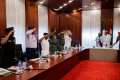
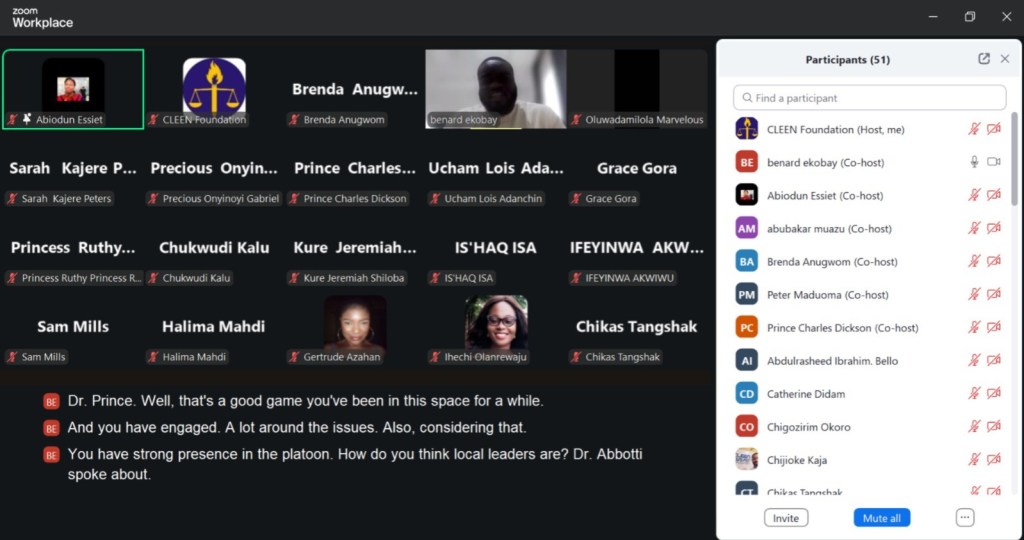
CLEEN Foundation held a webinar to further advance and provides a platform for our beneficiary communities to project their voices on local to global peace architecture.
Its Acting Executive Director, Peter Maduoma said the organisation and the work they do, Peace is not an abstract goal. It is the daily work of strengthening trust, ensuring justice, and creating opportunities for every Nigerian. The theme highlights the role of individuals, communities, and nations in solving conflicts and building a safer future. Whatever it means to you: We know Peace is personal. In Nigeria today, It is more important than ever today to promote peace and open-mindedness considering the surgical divide across political, ethnic and religious lines.
Over the past year, CLEEN has:
Expanded Early Warning and Early Response networks in at-risk states.
Launched and Trained community peace monitors and facilitated dialogue among security agencies, traditional rulers, and youth leaders.
Advanced the Women, Peace and Security agenda, empowering women as mediators and decision-makers.
Supported conflict-sensitive policing initiatives that strengthen accountability and public trust.
Deepened civil-security relationship and promoted trust and confidence on peace architecture
Invested in research around the administration of criminal justice which is often the bedrock of threats to peace.
As Nigeria prepares for upcoming elections and faces evolving security challenges, CLEEN calls on:
Government to prioritise inclusive dialogue and ensure justice systems is accessible to all.
Security agencies to uphold human rights and community-based policing standards.
Citizens to reject hate speech, misinformation, and violence, and to embrace peaceful engagement.
CLEEN Foundation reaffirms that peace is everyone’s responsibility. Together, through local solutions and national solidarity, we can secure a safer, more just Nigeria for generations to come.
The International Day of Peace, observed every 21 September, transcends a symbolic ritual on the United Nations calendar. It serves as a sober reminder that humanity’s collective survival hinges on the choices made in the face of violence, conflict, and division.
While the world urgently needs peace, violent conflicts across continents have devastated lives and communities, highlighting glaring failures by world leaders who repeatedly choose battlefields over diplomacy and dialogue to resolve disputes.
Therefore, the 2025 theme, Act Now for a Peaceful World, resonates with urgent clarity as the world seems determined to push the limits of destruction.
Russia’s war on Ukraine has forced 3.7 million people to become internally displaced and created 6.9 million refugees, destabilising global food and energy systems.
According to the Washington DC-based Centre for Strategic and International Studies, as of July, Russian casualties are estimated at 950,000, including up to 250,000 deaths—the highest fatality rate since World War II. Ukraine has sustained nearly 400,000 casualties, with deaths estimated between 60,000 and 100,000.
The Israel-Gaza war has exacted an unspeakable toll on civilians, with over 65,000 dead, the displacement of two million people, and 92 per cent of buildings and structures in the Gaza Strip reduced to rubble.
In the Democratic Republic of Congo, armed groups continue to unleash terror, leaving hundreds dead amid recurrent waves. Since war broke out in 1996, six million people have died, according to the Council on Foreign Relations.
Elsewhere in Sudan, Gaza, and Yemen, the human suffering wrought by conflict is almost indistinguishable in its horror.
In Sudan, two years of conflict have displaced 13 million people internally, with half the population facing starvation. The fierce war between the Sudanese Armed Forces and the paramilitary Rapid Support Forces has claimed 61,000 lives in Khartoum alone.
“This is a manmade crisis, driven by conflict, not by drought, floods, or earthquakes, and worsened by obstruction of humanitarian assistance by parties to the conflict,” said Shaun Hugues, Regional Emergency Coordinator at the UN World Food Programme.
Each theatre of war not only destroys populations but also erodes trust, dialogue, and reconciliation.
While international news outlets capture these conflicts in graphic detail, Nigeria faces its own battles, wars waged not only on battlefields but in farms, villages, highways, and even schools.
These are wars without declarations, yet they are as devastating as those fought with tanks and missiles.
According to Governor Caleb Muftwang of Plateau State, over 11,000 lives have been lost in the state alone to violent attacks in the last decade. Plateau, once renowned for its serenity and lush greenery, is now a tragic emblem of Nigeria’s descent into bloodshed.
In nearby Benue, banditry and attacks by armed herders have rendered thousands homeless and turned fertile farmlands into graveyards.
The Boko Haram insurgency, which began in the North-East, has claimed over 350,000 lives directly and indirectly, according to the UNDP.
Kidnappings for ransom have spiralled into a national emergency, with schoolchildren, clerics, and travellers abducted at will.
Violent groups like ISWAP continue to sow terror, exploiting Nigeria’s porous borders and governance weaknesses.
These conflicts are not mere statistics; they represent shattered families, ruined livelihoods, and a future mortgaged to violence.
They highlight a stark truth: no country can aspire to genuine development or prosperity without peace.
Nigeria, once seen as a haven of stability in Africa, now symbolises how unchecked violence corrodes the foundation of nationhood.
Peacebuilding must therefore move from rhetoric to concrete action. It is not the task of the government alone, though state actors bear the primary responsibility for security.
Communities, faith leaders, schools, civil society, and the private sector all have roles to play.
Every Nigerian is a stakeholder in peace, for without peace, every other ambition is reduced to ashes.
The nexus between peace and development is well established. No economy thrives where violence reigns. Farmers cannot cultivate in fields patrolled by gunmen.
Schools cannot function where abductions loom large. Investors flee environments where uncertainty replaces security. Peace is not a luxury but the basic infrastructure upon which progress is built.
The UN underscores this in its 17 Sustainable Development Goals, where peace, justice, and strong institutions are integral to prosperity, equality, and sustainability.
Without peace, the goals of quality education, gender equality, and economic growth remain hollow promises. Nigeria’s quest for equitable development will be fruitless unless peace is entrenched.
What, then, can be done? First, security must be restored with urgency. This requires more than deploying soldiers or establishing vigilante groups.
It demands intelligence-driven policing, justice systems that are swift and fair, disarmament initiatives that go beyond token gestures, and the creation of more opportunities for economic progress, especially in rural communities.
Nigeria must review its security architecture to attain peace. It is the only federal state operating a single police force, whereas Brazil, the United States, Belgium, Australia, India, and Ethiopia operate along devolved policing lines.
Worse, two-thirds of the corps are deployed illegally to secure the VIPs. So, Nigeria should change to achieve peace.
There must be accountability for every act of violence. The culture of impunity has emboldened killers; ending it will deter others.
Second, peacebuilding must address the root causes of conflict: poverty, inequality, and exclusion.
The Peacebuilding Commission of the UN, now marking its 20th year, emphasises that poverty and marginalisation often act as tinder for violence.
In Nigeria, unemployment, corruption, elections, and ethnic mistrust continue to fuel resentment and extremism. Policies that empower young people, bridge ethnic divides, and promote inclusion are indispensable.
Dialogue and reconciliation must be prioritised. Communities torn apart by violence cannot recover without intentional efforts to promote forgiveness and trust.
Traditional rulers, faith leaders, and grassroots organisations are central to this. Political leaders must resist the temptation to exploit divisions for electoral gain.
Peace begins at the individual level. Respect, tolerance, and empathy should be cultivated in homes, schools, and workplaces.
Hate speech, discriminatory language, and stereotyping must be challenged in every space.
The UN’s ActNow campaign reminds citizens that peace is built daily, through small acts of kindness, responsible use of social media, and the courage to speak out against injustice.
The blood of more than 11,000 victims in Plateau, the countless dead in Benue, and the thousands lost to Boko Haram and other insurgent groups should not be in vain.
They are a haunting reminder that silence always comes at a greater cost than action. Nigeria cannot afford to normalise violence or to bury its future in shallow graves dug by hate and suspicion.

