

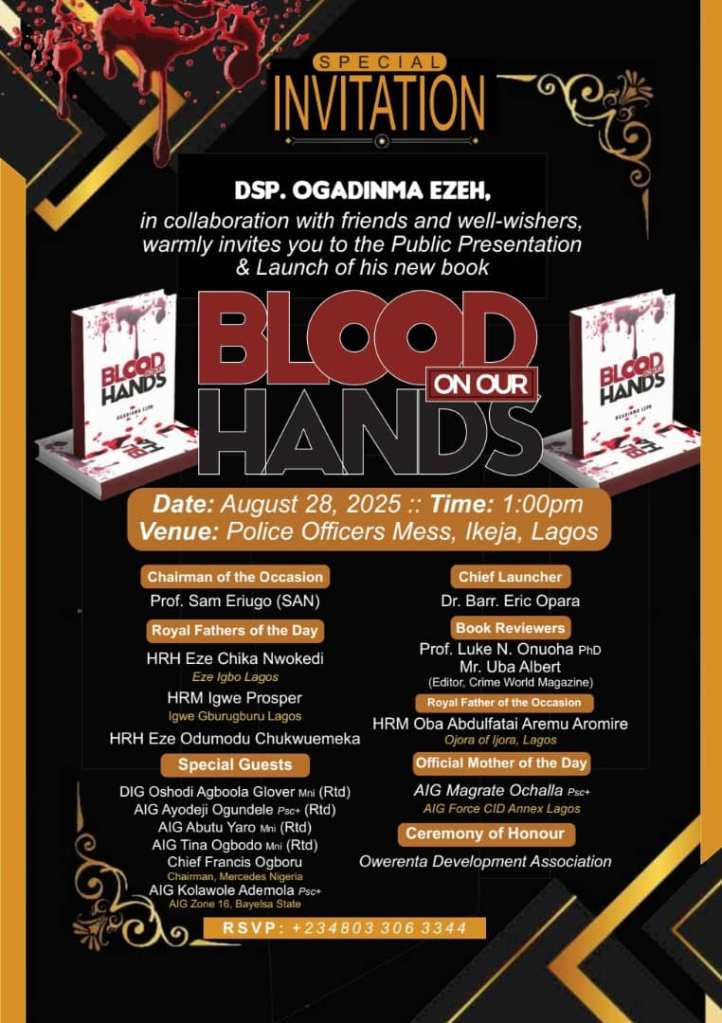
Intellectuals, Traditional Rulers, Title Chiefs, Security Experts, Academia and literary enthusiasts have gathered at the Police Officers’ Mess, Ikeja, Lagos, for the official launch of a book titled; Blood on Our Hands.

The book, Blood On Our Hands, is a gripping new book by a Deputy Superintendent of Police, DSP, Ogadinma Ezeh.
Speakers at the launch of the book, said Blood on our hands is a novel that every home, every tertiary institution and the national library should have copies.
According to them, this is because, it is educating, enriching and an expose of the type of society they find themselves today, saying your best friend could be your worst enemy.
In their words, DSP Ezeh is not just an invaluable asset to the Nigeria Police Force, he is equally a blessing to Nigeria and the literary community in particular.
The event was marked by a rich blend of cultural homage and intellectual discourse, with speakers praising the author for daring to capture what many described as the unfiltered realities of life in Nigeria.
The Eze Igbo of Lagos, His Royal Highness, Eze Dr. Chika Nwokedi, lauded Ezeh for overcoming challenges to weave a story that deals with an individual’s struggles in a way that sparks reflection.
The royal father of the day, the Ojora of Ijora Kingdom, Oba Abdullahi Aremu Aromire, Oyegbemi the second, hailed the book for reigniting Nigeria’s dwindling reading culture.
The oba who spoke through the Bashorun of Ijora and Iganmu Kingdom, Chief Akeem Oladipupo Ojora, encouraged the youth to embrace reading as a pathway to better understanding of society and themselves.
Adding an inter-state royal perspective, the Atayero of Aramoko kingdom, Ekiti, His Royal Highness Dr Ambassador Olusegun Aderemi Idowu emphasised how the book resonates with both law enforcement officers and civilians.
According to him, Blood on Our Hands could help foster improved police-community relations by deepening understanding between the uniformed and the public.
In his review, Deputy Vice Chancellor of Adeleke University, Professor Luke Onuoha, drew the audience’s attention to the book’s central message: that destiny is self-determined, with God as the ultimate guide.
Onuoha highlighted the themes of reconciliation, perseverance and positivity woven through the pages.
He said the author, Ezeh is a master story teller whose mastery of all the beauties of literary prose writing, including simplicity of language, poetry, clinical and flawless application of syntax and stylistic phenomenon; making one reading a chapter of the book hungry for the next chapter a delight.
According to him, incidentally, the author is a senior police detective bestowed with the onerous task of detecting and investigating the commission of crimes, it therefore, beats the imagination of the reviewer, how he expertly combines the tasking duo.
The event also featured critical insights from a, journalist and criminologist, Prince Albert Uba who described the work as akin to a Chinua Achebe masterpiece.
Uba, the Publisher of Crime World News Magazine praised Ezeh’s storytelling for its depth and societal relevance, recommending the book as essential reading for schools, homes and literary circles.
As conversations lingered long after the formal unveiling, one thing was clear, DSP Ogadinma Ezeh’s Blood on Our Hands is more than just a book.
It is a social intervention wrapped in the art of storytelling, a bold attempt to challenge, enlighten and inspire.
The Author, Blood On Our Hands, DSP Ogadinma Eze speaking with newsmen revealed that the book is purely a story of man’s inhumanity to man.
Ebiri, the lead character’s parents were callously sent to the great beyond by his father’s brothers because of sheer jealousy.
He too, was rejected by the community and the immediate family he belonged for no fault of his, left with no choice, he wandered into the unknown at the mercy of nature only for fate to smile on him.
He was picked up at the point of death by a total stranger, taken to an unknown community where he was introduced to western education and Christianity.
There, he rose to stardom, proliferating the words of God as against the Igbo traditional religion and became a prominent figure in the community.
The lead character is a rejected stone who became the head of the cornerstone. It is a melancholic narration of one whose parents were killed by those who called themselves brothers, he was to suffer a more devastating page in life as an orphan again, when he was rejected by his immediate family.
He therefore, wandered into the unknown forest without the luxury of clothing, shelter and food.
At the nick of time when he felt he was done with life and begged death to take him, somebody came picked him up and made him a notable figure in the communities including his own community which rejected him.
Blood On Our Hands by a Deputy Superintendent of Police DSP Ogadinm Ezeh is a masterpiece. It is a fictional prose with an adaption of the late Albert Chinalugo Achebe’s Things FallApart. It has an Igbo ethnic setting and narratives which almost earned the author the title of an ethnic chauvinist.
There’s hardly a chapter in the 140 page novel without ample use of rich parables peculiar to the Igbo race for illustration. But unlike the Things Fall Apart which is a pure tragedy; a story of the lead character, Okonkwo who rose to stardom; abhoring every relics of his indolent father, Unoka (referred to as a loafer) through tint of hard work but became desolate and committed suicide at the peak of his life, Ebiri, the lead character in Blood on Our hands was a downcast who wondered his rejection and wandered into the abyss of nature, cloaked in uncertainty but was lifted up to become somebody in the society by fate and providence. It is therefore, more of tragi-comedy.

