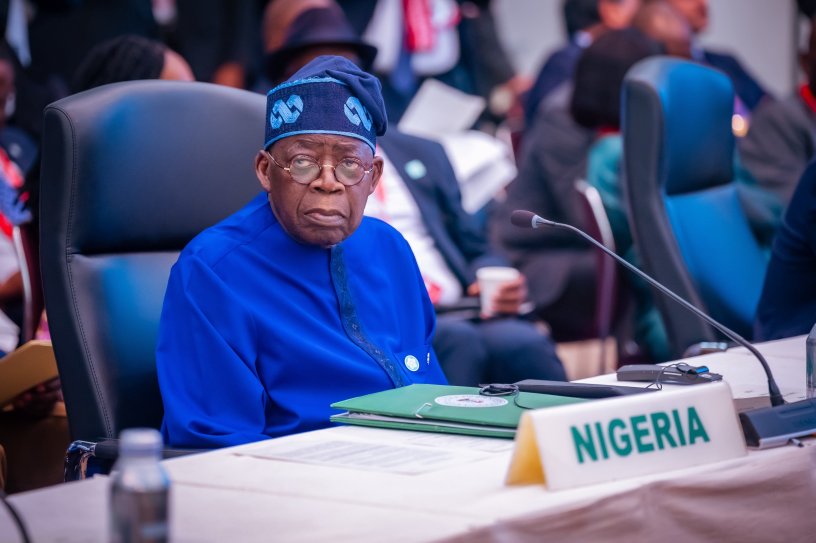
President Bola Tinubu, has in Yokohama, Japan, lauded the Nigerian armed forces for their successes in the war against insurgency and criminality.
President Tinubu emphasises his administration’s commitment to addressing the root causes of insecurity through strengthening the government security apparatus and ongoing economic reforms.
Tinubu made the remarks during his intervention at the plenary session on Peace and Stability at the 9th meeting of the Tokyo International Conference for African Development (TICAD9).
He reaffirmed that inclusivity, diversity, and the rule of law remain Nigeria’s greatest strengths.
The President described the current momentum in the Nigerian Armed Forces as a springboard for national development and stability.
He spoke after the opening ceremony, during which the Japanese Prime Minister Shigeru Ishiba emphasised the importance of mutual understanding, local solutions, and collaborative efforts for Africa’s development.
The Prime Minister outlined Japan’s focus on private sector-led sustainable growth, youth and women empowerment, and regional integration.
Prime Minister Ishiba announced a collaborative economic framework between Japan and the African Development Bank that will see a maximum of $5.5 billion disbursed to Africa, utilising Japan International Cooperation Agency (JICA) private sector investment finance as a catalyst.
President Tinubu emphasised the ongoing investments in infrastructure, institutional reforms, and collaboration with civil society and international partners to improve the living standards of all Nigerians.
Nigeria’s brave armed forces can win any number of battles, but we do justice to their heroism only when we, as government, are courageous in tackling not just terror, but also the underlying causes,” the President said.
President Tinubu stressed the essence of peace and stability to meaningful development, lamenting that conflicts are still ongoing in many African countries despite some progress.
However, he highlighted recent peace pacts brokered in the Congo as evidence that a new model of mediation and economic considerations can yield success.
President Tinubu appealed for market-driven cooperation and partnerships across nations rather than the hackneyed appeals for aid and handouts.
President Tinubu seized the opportunity to call on the Japanese government to support the campaign for reforms in the United Nations’ organs, especially the United Nations Security Council, to give African countries a greater voice.
“It is the view of Nigeria that Africa’s quest for fair and equitable representation in the UN Security Council is a just and fair demand. Indeed, Africa deserves two seats in the Permanent Category, with all its prerogatives and privileges, including the Right of Veto. Africa also deserves additional seats in the non–permanent seat category of the Security Council, as encapsulated in the Ezulwini Consensus and the Sirte Declaration.”
.
Addressing the role of information and technology, President Tinubu called for international cooperation to ensure technology becomes a tool for peace and trust, not division and alienation.
Prime Minister Ishiba emphasised that locally rooted solutions are essential for Africa’s development.
“Japan is providing various cooperation and support for Africa. But first of all, Japan needs to know more about Africa. So, in creating solutions together, this co-creation at the TICAD 9, we focus on three important areas: private sector-led sustainable growth, Youth and Women, and Regional integration and connectivity within and beyond Africa”.
He appealed to African countries to assist Japan as it grapples with the challenges of a declining population and shrinking agricultural land.
“In 75 years from now, the population of Japan would have been halved. In the local communities, the population continues to decline; this is one big challenge Japan is facing. All agricultural land is being reduced, another major challenge for Japan.
Ishiba underscored the positives of Africa’s youthful population: “There is another potential in Africa; there is so much growing young population in Africa, but for the power of young people in Africa to flourish, you need to create a manufacturing industry and create employment, and that, I believe, is very important.
“In Africa, there is a primary industry, agriculture, forestry, and industries, and then it jumped over to the tertiary sectors and the services industries.
“There is a jump in economic growth that Japan and other Asian countries have experienced and they have tried to move from the primary, the Agriculture, fisheries, forestry to the secondary, that is a necessary process because the power of the youth could be realised fully in the manufacturing industry to improve the productivity of Africa’s manufacturing sector.”
The trending social media narrative about an empty booth labelled ‘NIGERIA’ at the ongoing 9th Tokyo International Conference for African Development (TICAD9) in Yokohama, Japan, totally misrepresented our country’s mission and activities at the conference.
While we understand the urge by many social media users to seek clicks with many incorrect posts, we also recognise that the author may have acted out of patriotic concern. But it is a concern inspired by ignorance about Nigeria’s mission at the triennial conference.
The Nigerian delegation to the summit, led by President Bola Tinubu, is laser-focused on its core objectives of achieving tangible outcomes from the scheduled lineup of bilateral and multilateral engagements targeted at driving optimum performance in key sectors of the economy, especially in power, industry and agriculture.
The Nigerian official delegation working with Corporate Nigeria, represented by some of our leading business leaders, didn’t come to Yokohama and Tokyo to attend any Trade Expo, designed as an open forum for participating nations.
The Nigerian Association of Chambers of Commerce, Industry, Mines, and Agriculture (NACCIMA) is scheduled to host an investment forum on Thursday, August 21, 2025
The Nigerian ministers are busy with bilateral sideline discussions. At the same time, President Tinubu will lead meetings with the executives of Toyota Corporation, CFAO, UN-Habitat, UNDP, and the International Finance Corporation. The delegation’s schedule does not include participation in an open forum trade exhibition.
Specifically, the Minister of Power, Adebayo Adelabu, is leading the pre-activation meeting to execute several power projects in Nigeria that are being funded by the Japan International Cooperation Agency (JICA).
One of the projects is the Lagos-Ogun Power Transmission System Improvement, which is designed to improve the wheeling capacity and grid stability and enable the connection of industrial customers on the corridor.
There is also the partnership between the National Power Training Institute (NAPTIN) and JICA to enhance Vocational Training Delivery for the power sector.
The third power project is the Distributed Access Through Renewable Energy Scale-up, for which $190 million has been provided.
The Minister of Power is scheduled to negotiate with notable Original Equipment Manufacturers (OEMs) such as TOSHIBA and HITACHI.
The Bank of Industry, led by its Managing Director/Chief Executive, Dr. Supo Olusi, is also in high-level discussions with the Japan International Cooperation Agency and other participating multilateral institutions for its annual global fund syndication.
Social media posts are often sensational and do not tell complete stories, just as the trending video does not capture Nigeria’s participation at TICAD 9. Our country is fully and well represented and part of the essential conversations and negotiations that are going on at TICAD9.

