
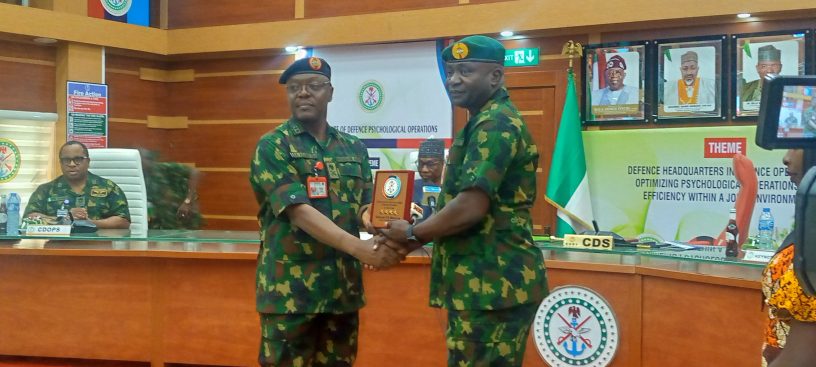
Nigeria’s internal security challenges have evolved beyond traditional military confrontations, demanding a more comprehensive approach hence kinetic actions remain essential which alone cannot adequately address the complexity of modern threats.
Chief of Defence Staff, General Christopher Musa made this known during the Psychological Operations Workshop in Abuja.
According to him, the workshop is a blueprint in their collective efforts at harnessing the potential of psychological operations to enhance their operational effectiveness towards national security.
He said he is delighted to witness their personnel and partners come together to share expertise, exchange ideas, and explore innovative approaches to psychological operations.”
This workshop is timely, given the evolving nature of modern warfare and the increasing influence of perceptions, attitudes, and behaviours. This is in line with my leadership concept for the Armed Forces, which is to nurture a professional Armed Forces on the threat of hypo centric, collaborative, and capable of meeting its constitutional responsibilities in a joint and collaborative environment.
The Defence Chief noted that these threats have brought to the fore some occurrences that threaten the peace and security of the nation, and have undoubtedly continued to threaten the resolve of the Nigerian people and the capacity of security agencies to discharge their constitutional roles.
He stressed that the perpetrators of these heinous acts have over the years threatened the whole existence, their tactics of indiscriminate violence against innocent citizens have continually created fear and despair among the populace.
Hence, the theme, the threat of hypocritical operations, of “optimising psychological operations for efficiency within a joint environment,” is apt.
He noted that this is likely due to the continuous mutation in the nature and character of the threats, as well as the asymmetric dimension that threats have assumed within the nation’s contemporary operating environment.
According to him, it requires a combination of robust and well-coordinated non-kinetic efforts by all stakeholders to support their kinetic actions.
“From experience, it is shown that the non-kinetic act would cost a lot more than the kinetic, so we must continue to leverage on the non-kinetic areas to reach out and provide better understanding to the common interests. When the kinetic partners improved our ability to deny Southern terrorists freedom of action, that’s why it has led to attacks on troop locations,” he said.
According to him, with the recent changes in some of the command and deterrence, they expect new strategies to further destroy the capacities of the terrorists who attack troop locations and isolated communities.
“We are more than ever determined to go after all the non-state actors who restore peace and stability in our country, and not only the state actors, those sponsoring them directly or indirectly, those providing information as to troop movements, those logisticians that continue to sustain them, we will continue to go after them. In the same vein, we need non-kinetic actions, particularly the psychological operations, to shape the environment in favour of the ultimate aim of all ongoing operations,” he said.
Earlier, Retired Major General Letam Wiwa, while talking on psychological operations said that in this era of hybrid warfare, kinetic force alone is no longer sufficient.
According to him, the adversaries from insurgents, other non-state actors, and foreign countries are waging battles in several forms, including using the media.
He noted that they manipulate perception, foster fear, and create doubts, all from behind the screen or with cleverly edited videos.
Moreover, in today’s world, victory is not just measured in territories gained or enemies neutralized. “It is measured in acts enforced, narratives controlled, and decisions shaped. For those of you who have followed the war in Ukraine and the raid in Burkina Faso, this assertion becomes stark,” he said.
In the same vein, psychological operations must involve all stakeholders in the Nigerian protests.
The Commander, Cyber Warfare, Command, Major General Adeleke Ayanduga said contemporary battlespace is no longer confined to the physical domains.
According to him, the pervasive influence of social media, coupled with the transformative power of artificial intelligence, has created a dynamic information ecosystem that significantly impacts operational effectiveness.
General Ayaduga noted that information operations and information warfare are now inextricably linked with psychological operations, forming a complex web of influence that can shape perceptions, erode adversary will, and ultimately contribute to mission success.
He noted that social media platforms serve as both a vulnerability and an opportunity, acting as conduits for rapid information dissemination and the potential spread of disinformation and misinformation. Artificial intelligence algorithms can analyze vast datasets to identify target audiences, tailor persuasive messaging, and even automate aspects of influence operations.
“Understanding this nexus is crucial for optimising psychological operations within a joint operational environment, ensuring that our efforts are synchronised, impactful, and ethically sound,” he said.
Meanwhile, the workshop demonstrates a forward-thinking approach to the conduct of our ongoing operations and, indeed, modern warfare.

