
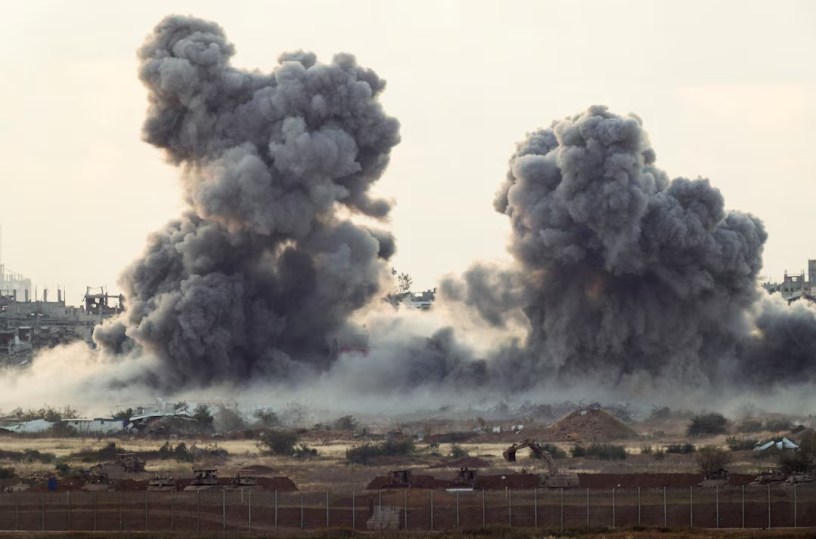
Israeli troops will remain in the buffer zones they have created in Gaza even after any settlement to end the war.
Defence Minister Israel Katz said this as efforts to revive a ceasefire agreement faltered.
Since resuming their operation last month, Israeli forces have carved out a broad “security zone” extending deep into Gaza and squeezing more than 2 million Palestinians into ever smaller areas in the south and along the coastline.
“Unlike in the past, the IDF is not evacuating areas that have been cleared and seized,” Katz said in a statement following a meeting with military commanders, adding that “tens of percent” of Gaza had been added to the zone.
“The IDF will remain in the security zones as a buffer between the enemy and the communities in any temporary or permanent situation in Gaza – as in Lebanon and Syria.”
In southern Gaza alone, Israeli forces have seized about 20% of the enclave’s territory, taking control of the border city of Rafah and pushing inland up to the so-called “Morag corridor” that runs from the eastern edge of Gaza to the Mediterranean Sea between Rafah and the city of Khan Younis.
It already held a wide corridor across the central Netzarim area and has extended a buffer zone all around the border hundreds of metres inland, including the Shejaia area just to the east of Gaza City in the north.
Israel says its forces have killed hundreds of Hamas fighters, including many senior commanders of the Palestinian militant group, but the operation has alarmed the United Nations and European countries.
More than 400,000 Palestinians have been displaced since hostilities resumed on March 18 after two months of relative calm, according to the UN humanitarian agency OCHA and Israeli air strikes and bombardments have killed at least 1,630 people.
Medical charity MSF said Gaza had become a “mass grave” with humanitarian groups struggling to provide aid. “We are witnessing in real time the destruction and forced displacement of the entire population in Gaza,” Amande Bazerolle, MSF’s emergency coordinator in Gaza said in a statement.
Katz said Israel, which has blocked the delivery of aid supplies into the territory, was creating infrastructure to allow distribution through civilian companies at a later date. But he said the blockade on aid would remain in place.
The comments from Katz, repeating Israel’s demand on Hamas to disarm, underscore how far away the two sides remain from any ceasefire agreement, despite efforts by Egyptian mediators to revive efforts to reach a deal.
Hamas has repeatedly described calls to disarm as a red line it will not cross and has said Israeli troops must withdraw from Gaza under any permanent ceasefire.
“Any truce lacking real guarantees for halting the war, achieving full withdrawal, lifting the blockade, and beginning reconstruction will be a political trap,” Hamas said in a statement.

