
The Civil Society Legislative Advocacy Center, CISLAC, says it is well established that small and medium-sized enterprises, SMEs, are the backbone of many developed economies.
According to its Executive Director, Auwal Rafsanjani, SMEs are important contributors to employment, output growth, and trade expansion and in Nigeria they remain critical constituents of the economy.
In his words, there are at least thirty-nine point six million micro, small and medium enterprises, operated in Nigeria as of December 2020.
He quoted a 2022 report jointly released by the Small and Medium Enterprises Development Agency of Nigeria, and the National Bureau of Statistics.
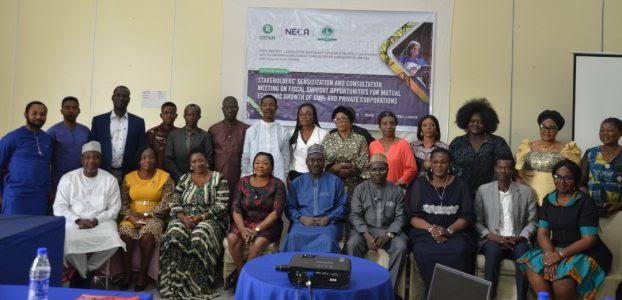
He reaffirmed this during a stakeholders sensitisation and consultation meeting on fiscal support opportunities for mutual economic growth of SMEs and private corporations.
“Accounting for 96.7 per cent of businesses, 87.9 per cent of employment, and 49.7 per cent of national GDP. Totaling about 17.4 million enterprises.
“SMEs account for about 50 per cent of industrial jobs and nearly 90 per cent of activities in the manufacturing sector, in terms of number of enterprises.
“As you know, business death is the last stage of any business life cycle” he said.
According to the African Development Bank, 80 per cent of businesses in Africa fail within five years of starting up and at least 1.9 million SMEs have been lost since 2017 in Nigeria according to a 2020 PwC report.
He says obtaining finance remains the most pressing problem, Medium Small Micro Enterprises, MSMEs, face in Nigeria.
Citing data from the National Bureau of Statistics, CISLAC boss says less than five per cent of Small and Medium Enterprises are able to access adequate finance for working capital and funding business growth.
This he observed is despite that Small and Medium Enterprises still contribute a staggering fifty per cent to Gross Domestic Product.
Rafsanjani said the need to support small businesses by providing insights, advice and support on access to finance remains critical to increasing their chances to succeed.
Others include the Central Bank of Nigeria and Nigeria Incentive-Based Risk Sharing System for Agricultural Lending (NIRSAL Plc.), Nigerian Export-Import Bank, Bank of Industry, Bank of Agriculture and Development Bank of Nigeria) and has established several agencies to assist SMEs.
Furthermore, at least 26 of Nigeria’s 36 state governments have set up an SME development agency or office.
He said in spite these seemingly significant efforts, challenges persist that hinder the growth and development of the sector.
Rafsanjani said the centre needs to support small businesses by providing insights, advice and support on access to finance and reducing financial liabilities.
It remained critical to increasing their chances to succeed in an often difficult environment.
He said that CISLAC workshop in partnership with the Nigeria Employers’ Consultative Association (NECA), and with support from Oxfam, was predicated on the above, towards strengthening fiscal opportunities through relevant consultations between SMEs, relevant government and professional agencies for mutual economic growth.

