
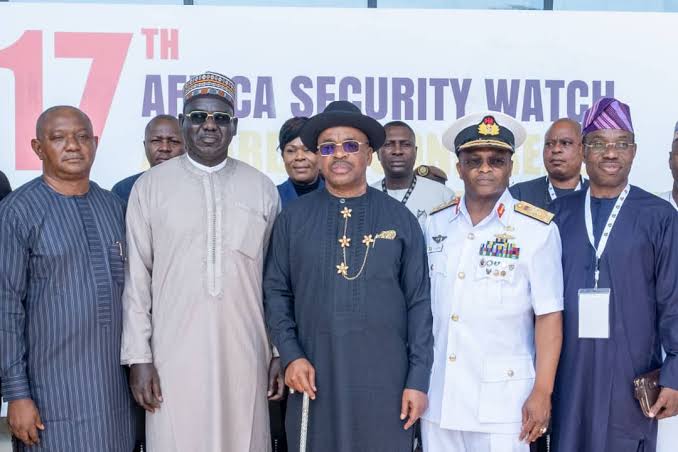
Governor Udom Emmanuel of Akwa Ibom State has identified economic security as the best foundation to guarantee total human security.
Emmanuel, who identified hopelessness as the highest causative factor for crime, posited that, the best way to stop crime is to beef up the economy, where people can make a decent living from honest means.
The governor stated this while delivering a keynote lecture at the 17th Africa Security Watch Conference at the Sir Dawda Kairaba Jawara International Conference Center, Banjul, The Gambia recently.
For the effective development of their countries, therefore, Governor Emmanuel, in his lecture titled: ‘Sustaining Security in Africa through Good Governance: A Panacea for Insecurity’, charged African leaders to explore the possibility of using other forms of money, other than cash.
To buttress his proposition to the leaders, the governor, who emphasised that “cash is limited but money is limitless and it can be created,” explained that “In starting Ibom Air, my state government did not use cash, we used money. We couldn’t have started the airline with cash, because we didn’t have such, but we created money and today, many years running, we are the only sub-national in the continent with a commercial airline, which is doing very well.”
Noting that Africa cannot achieve desired growth through investment, until the problem of insecurity was fixed, the Akwa Ibom State Chief Executive, echoed his alignment with the postulation that “a country cannot be free without her people being free.”
He consequently called on the followership to take ownership of governance and offer the requisite support for the leadership to move on, even as he called on African countries to stop adapting exogenous constitutions.
He underscored the need for home grown democratic styles that reflect African environment and culture. According to him, “Until that is done, democracy cannot sustainably thrive here.”
In his welcome remarks, the President and Chief Executive Officer of Security Watch Africa Initiatives, Patrick Agbambu, said “the conference invited Governor Emmanuel to share his development strategy, which has not only made his state peaceful, but has attracted huge Foreign Direct Investments there at a time when investors are divesting from Nigeria,” and explained that “the organization has been monitoring the steady improvement of the state in all areas of development.”
Agbambu also commended the Nigerian Navy and their counterparts in all the nations along the Gulf of Guinea, for frontally combating piracy and making the waterways safer for economic activities.
The event, which was attended by the military top brass across Africa, diplomats, Senior Security operatives, ECOWAS representatives, Senior Civil Servants among others, is one of the continent’s most prized security conferences, where key decision makers converge to X-ray the state of security of the continent.
The conference was declared open by President Adama Barrow of the Republic of The Gambia.
According to communique signed by SWAI President, Patrick Agbambu, and Chief Communique Rapporteur, Sani Usman from the 3-day conference that had the theme: “Post-COVID-19: Sustaining Security in Africa.”
SWAI, at its 17th annual conference and award ceremony in Banjul, The Gambia, also called for periodic assembly to assess the African security environment.
The Security Watch African Initiative called for intelligence sharing and synergy amongst sub-regional bodies on the continent to check insecurity in African countries.
The continental body emphasised the need for a unified and an enabling legal framework as well as a comprehensive, all-encompassing strategy to enable the continent tackle causes of insecurity.
It also called for a strengthened judicial system to address security challenges across Africa.
Participants also encouraged regular meetings of the security councils and commissions of sub-regional bodies such as SADC and ECOWAS, among others.
“African countries should collaborate more and look inward for solutions to address African security challenges.
“African leaders should adopt an all-of-society approach, particularly engaging the youths, to address evolving security challenges.
“To address maritime security, African Naval formations should strengthen their collaboration and synergy.
“African countries should come up with integrated, all-encompassing maritime strategies that are in line with continental and regional security architectures,” the communique said.
It emphasised the need for African countries to strengthen their research and development efforts through training and adequate funding.
“There is a need for the African Union to operationalise the collective security mechanism, particularly the African Standby Force, to address insecurity in Africa,” it added.
The participants also restated the need to encourage the media to consider national and victims’ security in their reportage.
SWAI was established in 1997 with the primary objectives of monitoring, collecting, analysing and broadcasting security issues on the African continent for public awareness and policy making.
To further encourage professionalism and intellectual engagements among African military and security forces, it holds annual conferences and award ceremonies in different parts of the world.
The conferences usually focus on showcasing the African military and security forces’ accomplishments and work toward enhancing friendship and military cooperation.
 securityandsafetymatters