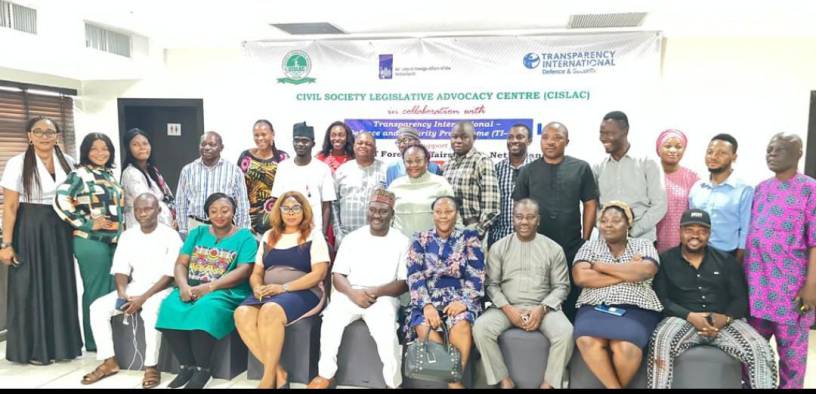
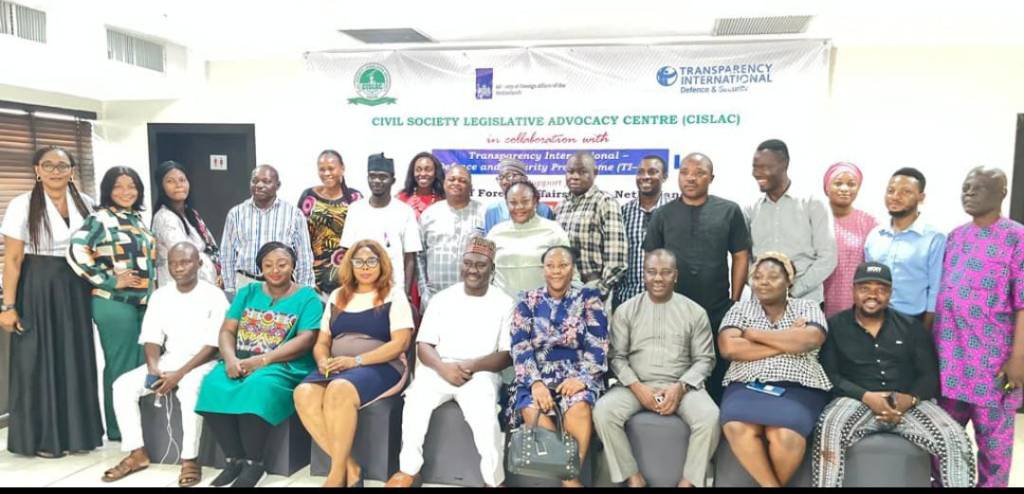
To address the issue of insecurity in the country, the Civil Society Legislative Advocacy Centre, CISLAC, has reiterated the need for the media and other stakeholders to be committed to monitoring and tracking the defence, security budget as a deliberate effort.
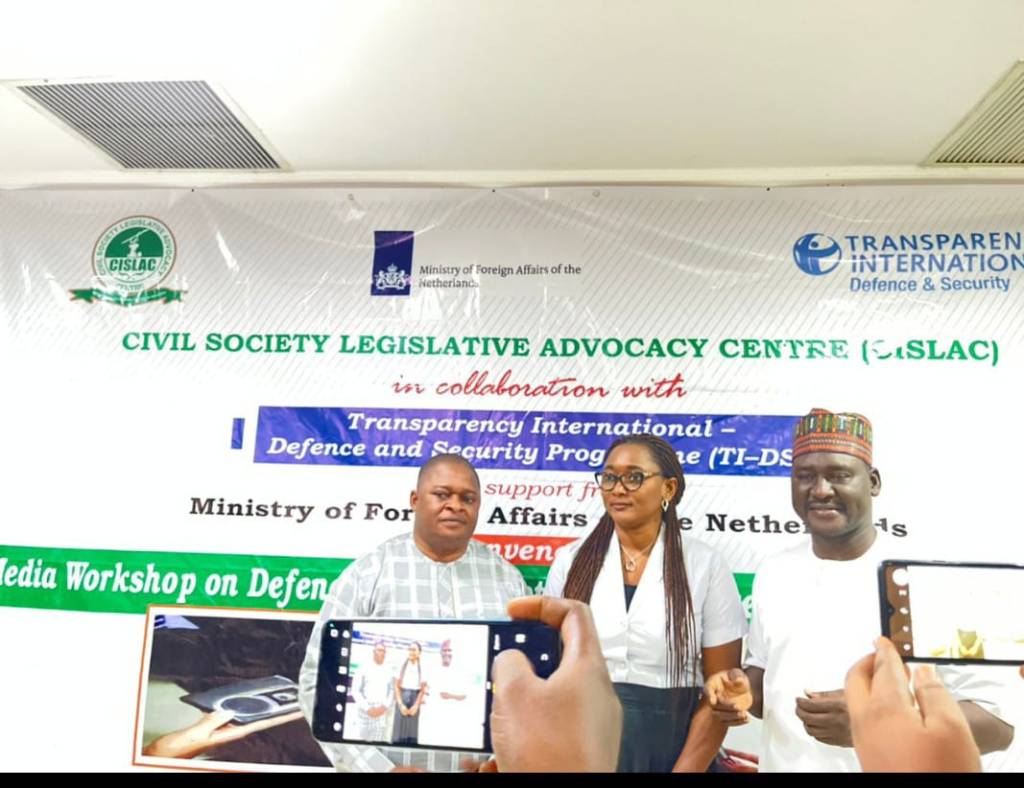
This was made known at a one-day Media Workshop on Defence Anti-Corruption Reportage, Civic Space, and Oversight,’ in Lagos, organised by CISLAC, in collaboration with Transparency International – Defence and Security programme with support from the Ministry of Foreign Affairs of the Netherlands.
The event was aimed at sensitising journalists on defense and security budgets, in order to identify corruption risks and possible areas of investigative journalism.
In his welcome address, CISLAC Executive Director, Auwal Musa-Rafsanjani, said the media workshop is designed to enhance knowledge on probable areas within the defence and security sector budgetary process and expenditures, for effective investigative journalism.
According to him, it will improve the capacity of participants to better understand areas of possible corruption risk and to flag same for evidence based civilian oversight in other to minimise corrupt practices and to improve defence and security architecture.
He urges participants who are Journalists drawn from different media house, both Print, Electronic, and Online covering security and defence beat to do everything within the law to make sure that protection of lives and properties remain a priority for the government, as provided for in the 1999 constitution of the Federal Republic of Nigeria, as amended.
Musa-Rafsanjani said both the media, stakeholders must not sit and watch a corrupt few embezzle monies meant for the welfare of security personnel, procurement of arms and ammunition while the challenges of insecurity continue to threaten the very existence.
According to him, many people known and unknown have been killed, maimed, kidnapped, robbed of their loved ones, properties and sources of livelihood, saying Terrorist attacks and kidnappings for outrageous ransom has become a norm in Nigeria.
Musa-Rafsanjani said they must as a matter of urgency begin to question the actions and in-actions of the government and to demand accountability for budgetary allocations meant for defence and security.
He added that it is time that the quest for reform in defence and security institutions transcend from mere words to an all inclusive participation in the formulation and effective implementation of policies for the actualisation of the transformation that citizens desire in defence and security sector.
Musa-Rafsanjani acknowledge the disciplinary actions taken by the leadership of the defence and security sector against erring officers who would rather undermine than uphold the ethics and values of the institutions, as has been aired more frequently by the media lately.
He noted that there is still so much more to be done structurally such as wrong and prolonged deployment of personnel in battle field, lack of transparency and accountability in fund management, procurement and project implementation, personnel recruitment process, personnel welfare, sub standard kits and equipment, among others.
According to him, CISLAC and its partners will continue to push for greater accountability and integrity in defence and security sector because it will require a multi-stakeholder engagement in line with the principles of democratic and participatory governance, to achieve the level reform desired.
He said they will not relent in advocating for an accountable defence and security expenditure, classification and declassification of information for public consumption, increased integrity for personnel and an uninterrupted civilian oversight of the sector in line with international best practices.
According to him, though trillions of naira were budgeted by FG between 2015 and date, to enhance national security, Nigerians have been groaning under the yoke of various security threats, in recent years.
The CISLAC boss observed that defence corruption is not only undermining the safety and security of Nigerian citizens, it is also responsible for the inflow of small arms and light weapons into the country.
Musa-Rafsanjani, maintained that citizens must begin to question the actions and in-actions of the government and to demand accountability for budgetary allocations meant for defence and security.
He argued that the quest for reform in the country’s defence and security institutions must transcend from mere words to an all-inclusive participation, in the formulation and effective implementation of policies for the actualisation of the transformation that citizens desire in Nigeria’s defence and security sector.
Speaking during a presentation titled Analysis of Government Defence Integrity Index: Establishing the Accountability Nexus, Conflict Advisor, CISLAC, Salaudeen Hashim said, even though there have been consistent calls for improved budgetary provisions for defence, it is important to ensure the available budget and releases are judiciously utilised for the purposes they are meant for.
According to him, his organisation has been strengthening the capacity of the lawmakers who are constitutionally recognised to oversee budget implementations across the ministries, departments and agencies of government across the country.
So, CISLAC saw the need to bring the state and non-state actors together to discuss the challenges and look at what we can do differently because Nigerians need to enjoy dividends of democracy and of course, the manor priority of the state government is to offer that protection.
“The moment the citizens don’t enjoy that safety, then, they begin to distrust their government leaders.
So, we want to help the government build that confidence and at the same time train the non-state actors so they can build their charter of need and allow the state to put a mechanism for protection.
Most importantly to ensure that every money that goes into security relations should be spent
judiciously and with every form of accountability”, he said.
He further stressed that “the legislature has not developed adequate skills to meet the expectation and help them to provide external oversight. They appropriate the funds, go for some oversight and do some debates and make laws for these agencies.
So in all of these, the parliament must have the capacity to understand how security functions and part of this project is to also build them to help them know the questions they need to ask and to look out for when they go for oversight visits”.
Given an Overview of The Defence and Security Budgets: Gap Analysis, Manager, Open Government and Institutional Partnerships, BudgIT, Tolutope Agunloye said using previous and current defence budgets to align the focus of media participants on soft areas for investigative journalism within the defence and security budgetary processes and expenditures;
For him, using the Government Defence Integrity Index (GDI) to build the capacity of media participants to understand areas of possible corruption risk within the defence and security sector; To improve access to information and evidences for effective civilian oversight of the defence and security sector.
According to him, a budget is an estimation of revenue and expenses over a specified future period of time, saying Budgets can be made for a person, a group of people, a business, a government, or just about anything else that makes and spends money.
In his words, the public budget is an annual plan of the government which outlines planned public revenue and expenditure, and usually is passed by the highest governmental bodies, such as: parliament, municipal councils and regional/provincial councils, known as legislature.
He said a military budget or defense budget is the amount of financial resources dedicated or appropriated by a state/country to raising and maintaining an armed forces or other methods essential for defense purposes.
According to him, Nigeria runs an envelope system of budgeting which requires MDAs to work within a budget ceiling, saying there is no formula for the determination of ceilings to the MDAs as this system of budgeting limits resource allocation and effective utilisation.
Capturing of recurrent expenditures as capital projects. For example, 2017 Ministry of Defence Budget has a budget of line item for PHCN OUTSTANDING DEBTS with (project code FMODM67375298) project amount of N2.4bn.
Bogus Amount for Capital projects: Still using the 2017 budget, there is a line item for INSPECTION OF ACCOUNTS BOOK & PAC MATTERS for N95m, IMPLEMENTATION OF FOI for N20.7m
Budget Duplication: This is when projects line items are duplicated sometimes in the same MDA. For example, HIV/AIDS Prevention appeared twice in the defence HQ budget in 2017 budget with total sum of N60.05m
Media should support the committees on defence on legislative oversight.
The use of FOI act to get access to information from the defence sector should be encouraged.
 securityandsafetymatters