Lagos State Independent Electoral Commission, LASIEC, should address factors hindering effective participation of Persons With Disabilities in elections ahead of Saturday’s local government poll.
The commission was asked to implement the disability act by ensuring all barriers that hinders persons with disabilities from participating in elections are removed.
It was urged to guide election security agencies on election day to ensure voters goes to the poll peacefully, as election day violence may hinder eligible voters with disabilities from participating.
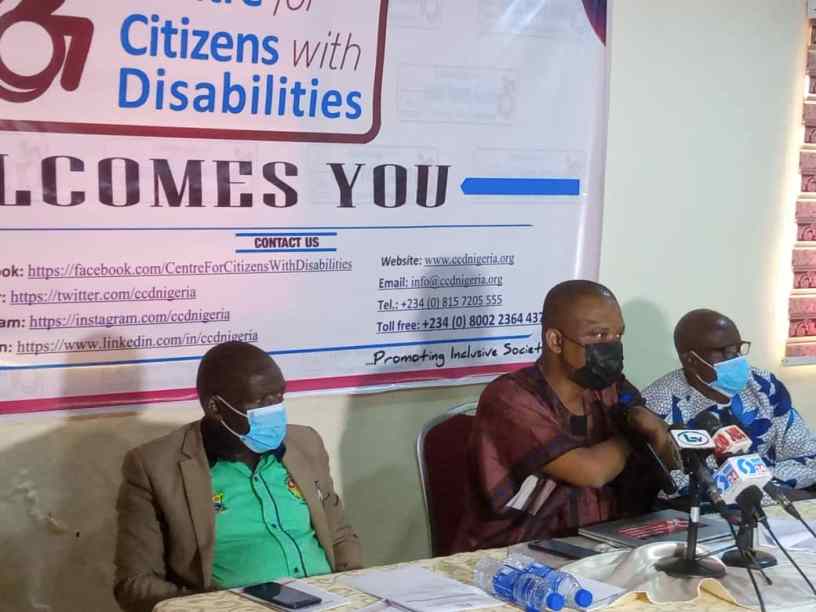
The plea came from the Executive Director of Center for Citizens with Disabilities, David Anyaele who spoke after presenting findings on pre-election assessment of LASIEC provisions for persons with disabilities participation for Saturday’s poll.
He said the goal of the Campaign is that eligible men and women with disabilities are able to participate in the electoral process on an equal basis with other members of the society.
His Remark at the Public Presentation of Pre-Election Assessment of Lagos State Independent Electoral Commission Provisions for PWDs Participation in the July 24, 2021 Local Government Elections held on July 24, 2021 at Elomaz Hotel, Ikeja, Lagos.
Since 2006, CCD has been in the vanguard for an inclusive electoral system. CCD has also been engaging the election management bodies in Nigeria for the inclusion of persons with disabilities in the electoral Process.
This effort is as a result of our understanding that 1999 Nigeria Constitution made minimal provisions for the protection of the rights of persons with disabilities.
This was evidenced by the minimal provisions in the Electoral Act for persons with disabilities, which is the instrument for the conduct of elections in Nigeria.
Recognizing that media, local and international organisations working on elections struggles to include citizens with disabilities in their narratives around election outcomes in Nigeria.
This has put citizens with disabilities to disenfranchisement, and abuse of their fundamental human rights as citizens of Nigeria.
The Campaign for Equal Voting Access (EVA) for Persons with Disabilities is the program of the Centre for Citizens with Disabilities that focuses on persons with disabilities participation in the electoral process.
The purpose of the EVA for PWDs is to ensure that electoral process in Nigeria is accessible to all irrespective of ability or disability.
The goal of the Campaign is that eligible men and women with disabilities are able to participate in the electoral process on an equal basis with other members of the society.
What we are doing here today is to present to you, findings from our Pre-Election assessment on LASIEC preparedness for the participation of Lagosians with disabilities in the forthcoming Local Government Area Elections slated to hold on July 24, 2021.
It is a reassurance of our commitment to the promotion of inclusive electoral process at local level, free from marginalization and exclusion on the grounds of disability.
The outcome of todays presentation would serve as a tool for advocacy engagement and sensitisation of the public on the rights of persons with disabilities to participate in political and civic activities.
We are going to circulate the outcome of this public presentation to local and international development partners with the view to attract policy attention to the neglected issue of right of PWDs to participate in the political process of our society.
We request you to pay attention to this presentation, takenote and ask your questions after the presentation.
Thank you.
PRE-ELECTION ASSESSMENT OF LAGOS STATE
INDEPENDENT ELECTORAL COMMISSION (LASIEC)
PROVISIONS FOR PERSONS WITH DISABILITIES IN
PARTICIPATION FOR THE JULY 2021 LOCAL GOVERNMENT
ELECTION IN LAGOS STATE
Mr. David Anyaele
Mr. Victor A. Owoyomi
BACKGROUND
• Persons with disabilities (PWDs) are the world’s largest minority group with majority living in developing countries (World Health Organization, 2019). Sadly, persons with disabilities are largely excluded from public life and underrepresented in parliaments and political offices,
hence, limiting their ability of taking decisions that impacts directly on their lives.
• The UN in December 2006 adopted the Rights of
Persons with Disabilities (CRPDs) which was entered
into force in May 2008 (Kanter, 2008).
BACKGROUND CONT’D
• Here, a number of substantive rights of Persons with
Disabilities (PWDs) was reaffirmed which set a pace for a
paradigm shift in understanding disabilities as effect of
interaction between an individual’s impairment and the
barriers created by the society and not a medical condition.
• PWDs are generally at a disadvantage and discriminated
against in politics and other public activities in Africa
despite the anti-discriminatory law that supports PWDs in
the continent (National Democratic Institute, 2019).
BACKGROUND CONT’D
• The CRPD was signed by 44 African states including Nigeria
out of 54 as of May 2015. The CRPD guarantees the rights
to political participation under article 29. The article
guarantees the rights of every disable person to political
participation which includes participation in electoral
process such as voting and holding public administrative
posts, participation in policy and administrative offices
(United Nations, 2007). The level of inclusiveness of PWDs
however in Africa in political activities is however
overwhelmingly low.
BACKGROUND CONT’D
• The rights of PWDs have also been advocated for in
Nigeria in series of political programmes and activities.
Nigeria is a signatory to the 2010 United Nations
protocols that call for the guarantee of equal political
rights for PWDs. Specifically, the Chairman of Lagos
state Independent Electoral Commission advocated for
vulnerable groups in the society, in essence, the
inclusiveness of PWDs.
BACKGROUND CONT’D
• To achieve the inclusivity of persons with disabilities
and ensure their participation in the electioneering
process across Nigeria, there should be specific
preparations that will address their various
peculiarities and create room for their unhindered
political participation. It is against this background that
this study aims at assessing the provisions for Persons
with Disabilities in Lagos State Independent Electoral
Commission’s (LAISEC) preparations for July 2021 Local
Government elections.
BACKGROUND CONT’D
• Data set showed that Lagos State was created
on 27th May, 1967 by a Decree No 14 of 1967
(NGEX Nigeria, 2019). The Capital of the state
is Ikeja and its lies to the southwestern part of
Nigeria. Lagos State share boundaries with
Ogun State both in the North and East and is
bounded on the west by the Republic of
Benin. In the south, the state spans the
Guinea coast of Atlantic Ocean for over 180km
(NaijaSky.com, 2016).
• Lagos State is the smallest state in Nigeria yet, it has the
highest urban population, which is 27.4 % of the national
estimate [UN-Habitat]. According to the 2006 National
Census, Lagos State has a population of 9,013,534 in
relation to the National count of 140,003,542. However,
based on the UN-Habitat and international development
agencies’ estimates, Lagos State is said to have about 24.6
million inhabitants in 2015 (Lagos Gov. Report, 2021). There
are 20 Local Government Areas (LGAs) in Lagos State.
BACKGROUND CONT’D
• The LGAs are: Agege, Ajeromi-Ifelodun, Alimosho, AmuwoOdofin, Apapa, Badagry, Epe, Eti-Osa, Ibeju/Lekki, IfakoIjaye, Ikeja, Ikorodu, Kosofe, Lagos Island, Lagos Mainland,
Mushin, Ojo, Oshodi-Isolo, Shomolu, and Surulere (NGEX
Nigeria, 2018d). Lagos was originally inhabited by the Awori
group of the Yoruba people. While the State is essentially a
Yoruba-speaking environment, it is a socio-cultural melting
pot attracting both Nigerians and foreigners alike (NGEX,
Nigeria 2019d). Understandably, Lagos State is the Nigeria’s
economic nerve centre with over 3,000 industries.
BACKGROUND CONT’D
• Two of the Nigeria’s largest seaports -Apapa and Tin-Can
Ports are located in Lagos State. According to the Lagos
State 2019 estimated population report, the population of
the state was estimated to 17,552,940, with over 2 million
persons as persons with disabilities (NGEX, Nigeria 2019d).
Of which the state population was estimated to have hit
the 35 million mark in 2020 (Lagos Gov. 2021).
Goal
• The purpose of CCD rapid assessment
therefore is to provide an evidence-based
anticipation of issues that might affect PWDs
in the forth-coming Local Council Elections in
Lagos State. It is also to engage with policylevel election stakeholders and persons with
disabilities towards addressing these issues.
Its specific objectives are to:
RESEARCH OBJECTIVES
• 1. Document the experiences of PWDs during the 2017 Local
Council elections, particular to voting process,
• 2. Evaluate LASIEC provisions and preparations for PWDs
participation in the July 2021 Lagos State Chairmanship and
Councillorship election during the Covid-19 pandemic,
• Assess PWD needs and expectations from LASIEC in the
election,
• 4. Propose actions to enhance PWD participation in the
elections,
• 5. Enhance confidence of PWDs in LASIEC programmes and
efforts to meet their needs during the July 2021 forthcoming
election in Lagos State.
RESEARCH QUESTIONS
• What were the experiences of PWDs during the 2017 Local
Council elections, particular to voting process?
• What are the LASIEC provisions and preparations for PWDs
participation in the July 2021 Lagos State Chairmanship and
Councillorship election during the Covid-19 pandemic?
• What are the PWD needs and expectations from LASIEC in
the election?
• How can we enhance PWD participation and confidence in
LASIEC programmes and efforts to meet their needs during
the forthcoming LG election in Lagos State?
METHODS AND FIELDWORK
• Field work for the assessment took place in July 2021 and
included five Local Government Areas in Lagos State:
Alimosho, Ikeja, Ikorodu, Kosofe and Surulere which cut
across the three senatorial districts in Lagos State. Its
method combined both survey (quantitative) and nonsurvey (qualitative) research methods using stratified,
cluster and purposive sampling techniques.
METHODS AND FIELDWORK CONT’D
• Fifty respondents participated in the survey and two
participants took place in the Key Informants InterviewsLagos State Office of Disability Affairs (LASODA) and Joint
Association of Persons with Disabilities (JONAPWDs)
Chairman, Lagos State Chapter (KIIs) while three focus
group discussions were held across five clusters (physical,
visual, hearing, spinal cord injured persons and persons
with albinism) of persons of disabilities. The study included
males and females across different age categories,
educational levels, ethnic groups, religion, marital status,
and the majority are self-employed. Regrettably,
researchers made effort to interview LASIEC Chairman/
Public Relation Officer but all efforts proved abortive as at
when the study was conducted.
SOCIO-DEMOGRAPHIC PROFILE OF
RESPONDENTS
SOCIO-DEMOGRAPHIC PROFILE OF
RESPONDENTS CONT’D
Fig 3
Finding from fig 3 shows that more than half of the PWDs
interviewed respondents for the survey were female.
Qualification and Participation of PWDs during
Elections
More than three quarter of PWDs interviewed respondents
registered to vote during the LG elections.
Findings show that majority 68% of respondents have a
permanent voter’s card while 32% do not have a permanent
voter’s card.
PWDS’ VOTING EXPERIENCE IN THE JULY 2017
LOCAL GOVERNMENT ELECTION
• Findings from the quantitative data showed that majority 72% of the PWDs
respondentsinterviewed indicated no to voting in the July 2017 Local Government
Election. The implication of this finding shows that close to 3 of every 4 PWDs
interviewed respondents with permanent voters’ card demonstrated less interest
in participating in the 2017 Local Government election in Lagos State because of
several reasons.
PWDS’ VOTING EXPERIENCE IN THE JULY 2017
LOCAL GOVERNMENT ELECTION CONT’D
In addition to the above quantitative data, similar
responses were pointed out during the FGDs thus:
• “I do not vote in the last local government in election
because I wasn’t interested. Someone likes me without leg,
I can’t run if trouble (violence) should arise (P3: FGD
Physically impaired cluster, Female, Kosofe LGA).”
• “My area is in Oyigbo, there was no interpreter, I tried to
vote but they embarrassed me and send me away because
there was no sign language interpreter to interpret to
understand me (P2: FGD, Hearing impaired (deaf) cluster,
Female, Surulere LGA).”
PWDS’ VOTING EXPERIENCE IN THE JULY 2017
LOCAL GOVERNMENT ELECTION CONT’D
• “I do not vote in the last LG Election because I felt
I will be discriminated against because it was not
too long that I lost my sight and I was ashamed to
go out because of public discrimination (P4: FGD,
Female, Visually impaired (Blind) cluster, Kosofe
LGA)”.
• “I did not vote because of the insecurity in my
area during the election because I am a PWD on a
wheel chair (P1: FGD, Female, Spinal Cord Injury
(SCIAN) cluster, Surulere LGA)”.
REASONS WHY PWDS DID NOT VOTE IN THE
LAST 2017 LG ELECTION
Fig 7
As indicated above in fig 7, majority of respondent 32% did not vote because
of security/violence, 24% did not have PVC, 17% was not interested, 12%
were not resident/available, 7% was proximity to voting points while 3% were
not registered, health and stigma respectively.
BARRIERS/ CHALLENGES FACED BY ALL CLUSTERS OF PWDS
INTERVIEWED DURING THE LAST JULY 2017 LGA ELECTION
Fig 7
• Findings from both the quantitative and qualitative data revealed that
majority of the PWDs who voted in the last 2017 LG elections in Lagos
State faced multiple barriers at their respective polling units as
indicated above in fig 7. In addition, the qualitative data was nothing
dissimilar from the quantitative data as discussants/participants
during the FGDs aired their opinion in the following ways:
BARRIERS/ CHALLENGES FACED BY ALL CLUSTERS OF PWDS
INTERVIEWED DURING THE LAST JULY 2017 LGA ELECTION
CONT’D
• “In the last 2017 Local Government Election in
Lagos State, the platform was very high for me
to cast my vote (P3: FGD, Female, Physically
impaired (leg) cluster, Kosofe LGA).”
• “I voted but I observed that there was no
privacy because I was led to thumbprint and
voted (P1: FGD, Female, Visually Impaired
(Blind) Cluster, Ikeja LGA).”
• “Despite all the turmoil in the country then, I voted
though it wasn’t easy for me. After voting, I left the
polling unit immediately and I did not wait ( P1: FGD,
Male, Physically Impaired Cluster, Kosofe, LGA).”
• “The last election I voted at the primary election
because I have my membership card. When it was time
for me to cast my vote, the area boys came and took
away the ballot box. There was no security (P3, FGD,
Male, Hearing Impaired (Deaf) Cluster Alimosho LGA).”
PWD FUTURE VOTING DECISION
• It is interesting to know that despite all the challenges
faced by PWDs in the last election more than half (52%) of
the PWDs respondents interviewed during the survey
reported that they plan to vote in the forthcoming LG
election.
PWDs SPECIAL NEEDS/ EXPECTATIONS WITH REFERENCE TO
ELECTION AND VOTING PROCESS DURING COVID-19 IN
LAGOS STATE
• Fig 12
• As indicated above in fig 12 PWDs respondent special needs/expectations with
particular reference to election and voting during COVID-19 pandemic in the
forthcoming LGA election were 21% adequate security, 20% LASIEC
enforcement of COVID-19 prevention protocol, 18% Alcohol based hand
sanitizer/hand washer at the polling unit, 16% disability friendly polling boot,
11% priority voting, 7% availability of methylated spirit for card reader while,
1% social distancing and special arrangement respectively.
PWDs SPECIAL NEEDS/ EXPECTATIONS WITH REFERENCE TO
ELECTION AND VOTING PROCESS DURING COVID-19 IN
LAGOS STATE CONT’D
• During the qualitative study, similar opinions were aired
this way:
• “As a person with visual impairment, the ballot paper
should come with something like a braille format or
something like a voice as we have it on our phone (P4: FGD,
Female, Visually Impaired (Blind) cluster, Kosofe LGA).”
• “For person with Albinism, there should be provision for
maximum shade for us (albinos) because sun is our greatest
challenge during election/voting process (P2: FGD, Female,
person with Albinism cluster, Kosofe, LGA).”
PWDs SPECIAL NEEDS/ EXPECTATIONS WITH REFERENCE TO
ELECTION AND VOTING PROCESS DURING COVID-19 IN
LAGOS STATE CONT’D
• LASIEC should make provision for inclusive and accessible polling units,
making the ballot paper lower for those on wheel chairs, provide
magnifying glasses for the Albinos and make provision for signage posters
at the polling unit (P1: FGD, Male, Physical disability, Ikeja LGA).
• A similar opinion was shared during the Key Informant Interview with a
representative from JONAPWD as thus:
• “We like to join our voice with CCD that is carrying out this assessment to
urge LASIEC to do the needful for all the disability clusters by ensuring that
they involve PWDs in the voters registration because we are not sure if
there is a column that capture disaggregated data of PWDs, we are not
sure if they are including PWDs as election observer or ad-hoc staff during
the election. We expect that LASIEC will be able to do all of these to ensure
that all stakeholders are comply with the electoral Act while responding to
the needs of PWDs during the election (KII, Male, Rep. JONAPWD, Lagos
State Chapter).”
PWDs SPECIAL NEEDS/ EXPECTATIONS WITH REFERENCE TO
ELECTION AND VOTING PROCESS DURING COVID-19 IN
LAGOS STATE CONT’D
Fig 13
• As indicated in fig 13, an overwhelming majority 74% of PWDs respondents
interviewed indicated that they have concern due to COVID-19 that may affect
their electoral participation, 22% said they have no concern while 4% said
they don’t know. A similar opinion was shared during one of the FGDs as thus:
• “My concern is the Delta COVID-19 pandemic and I think LASIEC should make
provision for Hand sanitizers at the polling units (P6: FGD, Male, Physical
disability, Kosofe LGA.”
PWDs SPECIAL NEEDS/ EXPECTATIONS WITH REFERENCE TO
ELECTION AND VOTING PROCESS DURING COVID-19 IN
LAGOS STATE CONT’D
• Fig 15
• As indicated above in fig 15, majority of respondent 88% have concern for
security in exercising their voting right, while 12% do not have concern. A
similar concern was shared during the FGDs by a person with spinal cord
injury (SCIAN) as thus:
• “My major concern for this forthcoming election is my “SECURITY”. There is
violence all over this Lagos State (P1: FGD, Female, Spinal Cord Injury
Association of Nigeria, Kosofe LGA).”
PWDS KNOWLEDGE ABOUT LASIEC
PREPARATION FOR THE LG ELECTION
• Findings showed that majority of the PWDs interviewed
during the FGDs have limited knowledge about LASIEC
preparation for the forthcoming Local Government
Election. A participant during the FGD has this to say:
• “This is the first time that I am hearing about them (LASEIC)
(FGD, Visually Impaired PWD, Surulere).”
• A similar opinion was shared by another participant during
the FGD at Kosofe LGA thus:
PWDS KNOWLEDGE ABOUT LASIEC
PREPARATION FOR THE LG ELECTION CONT’D
• 3 of every 4 PWDs in Lagos during the Focus Group
Discussions pointed out that they have refused to participate
in the last local government election because they were afraid
of discrimination from the electorates and electoral officials.
One of the participants put it this way:
• I did not vote in the last election because of discrimination.
and I was ashamed of going out because it hasn’t been long
that I got blind (FGD, Visually Impaired, Female, Kosofe LGA)
• “My area is in Oyingbo, there was no sign language
interpreter and as I wanted to vote, they embarrassed me and
they sent me away because there was no interpreter to sign
for me and to understand me (Female, Hearing Impaired,
Female, Surulere LGA).”
PWDS KNOWLEDGE ABOUT LASIEC
PREPARATION FOR THE LG ELECTION CONT’D
• The above qualitative data was nothing dissimilar from the
Key Informant interview with a representative from the
Lagos State Office of Disability Affairs (LASODA) and
another representative from the Joint National Association
of Persons with Disabilities (JONAPWD) during a key
informant interview. They both aired their opinions thus.
• “We (LASODA) have met with LASIEC and our next meeting
is to ascertain that those voting materials they (LASIEC)
have, to know the various provisions they have made in
terms of voting accessibility to ensure that the number of
PWDs that will be engaged in the election process are much
(KII, Male, Rep from LASODA, Ikeja Lagos).”
PWDS KNOWLEDGE ABOUT LASIEC
PREPARATION FOR THE LG ELECTION CONT’D
• “LASIEC has not reached out to us (JONAPWD) neither
has it responded to our request. Though we had report
that they have been engaging some CSOs but disability
community has not been engaged. We have concerns
about the electoral materials and the process because
LASIEC as of now has not indicated in their electoral
guidelines the specific provisions they have made for
persons with disabilities. In short, LASIEC has excluded
organizations of person with disabilities in their
preparation for this forthcoming election (KII, Male,Rep
from JONAPWD, Lagos Chapter).”
RESEARCH KEY FINDINGS
• Findings showed larger proportion of PWDs interviewed
lack sufficient knowledge about the specific provisions in
the state, national and international legal frameworks on
PWDs rights to vote and to be voted for.
• Findings showed Majority of PWDs interviewed shared
limited knowledge about the Lagos State Independent
Electoral Commission (LASIEC) preparations for the
forthcoming Local Councils elections because no deliberate
effort has been made so far to include various disability
clusters in LASIEC guidelines for the forthcoming election in
Lagos State.
RESEARCH KEY FINDINGS CONT’D
• Findings showed that while there were some levels of
engagement between the CSOs and LAISEC, regrettably,
LASIEC failed to reach out or respond to the request from
the organizations of persons with disabilities in Lagos State
while preparing the electoral materials, voters’ education,
recruitment of ad-hoc staff, and electoral observers among
other electoral stakeholders’ engagements.
• Findings showed that LASIEC excluded persons with
disabilities and other vulnerable groups in their electoral
guidelines for the forthcoming election because no
reference was made to PWDs in the extant LASIEC electoral
guideline. By implication, many PWDs will continue to
struggle in accessing electoral materials and participating
on equal basis with others.
RESEARCH KEY FINDINGS CONT’D
• Findings revealed that many among the few PWDs who
voted during the last July 2017 Local Government election
in Lagos State faced multiple barriers. Chief among these
barriers include: lack of sign language interpreters for the
deaf cluster, discrimination against the blind and placing of
polling units across gutters for physically challenged and
spinal cord injured persons on a wheel chair.
• Findings showed that many of the electoral materials
used by LASIEC in the conducted July 2017 Local
Government election were not available in accessible
and understandable format for the visually impaired
(blind) clusters and persons with albinism as well as
persons with auditory impairments
RESEARCH KEY FINDINGS CONT’D
• Findings revealed that majority of the PWDs
interviewed who plan to vote in the July 2021
forthcoming election have serious concern for
their security and public safety. Many of them
are worried about electoral violence and the
Delta COVID-19 pandemic.
RECOMMENDATIONS
The findings from this assessment led CCD to offer the
following recommendations for the urgent action by
electoral stakeholders in Lagos State.
LASIEC
• LASIEC as a matter of urgency should collaborate with
LASODA, JONAPWDS and other relevant OPDs to include in
their electoral guideline the disability component in order
to address the needs and concerns of persons with
disabilities in the forthcoming July 2021 Local Government
Election.
• LASIEC should include PWDs as ad-hoc staff, election
observer and create column for PWDs in their voters’
registration.
RECOMMENDATIONS CONT’D
• LASIEC as a matter of urgency should roll out aggressive
public awareness programmes on their provisions and
preparations for the PWD to ensure equal voting access
and participation in the forthcoming July 2021 election.
• LASIEC should ensure that electoral materials are available
in accessible and understandable formats for the visually
impaired (Blinds) and hearing impaired (deaf) clusters in
the forthcoming election in order to avoid violating of
PWDs voting right.
RECOMMENDATIONS CONT’D
• LASIEC should ensure that all polling units are accessible for
PWD on wheelchairs/crutches; provisions should be made
for signage posters, sign language interpreters for the
hearing and auditory impaired (deaf), and Braille ballot
paper for the visually impaired (blind) as well as magnifying
glasses for the albinos in order to ensure inclusive electoral
participation for all PWDs in Lagos State.
• LASIEC should give voting priority to all persons with
disabilities and other vulnerable group in the forthcoming
elections. Bearing in mind that PWDs and in particular,
person with albinism may not be able to stay long under
the scorching of the sun while on a queue to avoid other
health challenge such as skin cancer.
RECOMMENDATIONS CONT’D
• LASIEC should collaborate with NCDC to ensure proper
provisions are made to observe all COVID-19 safety protocol for
the public safety of all vulnerable groups especially persons with
disabilities.
• LASIEC should collaborate with all the security agencies to brace
up security in order to ensure full protection of lives and
properties of all voters especially persons with disabilities during
and after the forthcoming LG election in Lagos State.
LINE MDAs/ CSOs/ JONAPWDS/ OPDS
• LASODA should make deliberate effort to ascertain from
LASIEC that electoral materials are available and
accessible in an understandable format for all PWDs in
the forthcoming election.
RECOMMENDATIONS CONT’D
• LASODA should collaborate with LASIEC to ensure PWDs are
not left behind as election observer, ad-hoc staff and key
stakeholders in this forthcoming election.
• LASODA should always make deliberate effort in ensuring
that LASIEC involve them fully while developing electoral
materials for PWDs in the subsequent elections.
RECOMMENDATIONS CONT’D
• JONAPWD and other relevant OPDs should not
relent in their advocacy effort for inclusive
electoral participation of PWDs in the
forthcoming Local Government election.
• JONAPWD and OPDs should train PWDs on
voters’ education and their rights to voting.
• Security Agencies should respond professionally
to PWD voters during the election.

