
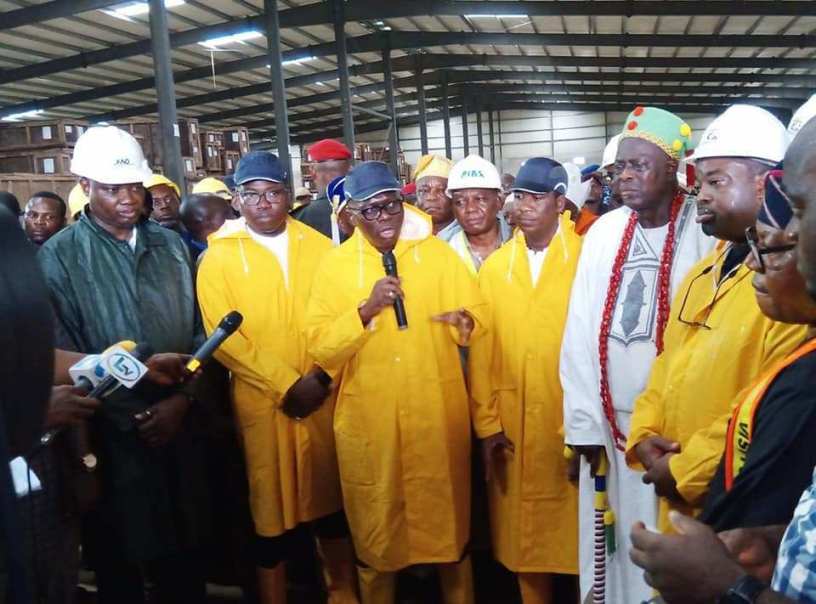
The multi-billion Naira, thirty-two Metric-Ton-per hour Rice Mill at Imota will be delivered on or before the end of this year.
According to the Lagos State Government, the Rice Mill had attained eighty percent completion level compared to thirty-five percent when the administration came in May last year.
Commissioner for Agriculture, Prince Gbolahan Lawal, says the Mill, when operational, will ensure a steady supply of about two point four million freshly processed fifty kilograms bags of rice per annum
He says in addition, over two hundred and fifty thousand jobs will be created in both the upstream and downstream sectors of the Rice Value Chain.
The Commissioner disclosed this at the Ministerial Press Briefing organised to commemorate the one year anniversary of Governor Babajide Sanwo-Olu’s administration.
Lawal said effective efforts had been put into backward integration along the rice value chain to ensure adequate supply of paddy to the mill for smooth operations.
He said the backward integration included the identification of farmers’ groups in conjunction with other states to cultivate the required amount of paddy and the provision of inputs such as seeds, fertiliser and irrigation facilities where applicable to the farmers.
“To meet the paddy requirement of the mill, we have undertaken a backward integration in form of collaboration with other states like Southwestern states, Kwara, Sokoto, Benue, Borno and Kebbi.
“This will be done leveraging on the Anchor Borrower Programme (ABP) of the Central Bank of Nigeria (CBN) with the rice mill as the off taker of the products,” Lawal said.
The commissioner explained that the Agriculture-based Youth Empowerment Scheme (Agric-YES) had been revamped within the past one year in such way that a total of 15,000 youth and women would be trained and empowered.
He said beneficiaries would be trained in various agricultural value chain such as poultry, aquaculture, rice, piggery and vegetable production by the year 2023.
“The Agric-YES is an initiative of the Lagos state government which targets to encourage youth and women who are interested in agriculture to embrace the sector.
“One of its major objectives is to achieve a significant reduction in unemployment, create more jobs and wealth, and significantly enhance food security in Lagos state by year 2023.
“It also seeks to promote the state’s target of producing at least 25 per cent of the food consumed by residents of the state before the end of year 2025,” the commissioner said.
Lawal said the need to meet the challenges of up scaling food production in the state made the ministry to treat agriculture as both a business and development platforms by using strategic partners to stimulate investment in the state.
“The increasing population of the state put pressure on the state’s food security, supply mechanism and available infrastructure, hence the need to prepare adequately to meet the challenges to upscale food production cannot be over emphasised.
“The ministry has, therefore, treated agriculture as both a business and development platforms with a plan to using strategic partners to stimulate investment in the state,” he said.
The commissioner explained that his ministry’s roles in the (T.H.E.M.E.S) developmental agenda are to ensure food security and improved nutrition for Lagosians; wealth and employment generation with inclusive participation of youth and women.
He listed other roles as to create enabling environment for private sector investment and institution of policies that supported sustainable agri-business practices.
“It is important to reiterate that the vision of making Lagos a 21st century economy through Agri-business transformation would result in the attainment of four goals.
“To contribute to job and wealth creation by training 15,000 people, ensure food security and improved nutrition, move to the top of key agricultural value chain and increase Internally Generated Revenue (IGR) for the state government,” Lawal added.

