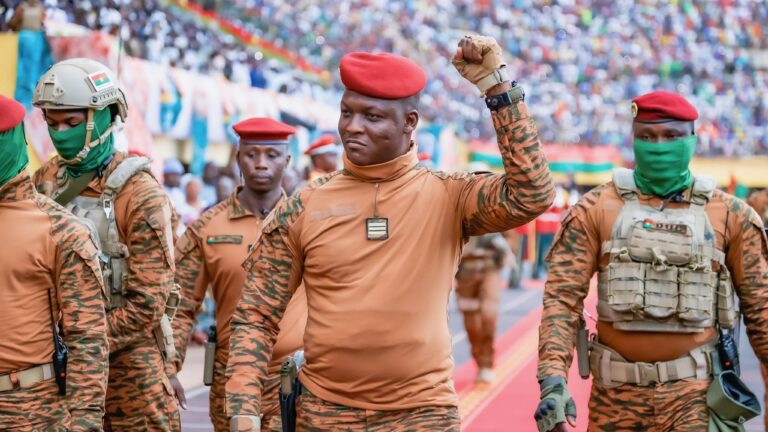
People gathered at the Place de la Révolution in Ouagadougou on Wednesday night to mark four years since Captain Ibrahim Traoré assumed power in Burkina Faso.
The event concluded anniversary celebrations organised to honour the armed forces and highlight achievements recorded under the military-led government.
One resident, Abdoul Rasmané Sawadogo, said the authorities had strengthened the country’s military capacity in response to security challenges.
“As part of the fight against terrorism, we have seen that we have established numerous Rapid Intervention Battalions, we have reorganised the army,” Sawadogo said.
Despite reported gains in security operations, Burkina Faso continues to face attacks by jihadist groups, with violence affecting several parts of the country and some communities remaining under blockade.
Government officials have also pointed to development projects implemented over the past four years in sectors such as healthcare, education, agriculture, industry and road infrastructure.
Journalist and political analyst Issouf Ouédraogo said visible changes had occurred in several parts of the country.
“Work is being done on the ground,” he stated.
“The proof is that when you travel throughout Burkina, you can see a radical change, whether in terms of morale or infrastructure, and many other things besides.”
Ouédraogo also noted efforts by the authorities to promote self-reliance and national sovereignty.
“They are instilling in the Burkinabe a sense of sovereignty, a sense of relying on ourselves,” he said.
The analyst, however, observed that challenges remained in areas including corruption, freedom of expression and human rights.
“There are also areas for improvement, particularly in certain sectors – the fight against corruption, and freedom in our dealings with one another,” Ouédraogo noted.
“For me, this means really working to ensure that all people in Burkina Faso can enjoy greater equality before the law.”
The government says more than 1.3 million people displaced by insecurity have returned to their communities.
Ouédraogo said further progress would require stronger cooperation among Burkina Faso, Mali and Niger, which together form the Alliance of Sahel States.

