The Federal Government has assured Nigerians that no part of the country will be left without constant power supply when ongoing infrastructure interventions are completed.
Minister of Power, Chief Joseph Tegbe, said President Bola Tinubu’s administration is leaving no stone unturned to resolve longstanding challenges in the power sector.
Tegbe highlighted that considerable improvements in electricity supply have been witnessed nationwide in recent weeks, assuring that the government remains committed to achieving even higher standards.
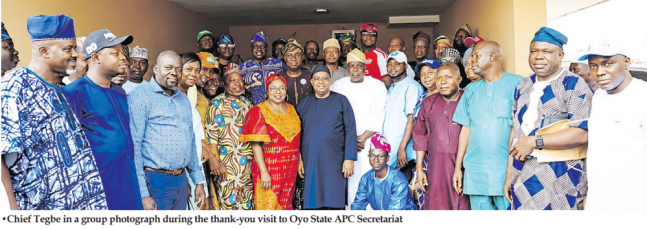
Speaking during a thank-you visit to the leadership of the All-Progressives Congress (APC) in Oyo State at the party’s secretariat in Oke-Ado, Ibadan, Tegbe appreciated party leaders and stakeholders for their support following his appointment by President Tinubu.
Addressing specific regional projects, he outlined that the Lagos-Ibadan Expressway will soon feature fully installed solar-powered streetlights, alongside mini solar grids being constructed in six different locations across Oyo State.
Tegbe also assured residents of Ogbomoso, Saki, Oke-Ogun, and Ibarapa that ongoing and age-long infrastructural challenges in their areas are receiving urgent attention to permanently tackle local power shortages.
He also pledged his full commitment to strengthening unity within the party ahead of the 2027 general elections, disclosing that he has already initiated discussions with aggrieved former governorship aspirants to ensure holistic support for President Tinubu’s reelection and all the party ‘s candidates.
Oyo State APC Chairman, Dr. Moses Adeyemo, commended the Minister’s performance and expressed strong confidence in his ability to deliver on the administration’s mandate for the power sector.
The visit was attended by many APC leaders and stakeholders, including Dr. Taofeek Lamidi, Fatai Adesina, Alhaji Lateef Ajiboye, Olawale Sadare, Joshua Oyebamiji, Tunde Oloyede, Comrade Olalekan Oladejo, Sunday Babalola, Alhaji Mojeed Delesolu, Sunday Aborisade, Fatima Hassan, Akanbi Elegbede, Alhaja Tinuade Adigun, Lukman Owonikoko and Comrade Muse Osundara among others.
Tegbe has stepped up implementation of a multi-prong strategy aimed at addressing key structural issues affecting power generation, transmission, distribution and reliability under a comprehensive plan to retool the power ecosystem.
The Federal Government inaugurated the construction of a new ultra-modern National Control Centre (NCC) for the Nigerian Independent System Operator (NISO) in a major move to strengthen grid reliability and support the realisation of the nation’s power generation target.
The new NCC, in Osogbo, Osun State, which will replace the existing 64-year old facility that no longer meets the demands of the country’s grid, formed a major part of comprehensive restructuring of the electricity sector by the government.
Tegbe said the new NCC in Osogbo will help improve the country’s power grid and reduce cases of grid collapse.
He stressed that the existing NCC, built in the 1960s, is no longer adequate to handle the growing demand and changes in the country’s power sector.
“The new centre would use modern systems to monitor the national grid and help operators detect and respond to problems faster. The facility would help with voltage and frequency regulation and allow operators to respond more quickly when problems occur on the grid,” Tegbe said.
He added that the new centre would improve the country’s ability to deal with cybersecurity threats and other forms of interference in the power sector.
Tegbe also recently held a strategic meeting with the leadership of select electricity distribution companies over proposed Energy Zones, designed to deliver stable, 24-hour power supply to homes, businesses and industries in the country’s highest-demand areas namely the Lagos axis, Abuja-Kaduna-Kano and Enugu-Port-Harcourt.
In attendance were leaderships of Abuja Electric Distribution Company (AEDC), Ikeja Electric, Eko Power Ltd, Ibadan Electricity Distribution Company (IBEDC) and Sahara Energy Group.
Tegbe, who noted that power constraint is not limited to generation and transmission but also how much power is taken and delivered at distribution, said the proposed Energy Zones are meant to close that gap, unlock commercial and industrial demand, and strengthen DisCo revenue and collections.
He reaffirmed Federal Government’s commitment to build up infrastructure in high-demand areas to ensure supply keeps pace with estimated demand in our growing economy.
The government also recently established an Off-Grid Coordination Secretariat to track commitments, manage risks, and eliminate project duplication across the power sector.
At the official relaunch of the Off-Grid Stakeholder Coordination and Partnership Forum, organised by Rural Electrification Agency (REA), an agency under Ministry of Power, Tegbe identified sector fragmentation as a major hindrance to rapid electrification.
At the forum were key partners including Deutsche Gesellschaft für Internationale Zusammenarbeit – Nigerian Energy Support Programme, UK Partnering for Accelerated Climate Transitions (UK PACT), SNV Netherlands Development Organisation, Global Off-Grid Lighting Association (GOGLA) and Murty International Ltd.
“Fragmentation is the quiet tax every under-coordinated sector pays: in duplicated effort, missed investment opportunities, and slower delivery of power to the Nigerians who need it most,” Tegbe said.
He noted that the Off-Grid Coordination Secretariat will convene issue-based working groups and generate shared market intelligence.
He assured that the ministry will continue providing policy direction through the National Electrification Strategy and Implementation Plan while supporting state electricity markets under the Electricity Act.
As part of efforts to widen electricity access to rural communities, Tegbe recently commissioned a 581 kWp Interconnected Solar Mini-Grid system with a 1.4 MW battery storage system in Oke-Oyi Community, Ilorin East Local Government Area of Kwara State.
The extended battery capacity enables the mini-grid to power the community throughout the night and reinforcing the Federal Government’s drive toward universal energy access.
The project, delivered under the Interconnected Mini-Grid Acceleration Scheme (IMAS) and supported by the Nigerian Energy Support Programme (NESP), was made possible through the combined backing of the European Union, the Federal Republic of Germany (through GIZ), and other development partners including UNICEF.
Tegbe described IMAS as a model for how international partnership should work, noting that it leverages public funding to attract private developers, establishes clear market rules, and builds long-term commercial viability rather than dependence on perpetual subsidy.

