A major breakthrough may have been achieved Thursday by those agitating for the creation of state police.
The Federal Government threw its back behind the agitation saying that creation of state police is clearly the way to go in the face of multifaceted security challenges in the country.
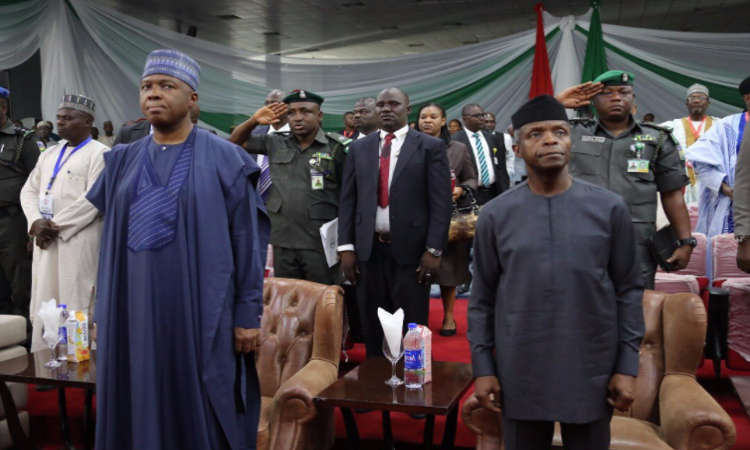
Vice President, Professor Yemi Osinbajo, stated government’s new thinking on the security architecture of the country at a summit on national security organised by the Senate in Abuja.
Osinbajo’s pronouncement on the need to create state police, which received spontaneous applause from participants at the summit, came as Senate President, Abubakar Bukola Saraki, told the gathering that the sharp increase in murderous violence, over and above the relatively manageable level of insecurity that has plagued the country for some time, jolted the Senate out of any last vestiges of complacency or denial of the challenge.
Saraki noted that there can be no denying the horrific reality in many parts of the country today.
He lamented that people who should be neighbours are turning on one another and taking up arms.
For him, “these attacks and reprisal attacks are an intolerable cycle of hell that must be broken. Killings, kidnappings, mayhem and general lawlessness cannot be the new normal. We must take this country back and restore order.”
Saraki noted that though there was no doubt that Nigerians possess the capacity to change the narrative, to end the violence and bring succor, what is required is the political will.
Saraki said: “The coming together of the Executive and Legislative arms of government for this discussion about security is a pointer to the seriousness of the situation, and our determination to tackle the problem. The Summit is also unique, because never before have we had such an inclusive platform for appraising security-related matters in this country.
“The spike in the bloodletting over the New Year period injected another note of urgency into the matter, and further served to augment the mandate of the Committee, whose members suspended their recess to conduct a fact-finding visit to Benue State, scene of one of the recent killings.
“It was envisaged that the Summit would provide a platform for critically examining the problem of insecurity, to help collate views and ideas in aid of the search for solutions. It is most reassuring to see us all here – people together – coming together to come up with a national response to a grave problem confronting our nation.
“To the Executive, I say this: you cannot do it alone – and this is why we are all here to join efforts. It is all hands on deck. No one person, organisation or arm of government can single-handedly tackle the hydra-headed monster of insecurity. The Constitution makes it clear that the safety of lives and property of citizens is the responsibility of government. We in government must therefore do everything in our power to ensure that Nigerians are safe from harm, and their livelihoods and belongings protected.
“Permit me to observe that those who are in this room have the capacity to bring about a change in this situation, to end the violence and bring succour. We have the capacity. But, do we have the political will? I daresay political will is what is required; and it is my hope that we shall marshal it as a legitimate instrument against this problem. Indeed, there is no reason why that should not be the case. This is not a Summit to trade blames – in no way is this a blame game. Neither is it convened so that any person or entity can take credit. We just want solutions. Solutions only. That is all Nigerians require of us.
“It is expected that at the end of our deliberations and submissions, we will have a more profound understanding of the nature of the crisis; as well as a realistic assessment of the strengths and weaknesses of our security assets. We should also have a more accurate assessment of challenges to the current disposition of the Nigerian state – through the level of preparedness of all its law and order agencies to security threats.
Let me add that this Summit should help us achieve some consensus around what needs to be done, in the short term as well as in the long term, to bring comfort and relief to those affected, and assurances of security throughout the country.
“Distinguished ladies and gentlemen, we would have failed in our responsibility if – by the end of this Summit – we didn’t succeed in triggering higher levels of collaboration and cooperation among all stakeholders, of a character that can be sustained and placed at the service of the nation. This spirit of collaboration and cooperation is, therefore, key.”
The Senate President said that Summit programme has been designed to allow full and unfettered discussion.
All participants, he said, are encouraged to be forthright in expressing their views, and show commitment to the need for solution.
“Let me reiterate that we are not here to indict anybody. This is not an indictment, it is not to lay blame or point fingers, and it is not to take credit for what goes well. This process is very much solutions-driven. In order for us to ameliorate the current difficulties, therefore, it is important that people speak frankly.
“In that vein, let me say to those who will make contributions during the sessions: please, do not be on the defensive. Nobody is on trial here. Let us make our submissions with openness, in good faith and with an attitude that is forward-looking. When all is said and done, this is a worthy exercise, for the good of Nigeria, and we should all strive to do our best, – and that work begins at this Summit.
“What our country needs at this time is leadership that will work to douse the flames and reduce tension in the land. It is essential that we lower the barriers in our actions and rhetoric, and refrain from playing politics with a crisis situation in which Nigerian lives are being lost, tragically and needlessly, on a regular basis,” Saraki said.
On his own, Prof. Osinbajo said, “The nature of our security challenges are complex and known. Securing Nigeria’s over 900,000sq km and its 180 million people requires far more men and material than we have at the moment. It also requires a continuous reengineering of our security architecture and strategy. This has to be a dynamic process.
“For a country of our size to meet the one policeman to 400 persons prescribed by the United Nations would require triple our current police force; far more funding of the police force and far more funding of our military and other security agencies.
“We cannot realistically police a country the size of Nigeria centrally from Abuja. State police and other community policing methods are clearly the way to go.”
The Vice President added that Nigeria must intensify existing collaboration with her neighbours in the Chad Basin by strengthening security especially at border communities to prevent the movement of small arms and disarming armed pastoralists and other bandits who go through the borders day after day.
He warned that the country must avoid the danger of allowing the crisis to degenerate into religious or ethnic conflict which he said is the responsibility of political, religious and all other facets of the country’s leadership.
On the upsurge of killings, the Vice President noted that the recent incidents of killings across the country are a reminder that there is no room for complacency in the task of securing Nigeria.
Osinbajo said: “This is against the backdrop of the remarkable improvements we have recorded on the most dreaded security challenge we had at a time – the fight against Boko Haram.

