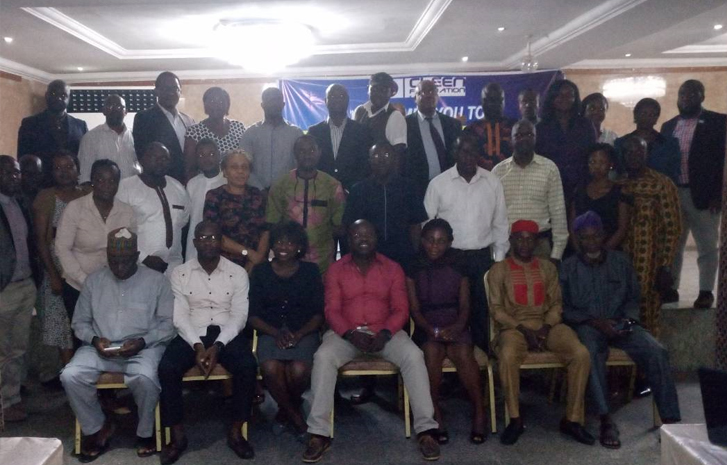
The need for synergy between civil society organisations, journalists, lawyers, security agents, among others was the summary of what participants agreed at a two-day training workshop on monitoring and advocacy for the implementation of the administration of criminal justice act twenty-fifteen.
They also called for the need for police, the judiciary and the prisons to synergise in the administration of criminal justice in Nigeria.
The training workshop organised by CLEEN Foundation, is aimed at sensitising participants on the provisions of the administration of criminal justice act twenty-fifteen to develop strategies to increase advocacy for full implementation of the act and monitoring of the relevant agencies compliance with their role under the act.
In her welcome, CLEEN Foundations Program Manager, Blessing Abiri said the project was aimed at stregthening the implementation of the administration of criminal justice act which was passed in twenty-fifteen, through the systematic monitoring of key agencies and increasing advocacy to ensure fulfil their new roles under the act.
According to Abiri, CLEEN conducted a survey in collaboration with Practical Sampling International (PSI), to assess the effectiveness of the Administration of Criminal Justice Act, 2015, (ACJA), and provide reliable and credible data and information to members of the public.
Advertisement
She said the survey consisted of 5,099 respondents drawn from Adamawa, Cross River, Imo, Kaduna and Lagos States and Abuja, with in-home, face-to-face personal interview using a modified, multi-stage random selection procedure, as the basic methodology employed, for data collection so as to achieve a representative sample.
The breakdown showed that 2669 males and 2430 females, participated in the survey with Abuja having (764), Adamawa, (714), Kaduna, (1239), Imo, (643), Cross River, (770), and Lagos (969).
About 21.9% of the respondent were very familiar with the police; 47.2% were familiar with the police; 16.8% were somewhat familiar and 13.9% were not familiar, while 69.1% were either very familiar of familiar with the police, she said.
Her words: “There were variations in the extent of familiarity with the police by respondents in the six states, namely 73.8% (Abuja, FCT); Adamawa (70.6%); Kaduna (74.8%); Imo (78.7%); Cross River (57.2%) and Lagos (60.3%), even as familiarity of citizens with the police was surprisingly highest in Imo and lowest in Lagos State.”
Familiarity with the courts revealed that 55.3% of the respondents were either very familiar (15.4%) and familiar (39.9%) with the courts, as 18.9% of them were somewhat familiar and 25.0% not familiar with the courts.
Those, who were either very familiar or familiar with courts in the states were 60.4% (Abuja FCT); 57.8% (Adamawa); 62.2% (Kaduna); 71.2% (Imo); 41.5% (Cross River) and 41.6% (Lagos State).
Familiarity with prisons, showed 48.7% of the respondents from the six states were either very familiar (12.6%) or familiar (34.2) with the prisons in the country. In contrast, 22.0% were somewhat familiar and 24.9% were not familiar.
Extent of familiarity (very familiar/familiar) in the states were 52.0% (Abuja, FCT); 50.5% (Adamawa); 56.0% (Kaduna); 63.2% (Imo); 35.8% (Cross River) and 36.2% (Lagos).
Significantly, 44.3% of the respondents in Cross River State and 47.9% in Lagos State said they were not familiar with the prisons. As expected, citizens were most familiar with the police which is the gate keeping agency in the criminal justice system.
Surprisingly, respondents in Lagos State, the most urbanized state in the country, consistently exhibited lowest familiarity with the three criminal justice agencies.
According to Lead Counsel of Legal Defence and Assistance Project, Barrister Chino Obiagwu, the quality of a nation’s criminal justice system was a reflection of the integrity, of not just those saddled with adjudicating over trials, but also of the entire structures put in place forthe proper administration of justice.
Obiagwu, who is also Chairman, National Working Group on the Reform of Criminal Justice Administration in Nigeria said the Administration of Criminal Justice Act twenty-fifteen was an excellent piece of legislation which many scholars, legal minds and commentators have commended for its several novel provisions and for its ability to fulfil its major aim which is that of quick dispensation of justice.
He said despite the kudos that had trailed the passage of the act, the Act was not without its short comings and it was in the light that attention must be drawn to certain aspect of the Act that might require amendments.
In his view, A legal rights practitioner, Princewill Akpapan said even though the Administration of Criminal Justice Act, contains daring innovations which are expected to help promote quick dispensation of justice, some of the contents are in contrast with some constitutional provisions and established judicial pronouncements.
Also, the National Coordinator of Network on Police Reform in Nigeria, NOPRIN, Nwanguma Okechukwu said the criminal justice system in Nigeria starts to run with the commission of a crime and straddles subsequent interventions by agencies, (Police, Courts and Prisons) of the system such as arrest, arraignment, trial, sentencing and punishment of the offender.
All participants which include Civil Society Organisations including the media drawn from different states of the federation concluded the two-day training workshop with a promise to work together to monitor activities of the relevant criminal justice agencies in relations to the implementation of the act.

