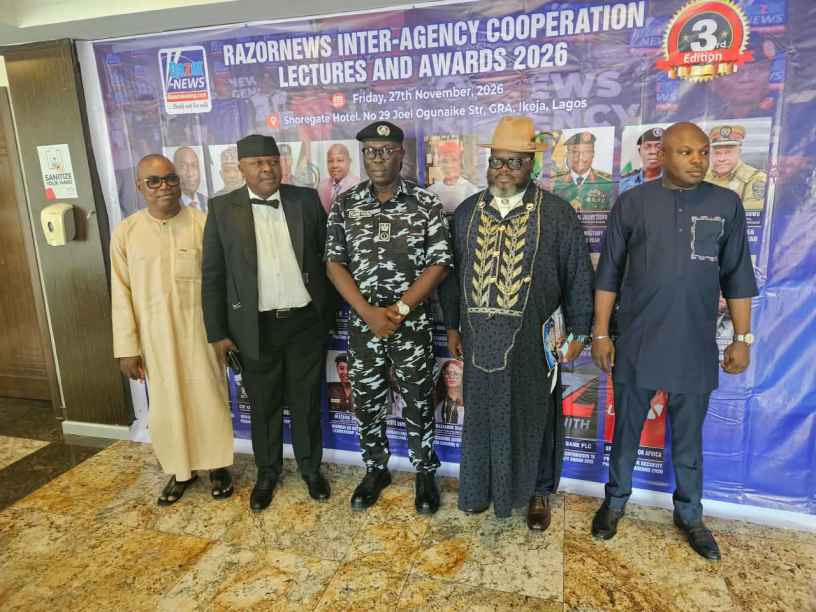
The 3rd Edition of the RazorNews Inter-Agency Cooperation Lectures and Awards, themed: “Inter-Agency Synergy for National Security: Strengthening Intelligence Sharing and Joint Operations,
has come and gone.
The event which brought together heads of security agencies, paramilitary formations, government institutions, corporate leaders, civil society actors, and media practitioners reflected Nigeria’s evolving security challenges, where no single agency can succeed alone.
According to speakers after speakers, no single agency could defeat Nigeria’s complex security threats alone, noting that emerging crimes demanded coordinated intelligence sharing and joint operations.
The speakers believed that Criminality in Nigeria has no boundary; hence all security agencies should play inter-agency roles in combating all crimes like terrorism, banditry, kidnapping, armed robbery, smuggling.
They said Inter-agency collaboration among the various security agencies is non-negotiable, saying Collaboration and partnership among state security agencies and non-state actors are inevitable.
In his keynote Speech, the Inspector-General of Police, IGP Olatunji Disu, urged security agencies to strengthen intelligence sharing, joint operations and mutual trust to address Nigeria’s evolving security challenges.
Disu noted that criminal networks were becoming increasingly organised and interconnected, making collaboration among security agencies imperative to preventing and responding to threats.
According to him, no single agency possesses all the information, resources and capabilities required to effectively tackle the country’s security challenges.
He said intelligence gathered by one agency could help another prevent attacks, apprehend suspects or disrupt criminal activities.
Disu stressed that inter-agency collaboration should be built on trust, mutual respect and a shared commitment to national security, adding that unnecessary rivalry must give way to a common objective.
The IGP identified consistent intelligence sharing, coordinated joint operations, investment in technology and training, and stronger institutional relationships as key measures to enhance security.
According to him, Intelligence should not be withheld because it was gathered by a particular agency, hence timely information sharing is essential to crime prevention and effective response.
He also said Joint operations must be properly planned, with participating agencies understanding their respective roles and responsibilities.
Disu said security operations must comply with the law, respect constitutional rights and uphold accountability.
He also called for stronger community engagement, describing citizens as important partners in identifying threats and preventing crime.
The Police Chief said the police remained committed to working with other security agencies to strengthen intelligence-led policing and improve public confidence.
He said collaboration must be reciprocal, with every agency willing to provide and receive support when necessary.
Disu urged security leaders to promote a culture of cooperation, stressing that the ultimate measure of success was the collective ability of security agencies to protect lives and property.
He stressed that no security agency could effectively tackle the country’s security challenges in isolation, calling for improved communication, intelligence sharing and joint operational planning.
Disu noted that criminal networks often operate across institutional and jurisdictional boundaries, making cooperation essential to effective security operations.
The IGP who spoke through Lagos State Police Commissioner, Tijani Fatai said effective collaboration would help create a safer environment where Nigerians could live, work and pursue opportunities without fear.
He also underscored the importance of inter-agency collaboration, noting that intelligence sharing and joint efforts had contributed to security operations in Lagos State.
Also, the Assistant Inspector-General of Police in charge of Zone 2, Olohundare Jimoh, called for stronger inter-agency cooperation, effective intelligence sharing and coordinated security operations as critical measures for tackling insecurity and strengthening national security.
Jimoh stressed that the complexity of contemporary security challenges required security agencies to move beyond isolated operations and embrace a coordinated approach built on trust, professionalism, timely information exchange and clearly defined operational responsibilities.
He noted that no single security institution could independently address the multifaceted threats confronting the country, emphasising that intelligence sharing and joint operations remained essential to identifying criminal networks, preventing security breaches and responding swiftly to threats.
Jimoh further underscored the importance of strengthening working relationships among the Police, military, intelligence services, Nigeria Security and Civil Defence Corps and other relevant agencies.
According to him, effective collaboration would eliminate operational gaps, minimise duplication of responsibilities and improve the overall effectiveness of security operations.
Speaking on security administration within Lagos and Ogun states, the AIG highlighted the importance of proactive policing, intelligence-led operations, effective deployment of personnel and sustained engagement with communities in maintaining law and order.
Jimoh maintained that security must be driven by prevention, rapid response and continuous assessment of emerging threats.
He also emphasised the need for discipline, accountability and professionalism among security personnel, noting that public cooperation and confidence remained indispensable to successful policing.
He urged stakeholders to support security agencies with credible information while encouraging closer partnerships between law enforcement institutions and the communities they serve.
The AIG spoke through the Deputy Commissioner of Police in charge of Finance and Administration, DCP Olayinka Ajeigbe.
In his remark, the Chairman of the occasion, retired Major General Raymond Ochei, called for stronger institutional trust.
Ochei warned that rivalry, intelligence hoarding and jurisdictional disputes could undermine collective security efforts.
He spoke through Arc. Emmanuel Egbumokei commending the management and editorial team of Razor Media Group, led by Sunday Odita, for sustaining the initiative and promoting developmental journalism at a time when sensational reporting often competes with responsible and issue driven journalism.
He noted that Nigeria’s security challenges had become increasingly complex and interconnected, requiring security institutions to move beyond isolated operations and embrace a unified approach.
Drawing from his military experience, Ochei stressed that no single arm of the armed forces could win a war independently, adding that success in modern security operations depended on intelligence fusion, logistics, tactical coordination and unified command.
According to him, insurgency in the North-east, banditry, kidnapping, illegal mining and transnational cybercrime demonstrate the changing nature of threats confronting the country.
He argued that criminal networks operate across geographical and institutional boundaries, making it imperative for security agencies to strengthen cooperation rather than operate within restrictive institutional structures.
Ochei warned that interagency rivalry, intelligence hoarding and jurisdictional disputes were costly weaknesses Nigeria could no longer afford.
He maintained that effective synergy must go beyond joint patrols, ceremonial engagements and occasional meetings to establish institutional trust and ensure that actionable intelligence is transmitted promptly to agencies best positioned to respond to emerging threats.
He further emphasised that the military, police, Nigeria Security and Civil Defence Corps, intelligence services and other paramilitary formations must function as interconnected components of a common national security framework.
Such cooperation, he said, would improve operational efficiency, strengthen responses to security emergencies and enhance the country’s collective capacity to confront criminal networks.
The former general also identified the media and the citizenry as critical partners in national security, describing them as indispensable force multipliers.
He said public confidence in security institutions encourages citizens to provide useful intelligence, while responsible journalism helps balance the media’s constitutional responsibility with the need to protect sensitive operational information and prevent misinformation from benefiting criminal elements.
Addressing the award recipients, Ochei described their recognition as an affirmation of their integrity, professionalism, resilience and sacrifices in the service of the nation.
He urged them to regard the honour as a renewed responsibility to uphold higher standards of accountability, institutional cooperation and commitment to national security.
He called on security leaders and other stakeholders at the gathering to translate discussions from the lecture into practical measures capable of strengthening operational relationships among agencies.
Ochei also expressed appreciation to Razor Media Group for the initiative and acknowledged the presence of distinguished guests, before formally declaring the third edition of the lecture and awards open.
The lecture titled; inter-agency cooperation in safeguarding Nigeria’s mineral resources and combating illegal mining, was delivered by the NSCDC Commander of Mining Marshals, Assistant Corps Commandant Attah Onoja.
Onoja said the security agencies must agree to deepen cooperation, enhance intelligence sharing and adopt proactive measures to prevent crime and criminality.
According to him, the ability of security agencies to exchange intelligence, identify potential threats and respond promptly to security challenges would go a long way to end insecurity in the nation.
Onoja urged security agencies to adopt a preventive approach by prioritising intelligence gathering, threat analysis and coordinated security deployments rather than waiting for incidents to occur.
In his welcome address, the Editor-in-Chief of Razor Newspaper, Sunday Odita, called for stronger collaboration among security agencies to address Nigeria’s security challenges.
Odita said the lecture’s theme was timely, given the complex nature of security threats confronting the country.
He said terrorism, kidnapping, banditry, illegal mining, cybercrime and organised crime required coordinated responses, stressing that no single agency could effectively tackle the challenges in isolation.
Odita urged security agencies to strengthen intelligence sharing, trust, communication and joint operations to improve national security.
According to him, the lecture was designed to promote practical recommendations and strengthen institutional relationships among security agencies.
He said Razor Media Group, publishers of Razor Newspaper and other media platforms, remained committed to developmental journalism and promoting professionalism, accountability and national unity.
The editor-in-chief said the awards sought to recognise individuals and institutions whose contributions to national security and development often went unnoticed.
He urged citizens, community leaders, traditional institutions, the private sector and the media to support security agencies through responsible information sharing and constructive engagement.
Odita appreciated the Chairman of the Occasion, retired Maj.-Gen. Raymond Ochei; the Royal Mother of the Day, Dr Yeye Afolashade Shona Aluko; and the Inspector-General of Police, Olatunji Disu, for their support.
He also commended the Assistant Inspector-General of Police in charge of Zone 2, Olohundare Jimoh, for his professionalism and commitment to policing, while urging award recipients to remain dedicated to service.
Odita thanked the guests, partners, sponsors and organising committee for supporting the event, urging participants to strengthen institutional cooperation towards building a safer and more prosperous Nigeria.

