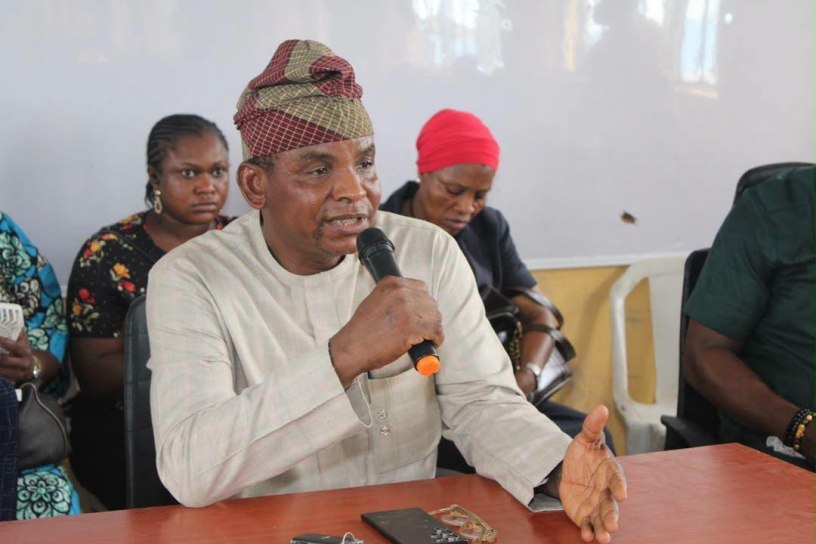
The Commissioner for Basic and Secondary Education, Lagos State, Jamiu Tolani Alli-Balogun, has urged parents and guardians to take greater responsibility for the upbringing, supervision and welfare of their children.
Alli-Balogun stresses that the task of raising responsible and disciplined students cannot be left to the government and teachers alone.
He gave this charge during a meeting with the Parents’ Forums of Coker Senior and Junior Secondary Schools, Jubilee Senior and Junior Secondary Schools, Sari-Iganmu Senior and Junior Secondary Schools, and Araromi Senior and Junior Secondary Schools, all under Education District IV.
The meeting, held at the respective school halls, was convened in compliance with the directive of the Deputy Governor of Lagos State, Dr. Obafemi Hamzat following a complaint from a concerned resident alleging incidents of violent confrontations among students of the schools after closing, involving the use of dangerous weapons and causing fear, disorder and disruption of peace within the community, between Orile, Alafia and Coker Bus-Stop along Badagry Expressway, an international route.
Addressing the parents, the Commissioner emphasised that effective parenting remains fundamental to ensuring discipline, good conduct and responsible behaviour among students.
He noted that while the government and teachers are committed to providing quality education, leaving no child behind, a conducive learning environment and maintaining discipline in schools, parents must complement these efforts by providing proper parental care, guidance, monitoring and moral upbringing at home.
He further reminded parents of their primary responsibility to ensure that their children are enrolled in school and attend regularly.
He stressed that the Lagos State Government has a law mandating that every child of school age must be in school, warning that parents who fail to comply with this legal requirement risk prosecution in accordance with the law.
The Commissioner called on parents to work closely with school authorities and relevant security agencies to discourage violence, promote peaceful coexistence and ensure that students conduct themselves responsibly both within and outside the school environment.
“The roles of teachers differ from those of parents. The responsibility for shaping children’s behaviour begins at home, and parents have a vital role to play in this regard.
Teachers and the government cannot do it alone; parents must also be actively involved. Together, let us build a better future for our children. Give them the right orientation and be present in their lives”, he pleaded.
He also stated that any student caught bringing electronic devices to school would face disciplinary consequences, and such devices would be permanently confiscated.
The engagement provided an opportunity for stakeholders to collectively address concerns surrounding student misconduct and identify the need for stronger collaboration among parents, school management, government and security agencies towards restoring and sustaining peace in the affected school communities. “
“Lagos State is peaceful. Why, then, should our students, who are expected to be enlightened, engage in activities that disrupt the peace of the State under the guise of wanting to become the ‘kings of the roads’? Such behaviour will not be tolerated,” he reiterated.
The meeting was attended by the Tutor-General/Permanent Secretary, Education District IV, Olufemi Bamidele Paseda; the overall chairperson, Apapa-Orile Parents’ Forum, Esther Oluwakemi Olatunji; the Chairman, Sari-Iganmu Senior Secondary School Parents’ Forum, Ademola Fasina; and personnel of the Lagos State Neighbourhood Safety Corps responsible for security coverage of the various schools, alongside other stakeholders.
The Ministry reiterated its commitment to providing a safe, peaceful and conducive learning environment for all students and urges parents, guardians and community stakeholders to support government efforts in raising disciplined, responsible and law-abiding young people.

