President Bola Tinubu’s economic and security reforms are putting Nigeria on the path to recovery.
Governor Babajide Sanwo-Olu of Lagos State who made this known, urged voters to give the administration another term to consolidate the gains.
Sanwo-Olu, a two-term governor and chieftain of the All Progressives Congress (APC), said the economy and security would be the defining issues of the 2027 presidential election, arguing that neither economic growth nor national development could be sustained without security.
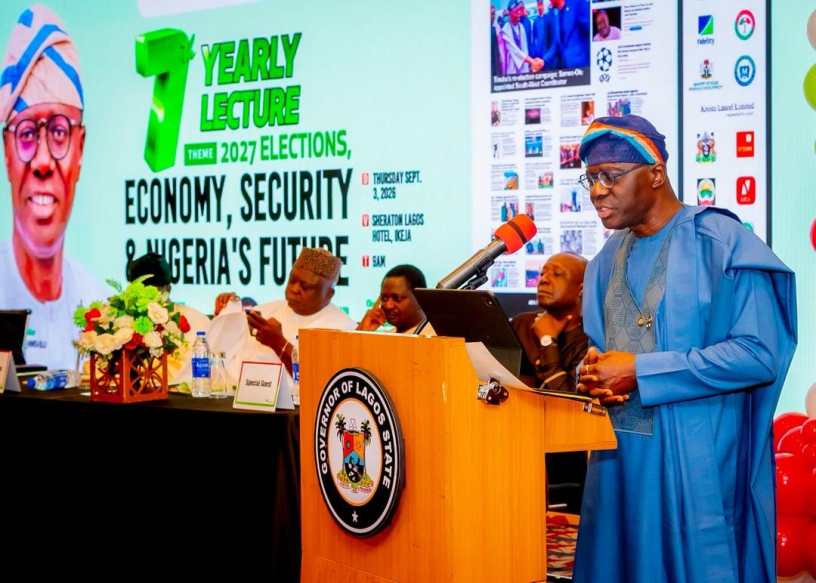
Speaking at the Freedom Online 7th Yearly Lecture at the Sheraton Lagos Hotel, Ikeja, Sanwo-Olu acknowledged that some of Tinubu’s reforms had imposed significant hardship on Nigerians, particularly the removal of the petrol subsidy.
But he insisted that the policy was necessary to rescue public finances and redirect resources to development.
The governor, who spoke on “2027 Elections: Economy, Security and Nigeria’s Future,” said recent economic indicators suggested that the reforms were beginning to deliver results.
He cited National Bureau of Statistics figures showing that the economy grew by 4.43 per cent in the second quarter of 2026, compared with 3.89 per cent in the first quarter.
He also said Nigeria’s foreign reserves had risen to $53 billion, while inflation had fallen to 15.9 per cent in June from almost 35 per cent in late 2024.
Sanwo-Olu added that formal remittances from Nigerians abroad reached $947 million in July, the highest monthly figure recorded.
“These are not my numbers. They belong to the Nigerian Bureau of Statistics and the Central Bank of Nigeria, and every journalist in this hall can check them,” he said.
The governor said the APC would campaign on the need to sustain the reforms and ensure that their benefits reached Nigerians more quickly.
“For us in the All Progressives Congress, the position that follows is a simple one. We intend to stay the course, to deepen the reforms, and to make sure that the benefits reach, quickly and visibly, the people who bore the cost,” he said.
Sanwo-Olu argued that the economic and security crises confronting the country could not be treated separately.
“Poverty feeds insecurity, and insecurity strangles the very economy that would cure poverty,” he said.
According to him, insecurity prevents farmers from accessing their farms, keeps children away from schools, discourages investment and disrupts businesses.
He warned that security would also directly affect the 2027 electoral process, as insecurity could restrict campaigns, impede the movement of electoral personnel and materials and discourage voters from turning out.
The governor said the Tinubu administration had responded with measures including expanding the Nigerian Army from eight to 12 divisions, adding personnel, and establishing new divisional headquarters.
He also cited the Navy Special Operations Command, decentralisation of police training and the deployment of Forest Guards and Mining Marshals.
Sanwo-Olu strongly backed the proposed establishment of State Police, saying bringing security closer to communities would make policing more effective.
Drawing from Lagos’ experience, he cited the Lagos State Security Trust Fund and Neighbourhood Safety Corps as evidence that community-based security could complement conventional policing.
“Security works best when the people who pay for it and the people who depend on it can see, and hold to account, the people who provide it,” he said.
He urged the National Assembly and state Houses of Assembly to complete the constitutional process for state policing.
His position was supported by former Ogun State governor and Senator representing Ogun East, Gbenga Daniel, and former Minister of Information, Lai Mohammed, who both stressed the importance of security to economic development.
Similarly, the Ogun State Peoples Democratic Party Governorship candidate, Ladi Adebutu, called for a transparent election, adding that there can’t be economic growth without adequate security.
Sanwo-Olu, who will not contest the 2027 governorship election because he is completing his second term, made clear his preference for the presidential contest.
“I will not disguise my hope for the outcome. I expect my party to win, and I expect a second term for President Tinubu to consolidate the Renewed Hope agenda,” he said.
He argued that abandoning reforms midway would be costly to the country.
“An unfinished reform is the most expensive kind,” he added.
The governor also defended Tinubu’s democratic credentials, citing the recent Osun governorship election, which the APC lost to Governor Ademola Adeleke.
He said Tinubu congratulated Adeleke after the election, arguing that the development showed that the ruling party could accept defeat at the polls.
“Under this President, the ruling party can lose a state, in the South-West, in an election year, and the sky does not fall. That is what a maturing democracy looks like,” Sanwo-Olu said.
He urged political parties to avoid violence and respect electoral outcomes.
“A mandate is only as strong as the process that produced it. No office in this land is worth the life of a single Nigerian, and no victory won by the wrong means is a victory at all,” he said.
The governor said the 2027 contest would also be shaped by state governments’ performance.
He urged governors to account for increased allocations following the removal of the fuel subsidy, saying voters would judge them by the quality of roads, schools, healthcare and other services delivered.
Sanwo-Olu also identified Nigeria’s youth population as both an opportunity and a security challenge.
He cited the Nigerian Education Loan Fund, the 3 Million Technical Talent programme, consumer credit initiatives and other government programmes as efforts aimed at expanding opportunities for young Nigerians.
He said failure to provide jobs and productive opportunities could worsen insecurity.
With the 2027 campaigns gathering momentum, the governor urged the media to scrutinise claims from all political camps.
“I am not asking for a compliant press. A compliant press is of no use to a democracy; it flatters the powerful and abandons the public,” he said.
“I am asking for a rigorous press. Check the facts, mine included. Call out disinformation wherever it comes from, including from my own side.”
He warned that misinformation, doctored videos and anonymous social media accounts could pose a serious threat to the electoral process.
Sanwo-Olu said the ultimate test of 2027 would not merely be who wins the election, but whether Nigeria could deepen democracy while consolidating economic and security reforms.
He expressed support for Tinubu’s target of building a $1 trillion economy by 2030, saying ambitious targets were necessary to drive national transformation.
“Let 2027 be remembered not as the election Nigeria survived, but as the election at which Nigeria came of age,” he said.
Earlier, Otunba Daniel had said: “Nigeria cannot have a strong economy without security, and it cannot have lasting security without a strong economy.”
The Ogun Senator, who acknowledged that the nation was facing several challenges, said they were not enough to define the country.
“But Nigeria must not be defined only by its challenges. We possess enormous potential: a young population, a dynamic entrepreneurial culture, a growing technology sector, strong financial institutions, a vibrant creative economy and businesses succeeding across Africa.
“Our challenge is to create the conditions in which Nigerian ability can flourish at scale. Those conditions include security, infrastructure and opportunity.”

