
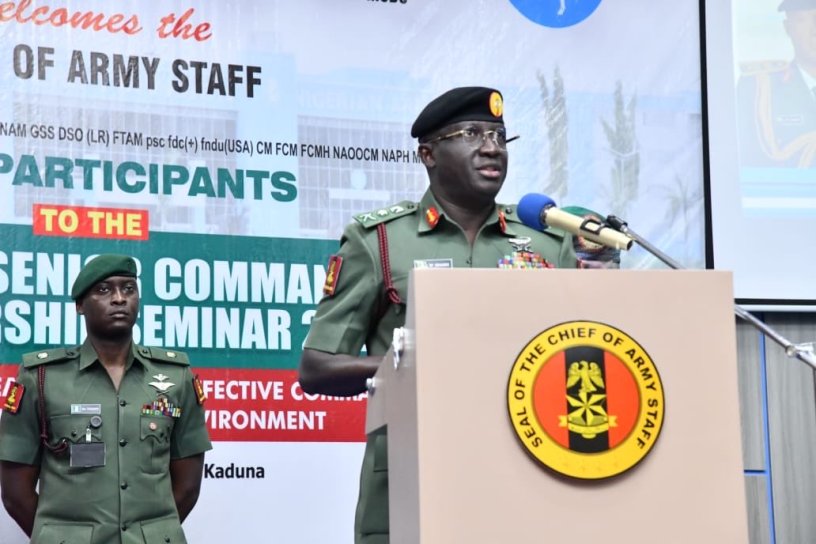
The Chief of Army Staff (COAS), Lieutenant General Waidi Shaibu, has charged senior commanders of the Nigerian Army to demonstrate strategic foresight, professional competence and exemplary leadership in confronting the increasingly complex security challenges facing the nation.
Shaibu stresses that contemporary military success depends not only on battlefield superiority but also on credibility, public confidence and effective leadership.
He gave the charge while declaring open the Second Senior Command and Leadership Seminar 2026 at Headquarters 1 Division Nigerian Army, Kaduna.
The seminar, themed “Strategic Leadership for Effective Command in an Evolving Security Environment,” brings together senior commanders and resource persons to strengthen leadership capacity, exchange operational experiences and develop practical approaches to contemporary command challenges.
Lieutenant General Shaibu observed that terrorism, insurgency, banditry, transnational organised crime, cyber threats, disruptive technologies and information warfare have continued to reshape the contemporary operating environment.
He therefore, urged commanders to remain intellectually agile, operationally innovative and morally courageous, while exercising sound judgement in conditions of uncertainty.
The COAS particularly underscored the growing importance of the information environment, warning that adversaries and other malign actors increasingly employ misinformation, deliberate distortion and manipulation of public perception to undermine military credibility and erode public confidence.
He stressed that commanders must factor the information environment into campaign design, operational planning and the conduct of activities, while ensuring that operational decisions are supported by timely, accurate and credible communication.
Shaibu further emphasised that professional conduct remains fundamental to protecting the reputation and legitimacy of the Nigerian Army. According to him, no strategic communication effort can compensate for indiscipline or unprofessional conduct in the field.
He consequently directed commanders to enforce strict adherence to Rules of Engagement, respect for human rights, protection of civilians and accountability at all levels, noting that the actions of troops can have consequences far beyond the immediate theatre of operations.
Speaking on the recent expansion of the force structure of the Nigerian Army from eight to twelve divisions, Lieutenant General Shaibu described the development as both an opportunity and a major leadership responsibility.
He noted that expanding the Army goes beyond increasing manpower and equipment, stressing that senior commanders have a decisive role in transforming newly established formations into cohesive, credible and combat-ready fighting organisations.
Shaibu added that the values commanders promote, the standards they enforce and the leaders they develop would shape the effectiveness of these formations for years to come.
The COAS also urged participants to translate lessons from the seminar into tangible improvements in command, campaign planning, operational effectiveness, mentorship and institutional performance.
The Army Chief encouraged commanders to build cohesive teams, develop successors, empower subordinates, promote innovation and deepen engagement with communities and legitimate stakeholders within their Areas of Responsibility.
 securityandsafetymatters