
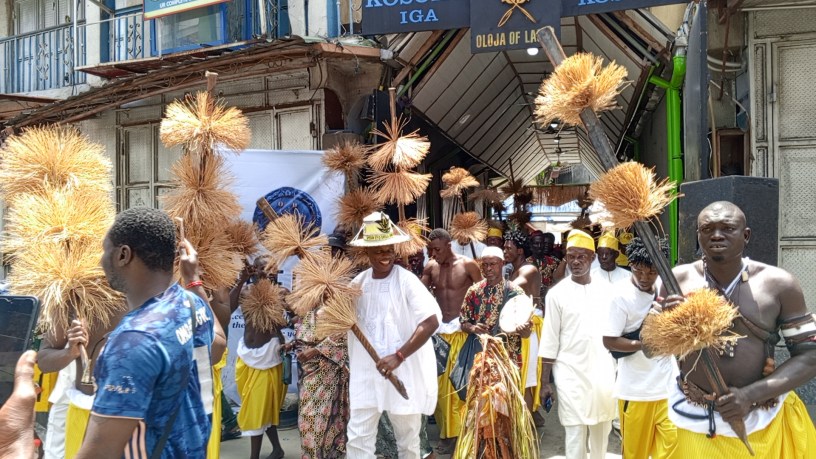
Lagos has witnessed a vibrant celebration of Yoruba culture, tradition and spirituality as worshippers, traditionalists and culture enthusiasts converge on the historic Oju Olobun Shrine on Lagos Island to mark this year’s Isese Day.
The celebration brought together over 3 million Lagosians to honour indigenous heritage, ancestral practices and culture, characterised by traditional prayers, cultural rites, drumming, chants and other activities showcasing the spiritual and cultural heritage of the Yoruba people.
The Lagos State has declared 20th August as ‘Isese Day’, on which all traditional worshippers celebrate their various religions and beliefs.
The day is dedicated to honouring Yoruba deities and Orishas, as well as preserving the heritage and customs of the Yoruba people.
Lagos State Governor Babajide Sanwo-Olu, who spoke through his Special Adviser on Tourism, Arts, and Culture, Idris Aregbe said Isese Day reflects the administration’s commitment to preserving Lagos’ rich cultural heritage and reconnecting residents with their roots.
The Senior Special Assistant to the Lagos State Governor on Wealth Creation and Empowerment, Tijani Saheed-Oluwadare, felicitated with traditional worshippers on Isese Day.
Oluwadare who congratulated the worshippers, said the annual festival, which featured traditional worship, pouring of libations to deities, cultural displays and family reunions, helped to reconnect people with their ancestral roots.
According to him, the celebration also serves as a reminder of the importance of wealth creation and employment in the community.
Prime Minister to the Oba of Lagos, traditionally known as the Eletu Odibo, Chief Ismaheel Ayeni, who led the rites and other traditional activities at the Oju Olobun Grove, described Isese Day as more than a traditional religious observance.
The head of the Akarigbere Royal Class of Chiefs in Lagos said the celebration represented the identity, history and cultural continuity of the Yorubas, stressing the importance of preserving indigenous traditions for future generations.
The Olorogun Adodo of Lagos, Chief Adebola Dosunmu, also expressed that Yoruba tradition was gradually taking its rightful position in society, with more young people showing renewed interest in tracing their roots and reconnecting with their cultural heritage.
Dosunmu further stressed the importance of protecting the cultural heritage of the people, particularly at a time when younger generations were increasingly exposed to foreign cultures and lifestyles.
He applauded Governor Babajide Sanwo-Olu for approving Isese Day as a public holiday, describing the decision as an important step towards giving greater recognition to Yoruba culture and traditional institutions, while praying for the long life and continued well-being of the Oba of Lagos, Oba Rilwan Akiolu.
A traditionalist, Chief Yusuf Atanda, offered free herbal medicine/treatments to residents of Ikorodu, as part of activities to commemorate the 2026 Isese Day.
Atanda, the Oluwo of Iledi Isesegbemi, Ebute, Ikorodu, said that about 50 persons benefited from the free herbal treatment provided during the celebration.
He said the initiative was aimed at promoting the Yoruba traditional heritage and its relevance to society.
Atanda, who is also the Head, Traditional Medical Association, said that the herbs were provided for ailments including piles, fever in children, fibroids, among others.
The traditionalist urged Nigerians to preserve and promote their cultural heritage, stressing that traditional practices remained an important part of the people’s cultural identity.
Today is a very important day for the traditionalists, both the worshippers of Osun, Ogun, Obatala, Sango, Egungun, Igunko, Ogboni and others,” he said.
According to him, some people have forgotten the importance of Isese, a strong cultural heritage that remains relevant to society.
He said traditionalists also believed that traditional practices could help address challenges confronting communities through prayers and sacrifices.
He identified Baales as major custodians of Isese, noting that traditionalists worked with them to ensure that community affairs were conducted in accordance with established traditions.
Atanda urged Nigerians, particularly traditionalists, not to abandon their cultural roots but to preserve the knowledge and practices associated with Isese.
Traditional rulers in Lagos State preached religious tolerance and peaceful coexistence as they celebrate the annual Isese Day festival across the state.
Oba of Igbobi Sabe, Oba Adeyemi Adeniyi, while given his remarks during the celebration on Thursday in his Palace, thanked Gov. Babajide Sanwo-Olu for given traditionalists opportunities to celebrate their religion annually.
Adeniyi urged residents to be religious tolerant and embrace one another’s beliefs to ensure peaceful coexistence ahead of the general elections.
In his remarks, Oba Sulaiman Ogun-Oloko, the Oniwaya of Iwaya Land, Yaba, appealed to the youths to embrace Yoruba cultural heritage, promote unity and leave peacefully in the community.
Baale Titun of Makoko Community, Chief John Kito, thanked the government for recognizing the traditional worshipers and giving them the opportunity to celebrate their festival.
A traditional ruler, Oba Abdulfatai Aromire, called for collective efforts to ensure the peaceful conduct of Nigeria’s 2027 general elections.
Aromire, who is the Ojora of Ijora and Iganmu Kingdom, said the forthcoming general elections should promote tolerance, reject hate speech and strengthen interfaith dialogue across the country.
He also urged citizens and politicians to maintain peace, ensure religious tolerance, and promote stability ahead of the upcoming 2027 general elections.
The ruler also urged the masses, especially the youth not to be used by politicians to cause unrest and problem during the elections.
Aromire reminded Nigerians to respect cultural and religious diversity, noting that peaceful coexistence remained vital for regional and national development.
The traditional ruler said the festival was significant because it brought back memories of the ancestors and also promote peace and unity within the community.
He urged the people not to forget their ancestors, noting that traditionalists had been in existence before the Muslim and Christianity religions came into existence in the country.
He described the celebration as an opportunity to honour the rich cultural heritage of the Yoruba people, promote unity and reaffirm the importance of preserving indigenous values for generations yet unborn.
Some traditionalists called for concerted efforts to safeguard Nigeria’s indigenous heritage, noting that Ìsèse serves as a living bridge between present generations and their ancestral roots.
Chairman, Association of African Traditional Religions, Nigeria and Overseas (AATREN), Lagos Mainland Chapter, Chief Adegboyega Junaid, described Isese as a tradition rooted in remembrance and respect for ancestors.
Junaid, who is also the Baale of Oyingbo community in Ebute-Meta area of the state, said preserving the tradition would help younger generations understand their cultural inheritance.
He called on practitioners to embrace honesty, patience, hospitality and peace, noting that their conduct would shape how society viewed and valued the tradition.
Junaid said he introduced his granddaughter to Isese but gave her the freedom to adopt another faith if she married outside the tradition in future.
Baale of Oyingbo, Lagos Mainland, and Awodiran Agboola, Araba of Oworonsonki at the 2026 Ìsèse Day celebration
He cited the participation of Christians and Muslims in the celebration as proof that cultural preservation could thrive alongside religious diversity and peaceful community relations.
The traditional leader added that practitioners were also considerate of people who abstained from foods linked to sacrifices.
Also, Secretary-General of AATREN, Awodiran Agboola, said Isese Day was created to unite practitioners in celebrating their shared African heritage.
Agboola, who is also the Araba of Oworonshoki, described the observance as the ‘Universal Day for African Traditional Religious Festival’.
He said it provided an avenue for Africans to reconnect with their origins and preserve indigenous knowledge.
Agboola said the celebration had expanded beyond Nigeria to countries including the United States, Brazil and the United Kingdom, with young people increasingly using social media to rediscover their heritage.

