
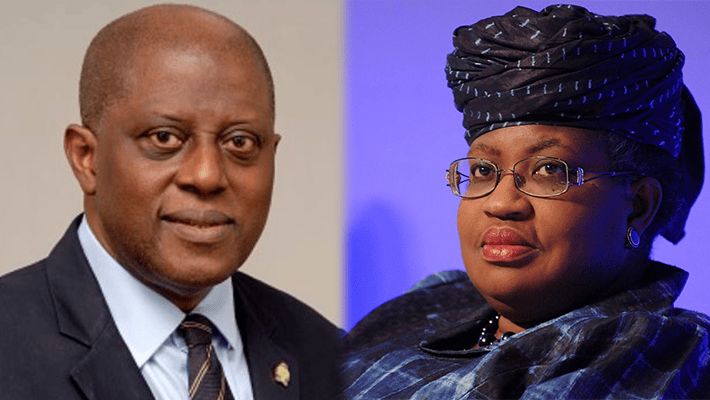
World Trade Organisation, WTO, Director-General Dr. Ngozi Okonjo-Iweala and Central Bank of Nigeria, CBN, Governor Olayemi Cardoso have agreed that Sweeping changes in the global economy create opportunities for Nigeria and other African countries to grow and develop their economies.
The two economic leaders who spoke at the Seventh Africa Emerging Market Forum in Abuja, said global economic changes should not be seen as threat to Africa but as unique opportunity for the continent to build stronger economies, create jobs and play bigger role in global trade.
According to them, the world is undergoing a major transformation driven by geopolitical tensions, changing trade patterns, technological advances and shifting investment flows.
They agreed that although these developments have created uncertainties, they have also opened windows for Africa to reposition itself by strengthening regional trade, attracting investment, building industries and improving economic governance.
Okonjo-Iweala said international economic system established after Second World War is facing its biggest test in decades, but insisted that globalisation is not ending.
She said: “What we are seeing is not the end of globalisation but its transformation from cooperative to competitive interdependence. States compete vigorously but within a global economic system they cannot afford to abandon”.
The WTO boss explained that countries are now competing more aggressively while remaining connected through trade and investment, making it even more important to preserve rules-based international cooperation.
Cardoso shared the same view, saying the question before Africa is no longer whether the global economic order is changing but how the continent can turn the changes into an advantage.
“The question is no longer whether the global order is changing, but how we turn that change from a source of vulnerability into a source of growth and shared prosperity,” the CBN governor said.
Both leaders said one of the biggest opportunities emerging from the current global uncertainty was the restructuring of international supply chains as companies seek to reduce overdependence on a few countries.
Mrs. Okonjo-Iweala said many multinational companies are looking for new production locations, creating an opening for Africa to become a preferred destination for manufacturing and industrial investment.
Warning, however, that the opportunity would not come automatically, she said: “If we can get our house in order, we are capable of attracting these supply chains. It will not fall on our lap.”
She said Africa possesses abundant critical minerals needed for electric vehicles, renewable energy technologies and other industries, but urged African countries to stop exporting raw materials without adding value.
Instead, Mrs. Okonjo-Iweala called for regional value chains that would allow African countries to process minerals into higher-value products, create jobs and increase industrial capacity.
She said: “For Africa in particular, instead of the extract-and-export model, the goal should be higher value, higher productivity growth driven by the development of sub-regional value chains.”
Cardoso also argued that Africa must move away from simply supplying raw materials to becoming a producer of finished goods and services capable of competing globally.
He said investment flowing into Africa should help create industries, transfer technology and develop local businesses rather than merely extract resources.
He said: “We must also seek foreign investment that creates jobs, transfers technology, develops local suppliers and strengthens African businesses.”
A major area of agreement between both speakers was the need for African countries to trade more with one another.
Cardoso noted that trade among African countries remains far below its potential despite the establishment of the African Continental Free Trade Area (AfCFTA).
He said Africa must remove practical barriers that continue to slow trade across borders.
“With intra-African trade still accounting for only about 16 per cent of our total trade, we must build stronger regional value chains, produce more of what we consume and trade more with one another,” Cardoso said.
He urged governments to improve transport infrastructure, harmonise customs procedures and make cross-border payments faster and cheaper.
Okonjo-Iweala described the AfCFTA as one of Africa’s most powerful economic tools.
During the fireside discussion, she urged African governments to increase trades among themselves instead of depending heavily on overseas markets.
She said: “Why can’t we move from 20 per cent trade among ourselves? Even if we could double over the next five or six years, let’s trade among ourselves.”
Both speakers also agreed that macroeconomic stability remains the foundation for sustainable economic growth.
Okonjo-Iweala praised CBN’s efforts at restoring confidence in Nigeria’s economy through monetary reforms and exchange rate stabilisation. NigerianEntrepreneur Support
She, however, stressed that monetary reforms alone would not be enough unless they translated into improvements in the lives of ordinary Nigerians.
He said the apex bank’s focus is on restoring credibility by returning to its core mandate of maintaining price stability and strengthening confidence in the financial system.
“We unified the exchange rate, restored price discovery, ended monetary financing of fiscal deficits and rebuilt the foreign exchange market around transparency and settlement integrity,” Cardoso said.
According to him, difficult policy decisions were necessary to stabilise the economy, rebuild reserves and restore investor confidence.
He said the results are beginning to emerge through lower inflationary pressure, stronger external buffers and a more resilient financial system.
Cardoso said: “We have learned one lesson: credibility is built intentionally, one right decision after another.”
Both leaders agreed that investors increasingly favour countries with transparent institutions, predictable policies and sound economic management.

