In a strategic effort to enhance security effectiveness and inter-agency collaboration, the Lagos State Security Trust Fund (LSSTF) has launched a 10-month statewide capacity-building initiative targeting more than 1,000 operatives across various security and law enforcement agencies.
Declaring the programme open, the LSSTF Executive Secretary, Dr. Ayodele Ogunsan described the initiative as a deliberate shift towards intelligence-driven, ethical, and coordinated security operations in Lagos, Nigeria’s commercial nerve centre.
According to him, the increasing complexity of modern security challenges demands not only advanced equipment but also highly trained personnel equipped with professional competence, ethical discipline, and the ability to work seamlessly across agencies.
Modern security challenges are becoming more sophisticated, dynamic, and interconnected. Addressing them requires not only equipment but well-trained personnel with the right professional skills, ethical orientation, and the ability to collaborate effectively,” Ogunsan stated.
The training programme, themed “Enhancing Professional Capacity, Ethical Standards and Inter-Agency Collaboration for Effective Security Operations,” will be implemented in phases throughout 2026, beginning with the current March session.
Ogunsan noted that the initiative is built on three core pillars—professional capacity, ethical standards, and inter-agency collaboration—which he described as essential for efficient and people-centered security delivery.
He further emphasised the importance of public trust in security operations, stating that citizens must perceive security personnel not merely as enforcers of the law, but as protectors of rights and community partners.
Highlighting Lagos’ growing population and economic significance, the LSSTF boss stressed that no single agency can independently address the state’s security challenges, underscoring the need for synergy and coordination among stakeholders.
“This programme is designed to foster mutual understanding, cooperation, and operational synergy among agencies,” he added, urging participants to actively engage and apply the knowledge gained in real-life situations.
Ogunsan also expressed appreciation to Lagos State Governor, Babajide Sanwo-Olu, for his leadership and continued support in strengthening the state’s security architecture.
The Lagos State Commissioner of Police, Olohundare Jimoh, an Assistant Inspector General (AIG), said the training would deepen cooperation among junior officers of security and paramilitary agencies, and help prevent inter-agency clashes during operations.
He emphasised that security personnel must remain accountable to citizens, warning that esprit de corps should never be used to justify misconduct or rights violations, since officers are employed primarily to protect the public.
Jimoh also revealed that new surveillance arrangements by the LSSTF were underway, including collaboration with the police air wing for aerial monitoring and plans to strengthen marine security coverage across Lagos waterways.
He also said the Fund has made plans to emplace improved maintenance systems for operational vehicles and equipment.
AIG Jimoh thanked Governor Sanwo-Olu and Dr. Ogunsan for the enormous support he received as CP Lagos, describing the various equipment and welfare interventions the government provides for security personnel and their families as remarkable.
Commander of 9 Brigade, Nigerian Army, Brig.-Gen. Ayokunle Owolabi described the programme as timely, warning that security challenges in Lagos have national implications due to the state’s economic significance.
He said no single agency could effectively address modern threats alone, stressing that improved intelligence sharing and coordinated responses remain essential to safeguarding critical national assets located in Lagos.
Owolabi noted that stronger collaboration among agencies would enhance discipline, operational effectiveness, and public confidence in security institutions.
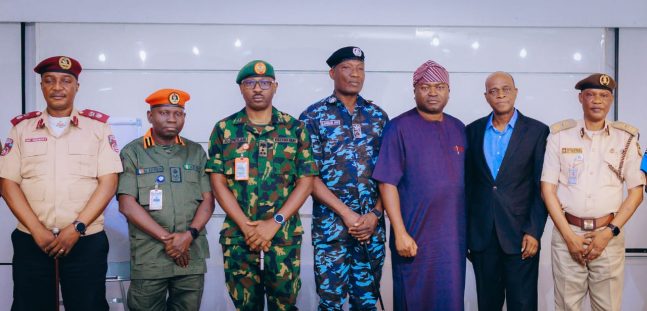
The opening ceremony attracted top security officials and stakeholders, including representatives of the LSSTF Board, senior police officers, military commanders, and heads of key paramilitary agencies.
Participants in the training were drawn from a wide range of security organisations, including the Nigeria Police Force, Nigerian Army (Operation Mesa), Nigeria Immigration Service (NIS), National Drug Law Enforcement Agency (NDLEA), Nigeria Security and Civil Defence Corps (NSCDC), Federal Road Safety Corps (FRSC), Lagos State Traffic Management Authority (LASTMA), Rapid Response Squad (RRS), Lagos Neighbourhood Safety Agency (LNSA), Marine Police, and other specialised units.
The two-day training marks one of the most comprehensive multi-agency security capacity-building efforts undertaken in Nigeria, reinforcing Lagos State’s commitment to a safer and more secure environment through professional excellence and institutional collaboration.

