
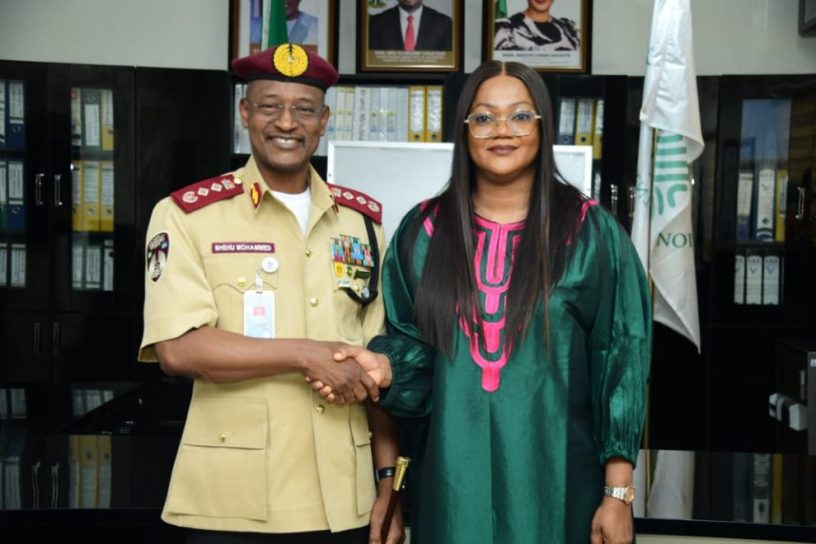
The Federal Road Safety Corps has reaffirmed its commitment to strengthening national security and road safety through enhanced data integration.
The Corps Marshal, Shehu Mohammed, reaffirmed the commitment in a statement signed by the FRSC spokesman, Olusegun Ogungbemide, on Thursday in Abuja.
Mohammed said the commitment followed a high-level engagement with the Director General of the National Identity Management Commission, Ms Adesoye Coker.
The corps marshal emphasised the urgent need for robust data harmonisation among government institutions to improve efficiency and national security.
This is to build a secured and intelligent nation where individuals can be properly identified for who they truly are.
Credible identity management remains central to effective law enforcement, crash reduction strategies, and national planning, ‘’ he said.
The corps marshal commended the remarkable strides made by National Identity Management Commission in deepening Nigeria’s identity database and strengthening the National Identification Number (NIN) ecosystem.
He reiterated the corps’ resolve to adopt and enforce the NIN as a mandatory requirement for vehicle registration and the acquisition of the National Driver’s Licence.
He described the move as a critical step toward sanitising the motoring space and enhancing traceability within the road transport sector.
Additionally, he requested the inclusion of Federal Road Safety Corps in the Commission’s Annual Identity Forum.
According to him, the corps plays a pivotal role as a frontline identity manager through its driver licensing and vehicle registration processes.
The close institutional collaboration will accelerate innovation, improve data accuracy, and enhance operational efficiency across agencies, Mohammed said.
In her remarks, Coker pledged the commission’s unwavering commitment to partner with FRSC across critical areas.
She said such area included data integration initiatives that supported crash reduction and national security objectives.
She expressed appreciation to the corps marshal for the transformation and modernisation witnessed in the corps, saying, ‘’strategic synergy between both institutions will deliver far-reaching benefits for the country.’’
The meeting marked another milestone in the Federal Government’s drive toward building a harmonised, technology driven identity architecture.
Such architecture that strengthens governance, promotes accountability, and safeguards lives on Nigerian roads.
Nigeria is moving toward a single national identity trail for motorists as road safety authorities and the national identity agency sealed a major data-sharing pact aimed at tracking drivers, reducing crashes and tightening security.
Security analysts say the reform could fundamentally alter road enforcement in Nigeria: fake licences become difficult to obtain, stolen vehicles easier to trace, traffic offenders permanently identifiable, accident investigations faster
Officials described the meeting as another step toward a unified government identity architecture one database connecting citizens, vehicles and enforcement agencies.
For motorists, the message is clear: every car, every licence and every driver may soon carry a verifiable digital footprint.
In the emerging system, anonymity on Nigerian roads is fast becoming history.

