
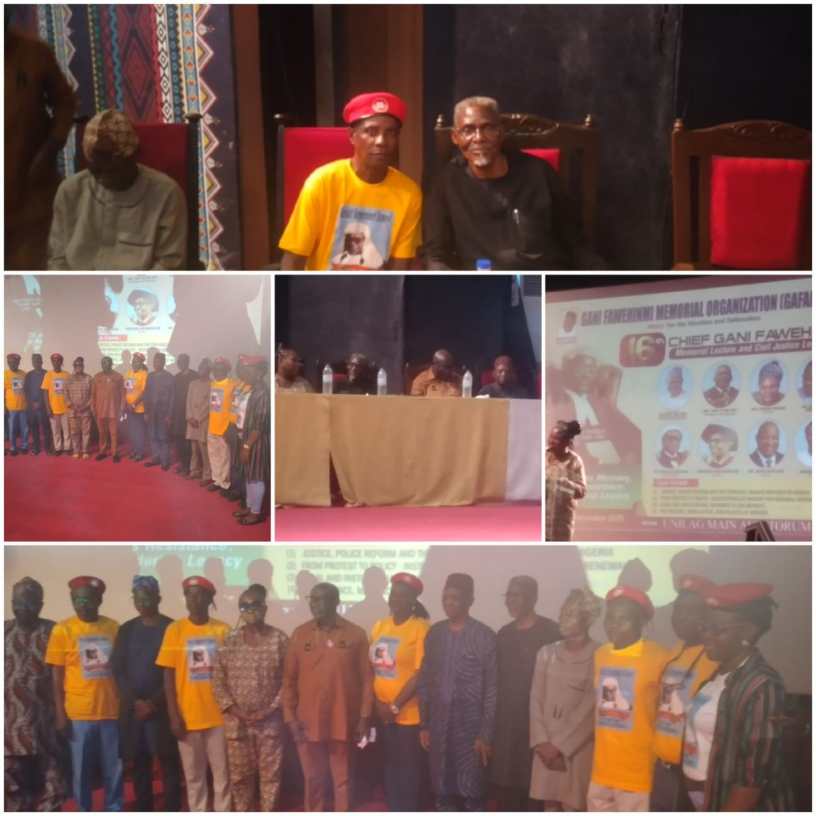
Labour Leaders, Academia, Legal Practitioners, Rights Activists, Youths, Community Leaders, Journalists, Civil Society Groups, Faith Leaders, Scholars, and International Partners have participated in 16th Chief Gani Fawehinmi Memorial Lecture alongside the national launch of a major civic accountability initiative, the Civil Justice Legacy Project, CJLP.
The lecture organised by Gani Fawehinmi Memorial Organisation, GAFAMORG, is a sweeping programme designed to strengthen accountability, protect vulnerable communities, and rebuild trust in Nigeria’s justice institutions.
GAFAMORG declares that the initiative is both a tribute to the legendary human rights advocate, Chief Gani Fawehinmi, and a direct response to Nigeria’s worsening landscape of mass killings, extrajudicial executions, mob violence and systemic failures.
At the event, GAFAMORG issued a formal Civil Justice Legacy Project Declaration, affirming that: Memory is evidence and resistance. Silence in the face of injustice is complicity. The law must serve the people, especially the weak. Citizens have both the right and duty to demand accountability.
Held under the theme “Justice as Memory, Law as Resistance – The Enduring Legacy of Chief Gani Fawehinmi,” the event transformed remembrance into a rallying point for reform, echoing the lifelong philosophy of the late Chief Gani Fawehinmi, SAN, SAM, GCON, famously known as the Senior Advocate of the Masses.
President of the Institute of Alternative Dispute Resolution Development and Conflict Management of Nigeria, Professor Akin Ibidapo-Obe described late Fawehinmi as a selfless advocate for justice.
Ibidapo-Obe said Gani devoted his life to justice, he was always there for the oppressed, whether students, workers, or those marginalised by the system. His brilliance in the courtroom inspired a generation of lawyers, including myself.
According to him, Governor Uba Sani of Kaduna State said Chief Gani was not just an advocate for justice, he lived it, gave scholarships to indigent students and shared his resources with the less privileged, even during his birthday celebrations, His legacy remains a beacon of hope for those fighting for transparency and accountability in Nigeria.
Reflecting on Chief Fawehinmi’s contributions to Nigeria’s legal and political systems, first daughter of the late activist, Bashirat Fawehinmi-Biobaku, highlighted his role in advocating for the accountability of governors through investigations despite their immunity from prosecution.
She said the ideals that Chief Gani stood for justice, fairness, and accountability are more relevant today than ever. It is up to us to ensure they remain a guiding light for our democracy.
Speaking on behalf of the organisation, GAFAMORG Governing Council Chairman, Comrade Babatunde Agunbiade, said the initiative aims to place justice, memory and citizen power at the centre of public life at a time Nigeria faces deepening concerns over impunity, mass killings and declining public trust in state institutions.
Agunbiade said Nigeria is currently dealing with a grave crisis of unchecked violence, noting that daily killings, extrajudicial executions and systemic failures have devastated communities and eroded confidence in state institutions.
According to him, Nigeria is grieving too many preventable deaths, saying Impunity for mass killings, extrajudicial executions, mob violence and institutional failure has eroded public trust and devastated communities.
He described the Civil Justice Legacy Project as a long-term, citizen-led platform designed to strengthen accountability mechanisms and protect the vulnerable.
Agunbiade said Nigeria is grieving too many preventable deaths and that public institutions have failed to respond adequately to widespread extrajudicial killings, mob violence and institutional negligence.
In one of the most significant proposals unveiled, GAFAMORG formally declared September 5 as the National Civil Day of Remembrance for Victims of Mass Killings, Extrajudicial Killings, Mob Actions and Impunity.
The organisation called on federal and state governments, civil society groups, religious leaders, the private sector and the media to adopt and observe the date nationwide.
Key proposals for the annual observance include, official government endorsement of 5 September as a national day of remembrance, and one-minute silence at noon every 5 September.
Others are wearing an Emblem of Remembrance, which GAFAMORG will distribute, and nationwide activities highlighting solutions to mass violence and justice reform.
“This is not only an act of memory, it is an act of accountability,” the statement read. “To never forget, to demand justice, and to end the atrocious killings that plague our communities.”
As part of the CJLP, GAFAMORG said it will publish a Roll of Honour documenting victims of mass killings, extrajudicial executions and mob violence.
A partial unveiling will be shared with accredited editors in a closed briefing.
The organisation said each entry is carefully verified and subject to consent and privacy protocols.
“The Roll is a humanitarian and legal record aimed at securing accountability and reparative remedy, not a political instrument,” GAFAMORG stressed, urging journalists to report responsibly and safeguard victims’ dignity.
GAFAMORG urged federal and state governments to support the CJLP and adopt the National Civil Day of Remembrance.
It also called on judicial and security agencies to engage with the project’s research and data-gathering mechanisms.
The organisation encouraged civil society groups and the media to expand investigative reporting, protect sources and amplify verified evidence.
It asked donors, foundations and corporate partners to fund the project’s technology development, legal literacy initiatives and fellowship programme.
The organisation said a full list of partners will be released at the 18 December event.
It noted that this year’s memorial lecture will bring together senior jurists, human rights activists and scholars.
Speakers painted a stark picture of a country grappling with mass killings, extrajudicial executions, mob violence, enforced disappearances and abductions—often without truth, justice or consequences.
From terrorised villages to overcrowded detention centres and communities emptied by violence, the lecture underscored the erosion of public trust in institutions meant to protect citizens.
It was against this backdrop that GAFAMORG formally unveiled the Civil Justice Legacy Project, positioning it not as a symbolic initiative but as a structured, evidence-driven intervention.
According to the organisers, CILP is designed as a national accountability architecture rooted in law, civic participation and ethical documentation. Key components include:
The Civil Justice Roll of Honour: a dignified, verified memorial record of victims of mass killings, extrajudicial executions, mob violence, enforced disappearances and mass abductions. Organisers stressed that naming victims is not revenge but recognition and a foundation for redress.
The Civil Justice Tracker (CJT): a digital platform aggregating citizen reports, investigative findings and official records into a searchable, verifiable evidence base.
The Citizen Auditor Network (CAN): trained civic monitors deployed to police stations, courts, detention centres and public agencies to gather structured, ethical data.
The Gani Fawehinmi Youth Civil Fellowship: a national pipeline to train young public-interest lawyers, journalists and civic technologists.
Accessible Law Initiative: translation and simplification of the Administration of Criminal Justice Act (ACJA) into major Nigerian languages and multimedia formats.
Central to the project is the operational use of the Freedom of Information Act (FOIA). Agunbiade described FOIA as “the torch that will pierce institutional darkness,” enabling access to detention registers, use-of-force logs, internal investigation files, court statistics and budgetary records.
Kaduna and Lagos states were announced as pilot locations. Kaduna represents conflict-affected accountability challenges, while Lagos offers the complexity of urban justice systems and digital scale. Lessons from both, organisers said, will inform national expansion.
CILP also issued a broad call to journalists, lawyers, faith leaders, donors, students and citizens to move “from outrage to organisation,” while urging governments at all levels to cooperate with FOIA requests, publish data and endorse 5 September as a National Civil Day of Remembrance.
The declaration emphasised that CILP is non-partisan, non-violent and reform-oriented, rejecting vengeance in favour of lawful accountability.
The Civil Justice Roll of Honour, unveiled symbolically at the venue, categorised victims of violence and injustice, including mass killings, extrajudicial killings, mob actions, enforced disappearances, displacement and iconic national cases.
Symbolic references included Ken Saro-Wiwa, Kudirat Abiola, Dele Giwa, the EndSARS/Lekki Toll Gate victims and Deborah Samuel Yakubu, among others.
A moving tribute titled “Remembering Gani Fawehinmi: My Mentor, My Hero” was delivered on behalf of Kaduna State Governor, Senator Uba Sani, recounting his personal journey under Fawehinmi’s mentorship during the military era.
The tribute highlighted Fawehinmi’s pan-Nigerian vision, sacrifices, repeated imprisonments, leadership in pro-democracy coalitions, landmark court victories expanding political space, and his nationwide scholarship scheme that empowered over a thousand indigent students.
“He taught us that democracy is not merely the absence of dictatorship,” the governor noted, “but the presence of justice, accountability and inclusivity.”
As the event concluded, organisers stressed that the memorial lecture must go beyond ritual.
“We will record. We will request. We will report. We will litigate. We will teach. We will remember,” Agunbiade declared. “If we are faithful to this work, one day ‘mass killing’ will belong in history books, not daily headlines.”
The 16th Gani Fawehinmi Memorial Lecture thus ended not only as a commemoration, but as the launchpad of a national movement—one determined to make justice visible, law meaningful, and memory a force capable of changing institutions.

