
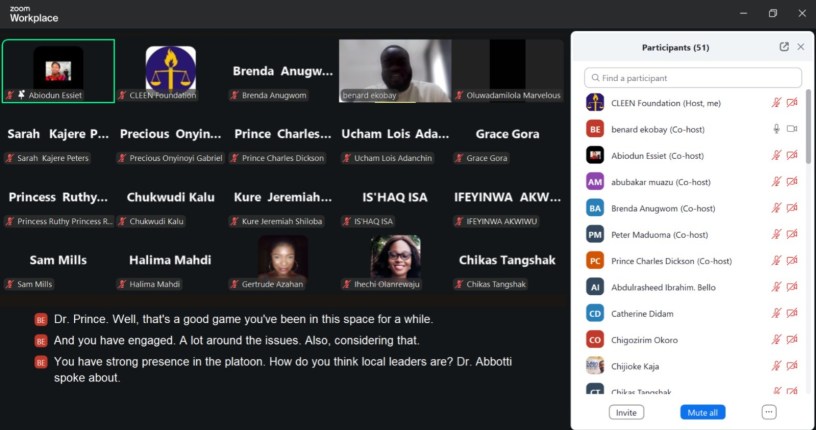
As the world marked the 2025 International Day of Peace, the CLEEN Foundation has stressed that the path to national stability lies in empowering communities to resolve conflicts and strengthen dialogue.
The International Day of Peace, themed; Act Now for a Peaceful World locally adapted as Community First: Local Solutions for a Peaceful Nigeria, is commemorated beyond rhetoric, spotlighting the lived realities of citizens caught in the crossfire of banditry, terrorism, communal clashes, and economic displacement.
Acting Executive Director of CLEEN Foundation, Peter Maduoma, said peace in Nigeria is no longer an abstract ideal but an urgent necessity.
Speaking at a webinar organised to mark the day, he painted a grim picture of how insecurity has torn through rural life, forcing mass migrations into already overstretched cities.
Maduoma lamented that it used to be that people retired to their villages for rest and safety, but that is no longer the case as Communities have become unsafe.
According to him, the collapse of peace in rural areas has driven people into ghettos and urban slums, worsening poverty, crime, and social vices.
Maduoma argued that restoring peace to Nigeria’s grassroots is not only a moral duty but an existential one, saying the absence of security in farming communities, has worsened the country’s food crisis, raising the cost of living and fuelling further resentment.
In his words; Peace is everyone’s responsibility, saying if the Nation fail to return peace to the communities, the ripple effects will continue to destabilise the nation.
The session also amplified the voices of women, who often bear the brunt of conflict.
Women’s Rights Advocate, Brenda Anugwom, described peace from a gendered lens, saying to a woman, peace means freedom, freedom to be herself, to express herself, to raise her family without fear, when that freedom is stripped away, society loses not just her contribution but its resilience.
Anugwom identified four pillars for a peaceful Nigeria: inclusive governance, culturally grounded strategies, locally driven solutions, and stronger institutions.
Citing examples from the Central African Republic and South Sudan, she warned that when communities feel excluded, instability festers.
Nobody should feel left out. Representation matters. Good governance matters. Accountability matters,” she said.
She also urged Nigeria to look inward, not outward, for solutions: “Most times, we seek answers from outside. But peace can only be built from within. Traditional rulers, religious leaders, and women must be central to conflict resolution.”
The conversation also resonated with government officials. Abiodun Essiet, Senior Special Assistant to the President on Community Engagement (North Central), acknowledged that Nigeria’s ethnic diversity, while a strength, has also been a fault line for division in her region.
In North Central, our diversity has often deepened insecurity instead of fostering cohesion,” Essiet said.
She disclosed that the Presidency is set to launch a Community Engagement Peace Initiative across 121 local governments in the zone.
The initiative, she explained, will decentralise peacebuilding by creating structures at ward level, allowing affected groups to resolve disputes directly rather than waiting for state-level interventions.
Too often, those who suffer most from violence are not at the table when decisions are made, she noted.
By taking peace dialogues down to the grassroots, we can give voice to the voiceless and rebuild trust where it has broken down.”
The webinar reflected a sobering truth: Nigeria’s peace is fragile, but it is not beyond repair. What stood out was not only the call for policy reforms but the insistence that ordinary citizens, women’s groups, traditional rulers, and youth leaders are already charting new ways to coexist.
In a country where headlines are dominated by violence, the gathering was a reminder that the quest for peace does not belong to government alone.
It begins in the everyday choices of communities, in dialogue instead of revenge, in inclusion instead of exclusion, and in resilience instead of despair.

