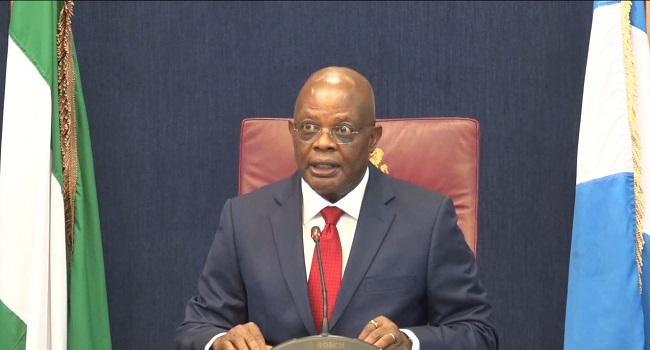
The Ad-Hoc Committee of the House of Representatives on Rivers State has summoned the Sole Administrator of the state, retired Vice Admiral Ibok-Ete Ibas.
The committee directed Ibas to appear before it for a “comprehensive interactive session” on Thursday, 17th April 2025, at the National Assembly Complex, Abuja.
According to a statement by Reps spokesman Akin Rotimi, the session would provide a platform for members of the committee to deliberate on preliminary reports and developments emerging from Rivers State since the sole administrator assumed office.
Chairman of the Committee and House Leader, Julius Ihonvbere, said this engagement is necessary to ascertain the true state of affairs in Rivers State and ensure the House remains properly guided in the discharge of its oversight responsibilities in the public interest.
The committee said a formal letter of invitation has been sent and acknowledged by the retired naval chief.
On March 18, 2025, President Bola Tinubu imposed an emergency rule on oil-rich Rivers State and suspended Governor Siminalayi Fubara; his deputy Ngozi Odu; and all the members of the House of Assembly for six months.
The president immediately nominated Ibas as administrator to take charge of the affairs of the state for the first six months.
The president relied on Section 305 of the 1999 Constitution to make the proclamation.
The section interprets a state of emergency as a situation of national danger, disaster or terrorist attacks in which a government suspends normal constitutional procedures to regain control.
In about 48 hours, the National Assembly ratified the president’s emergency rule decision despite stiff opposition to the move.
The suspension of Fubara and other democratically elected representatives was expressly rejected and condemned by many eminent Nigerians, legal luminaries, and groups including Atiku Abubakar, Peter Obi, Rotimi Amaechi, Atedo Peterside, Nasir El-Rufai, Femi Falana, the Labour Party (LP), the Peoples Democratic Party (PDP), the Nigerian Bar Association, the Pan Niger Delta Forum (PANDEF), among others.
The last time a president declared an emergency rule in Nigeria was on May 14, 2013, when Goodluck Jonathan imposed it on the entire northeast insurgent-ridden states of Borno, Yobe, and Adamawa.
Women on Wednesday thronged major streets in Port Harcourt to protest against the imposition of emergency rule in Rivers State.
Under the aegis of the Rivers Women Unite Prayer Group, the protesters kicked against the suspension of Siminalayi Fubara as governor.
They chanted slogans and demanded an end to what they perceive as an “unconstitutional state of affairs” in Rivers.
The protesters wore red attires and held placards bearing inscriptions like ‘We have conscience’, Bring Back Governor Fubara’, ‘We are gagged’, ‘Rivers state economy suffers under Ibas’, ‘NBA have conscience’, among others.
Monday’s protest is coming on the heels of last week’s women’s demonstration in favour of Governor Siminalayi Fubara, who was suspended by Tinubu owing to the political crisis in the state.
Last month, President Bola Tinubu declared a state of emergency in Rivers State, owing to the unending political crisis in the state. He suspended Governor Fubara, his deputy, Ngozi Odu, and the members of the House of Assembly for six months.
Citing “security reports,” in the wake of two pipeline explosions in the state, Tinubu said the declaration of a state of emergency was “inevitably compelling”.
“By this declaration,” Tinubu said, “the Governor of Rivers State, Siminalayi Fubara, his deputy, Ngozi Odu, and all elected members of the House of Assembly of Rivers State are hereby suspended for an initial period of six months.
He appointed Ibas to supervise the affairs of the state pending the resolution of the crisis in a move that has continued to sharply divide opinions across the country.
But on Monday, the women protesters backed the president, describing his action as constitutional.
The governors of the main opposition People’s Democratic Party (PDP), have, however, rejected the declaration and have headed to the court to challenge the imposition.

