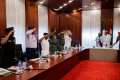

The Federal Executive Council, has approved ten point two-nine-nine billion naira for the procurement of essential medical commodities, including diabetes diagnostic kits, antiretroviral drugs for HIV/AIDS patients, antibiotics, and hypertensive medications.
The Council says the move aligns with President Bola Tinubu’s commitment to improving healthcare accessibility and affordability for Nigerians.
Coordinating Minister of Health and Social Welfare, Prof. Ali Pate, announced the approvals while addressing journalists at the State House, after the Council meeting, presided over by the President Tinubu.
According to Pate, the intervention targets critical areas of healthcare, ensuring Nigerians particularly the poor and vulnerable can access essential medications and diagnostic tools.
The approved funds cover various medical supplies and hospital equipment, including:
₦997 million for third-line antiretroviral drugs to treat HIV/AIDS patients who have developed resistance to first- and second-line treatments.
₦2 billion for the procurement of locally manufactured diabetes diagnostic kits to improve early detection and monitoring of the disease.
₦4.5 billion for essential antibiotics, antihypertensive, and antidiabetic medications, ensuring affordability for Nigerians.
₦2.1 billion for the procurement of a mobile X-ray machine, rehabilitation of a computerized tomography (CT) scan, and installation of a 64-slice CT scanner at Abubakar Tafawa Balewa University Teaching Hospital in Bauchi.
A significant aspect of the FEC’s decision is the government’s support for local manufacturers.
The diabetes diagnostic kits, which will be procured using part of the ₦2 billion allocation, will be sourced from a Lagos-based Nigerian company, making it one of the first in Africa to produce such medical equipment locally.
“Diabetes is a major health challenge in our country, with many Nigerians unaware they have the condition. For the first time, a local company in Nigeria will manufacture diagnostic test kits, bringing to life the effort to unlock the healthcare value chain”, Pate explained.
The government will also procure Onpoint blood glucose monitoring systems alongside diagnostic kits, ensuring that diabetes patients can consistently monitor their condition.
Pate emphasised that health workers across primary healthcare centers and other medical facilities would be trained to use these kits.
In addition to diagnostic tools, the ₦4.5 billion approved for antibiotics, antihypertensives, and antidiabetic medications will help reduce costs for patients.
The minister noted that these medications would be sourced from local manufacturers, strengthening Nigeria’s pharmaceutical industry.
“We are pooling demand and prioritizing our local manufacturers to reduce costs while ensuring that Nigerians have access to essential medicines,” Pate stated.
The FEC also approved ₦2.1 billion for Abubakar Tafawa Balewa University Teaching Hospital in Bauchi to improve its diagnostic capabilities.
The funds will cover the procurement of a mobile X-ray machine to enhance radiology services and the rehabilitation and equipping of a CT scan facility.
It will also include the installation of a 64-slice CT scanner, ensuring high-quality imaging services.
Pate highlighted the hospital’s regional importance, serving not just Bauchi State but also neighboring states.
“The diagnostic services and clinical care at this hospital will be of the highest quality, strengthening its role as a key referral center,” he said.
The approvals are part of President Tinubu’s broader vision for healthcare reform.
According to Pate, the administration is working “relentlessly” to enhance Nigeria’s healthcare system, ensuring that policies translate into tangible improvements for citizens.
“These interventions are in line with our transformation agenda for the Nigerian health sector. We are executing them with urgency and efficiency to deliver results”, he affirmed.

