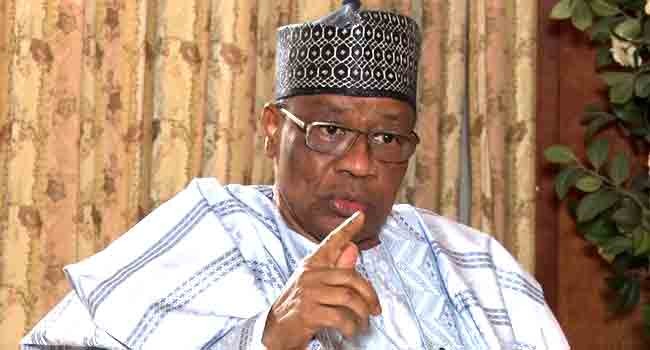
Former Military President, General Ibrahim Badamasi Babangida, IBB, has finally opened up on the nation’s adjudged freest and fairest June 12 election.
Babangida says the annulment of the June 12, 1993, presidential election was for “national interest”.
IBB, as he is fondly called, was the military president during that election which was widely believed to have been won by Moshood Abiola. The election was annulled without the announcement of a winner.
But 32 years after the election, Babangida said he acted to protect the country’s interest. He said this in Abuja on Thursday during the launch of his autobiography “A Journey in Service”.
“As the leader of the military administration, I accept full responsibility for all decisions taken by me. And June 12 happened under my watch. Mistakes, oversights, and missteps happen in quick succession but I say in my book, in all matters, we acted in extreme national interest so that Nigeria could survive,” the former military president told the gathering.
Babangida regretted the annulment of the poll which he said interrupted the return to democratic leadership.
“Our nation’s march to democracy was interrupted, a fact that I deeply regret. But Nigeria survived and democracy is still alive, a testament to our resilience and commitment to progress. This book is part of my personal story with national history,” Babangida added.
The 1993 presidential election which many observers have adjudged as the most credible election in Nigeria’s history has continued to dominate discussions in Nigeria.
Abiola was believed to have won the exercise. Calls for the then-Social Democratic Party (SDP) candidate to be declared as the winner of the poll have continued over the years.
To honour Abiola, former President Muhammadu Buhari in 2018 shifted Democracy Day from May 29 to June 12.
But on Thursday, ex-Vice President Yemi Osibanjo who reviewed IBB’s book made a striking revelation.
“Although I am on record to have stated after the election that Abiola may not have won the election, upon further reflection, and a closer examination of all available facts, particularly the detailed election results which are published as an appendix to this book, there was no doubt that MKO Abiola won the June 12 elections,” Babangida wrote in the 420-page memoir.
Thursday’s event was attended by former presidents, governors – past and present – captains of industry, and other top shots within and outside Nigeria.
The former maximum leader noted in the book that he was away in Katsina to commiserate with the Yar’Adua family over the death of Alhaji Musa Yar’Adua, only for the him to be informed the June 12 election had been annulled.
In the book, Babangida admitted that the annulment of the election was contained in “a terse, poorly worded statement from a scrap of paper, which bore neither the presidential seal nor the official letterhead of the government, annulling the June 12 presidential election.”
Exonerating himself from the annulment, Babangida on page 275 of his book admitted that the annulment was only a component of a series of other options.
According to him: “But to suddenly have an announcement made without my authority was to put it mildly, alarming.
“I remember saying: ‘These nefarious inside forces opposed to the elections have outflanked me! I would later find out that the ‘forces’ led by General Sani Abacha annulled the elections.
“There and then, I knew I was caught up between ‘the devil and the deep blue sea’!! From then on, the June 12 elections took on a painful twist for which, as I will show later, I regrettably take responsibility.”
Babangida also regretted in the book how the fallout of the annulment of June 13 divided the military hierarchy in 1993.
On page 276 of his book, Babangida said: “Within the military leadership, there was palpable outrage. The best of us, like Lt. General Salihu Ibrahim and Major General Ishola Williams were alarmed and Colonel Abubakar Dangiwa Umar threatened to resign.
“Even Admiral Aikhomu, whose press secretary, Irabor, had announced the annulment , was horrified. The public vilified me. Instigated, among other things, by elements within the Armed Forces, the Nigerian press called me all kinds of names and described me as a power-drunk dictator who desperately wanted to cling to power.”

