
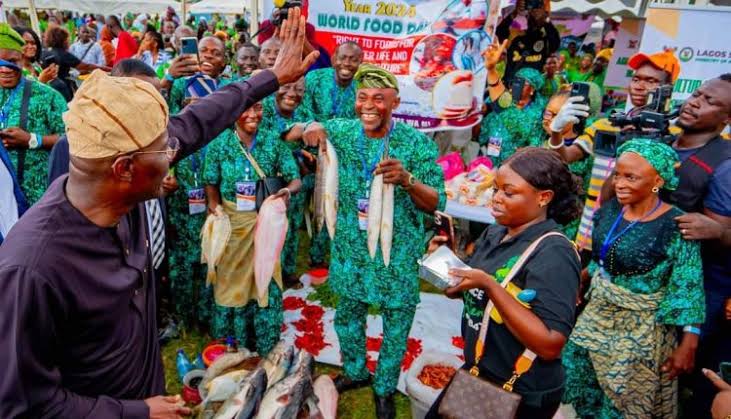
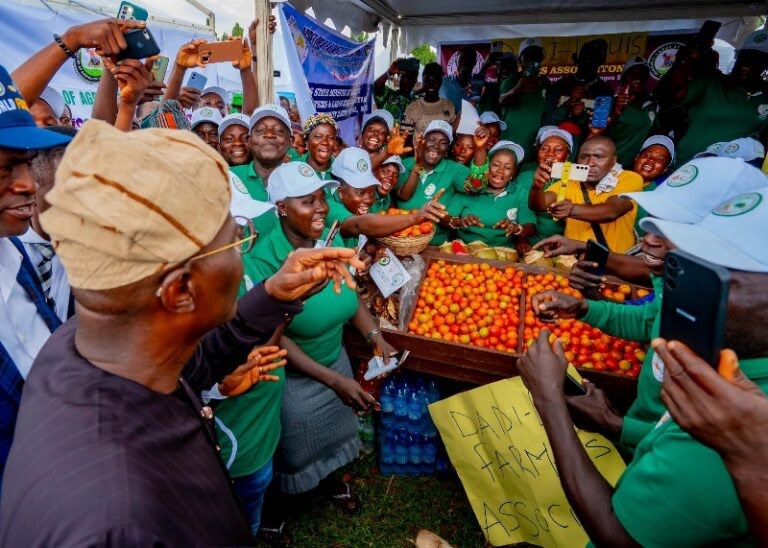
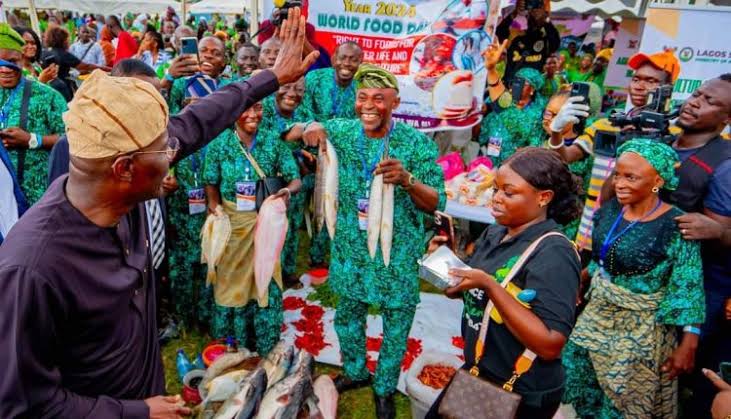
About twenty local government councils, Farmers, Food Manufacturers and other private sectors have showcased their farm produce at the 2024 Lagos Farm Fair to commemorate World Food Day.
The fair, according to our correspondent Babajide Alli-Balogun is organised by the Lagos State Ministry of Agriculture and Food Systems with partnership from British American Tobacco Nigeria Foundation.

Alimosho, Ifelodun, Agege, Apapa, Lagos Mainland, Apapa-Iganmu, Lagos Island, Onigbongbo, Ikorodu, Badagry, Epe, Ojodu, Kosofe, Coker-Aguda, Mosan-Okunola, Ijede, Isolo Farmers are among the local government councils that showcased their farm produce.
This year’s theme, ‘Right to Food for a Better Life and a Better Future’, emphasises the urgent need for innovative solutions to combat food insecurity, particularly through local initiatives and sustainable agriculture that promote self-sufficiency.
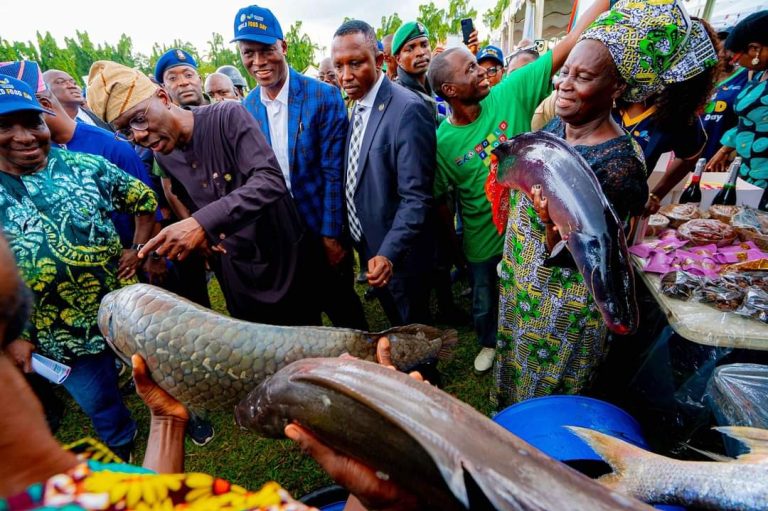
Speaking at the grand finale of the 2024 World Food Day celebration at the Police College in Ikeja, Governor Babajide Sanwo-Olu said the event is to encourage all the farmers in the state managing to wriggle out of the current global food crisis as farming is important to his administration to ensure food is affordable and accessible to all.
Sanwo-Olu pledged his administration’s commitment to a more secure, stable food supply chain and sustainability to address the emerging threats of food insecurity and wastages.
He reaffirmed his commitment to continue to invest in agriculture and partner relevant stakeholders to find a lasting solution to the problem of food insecurity.
Governor Sanwo-Olu, announced his administration’s substantial investments in the agriculture sector, aiming to establish it as a cornerstone of the state’s economy.
The governor emphasised the intentionality behind the state government’s agricultural policies.
To align with the objectives, Sanwo-Olu revealed plans to rebrand the Ministry of Agriculture as the Ministry of Agriculture and Food Systems.
According to him, the change will enable the government to focus on food systems management, enhance agricultural mechanisation, improve food safety standards, and ultimately lower food prices.
In his words, they are actively pursuing a Food Systems Transformation Agenda designed to create a resilient and secure food ecosystem in Lagos.
He said the initiative will address post-harvest losses, alleviate traffic congestion around food markets, and boost state revenues, saying a significant project within this agenda is the Lagos Central Food Security System and Logistics Hub at Ketu-Ereyun, which they aim to complete by December 2024.
Sanwo-Olu also highlighted the successful establishment of the Lagos Rice Mill in Imota, which operates at 32 tons per hour and has the capacity to produce 2.4 million bags of rice annually.
This initiative is expected to reduce reliance on imported rice while generating over 250,000 direct and indirect jobs, thus contributing to economic growth.
In a bid to modernise farming practices, he said his administration introduced the Eko Agro Mechanisation Programme, integrating technology into agriculture.
Sanwo-Olu said partnerships with the private sector ensure farmers across the state have access to necessary mechanization services, adding that to date, over 100,000 women and youth have been trained in various agricultural value chains, receiving support in inputs, infrastructure, and equipment.
The governor also noted the significance of the Lagos Agricultural Scholars Programme, which aims to inspire secondary school students to pursue agriculture by equipping them with sustainable farming skills.
Additionally, he disclosed that the Cattle Feedlot Project at Igbodu is poised to cut cattle imports into Lagos by 50% over the next five years, promoting the availability of locally sourced, disease-free beef for residents.
Sanwo-Olu stressed that the Lagos Aquaculture Centre of Excellence (LACE) is pivotal in fostering growth within the aquaculture sector, addressing the increasing demand for fish while boosting the state’s economy.
He also mentioned ongoing collaborations with the World Bank on projects such as the Agro-Processing, Productivity Enhancement, and Livelihood Improvement Support Project (APPEALS) and Lagos CARES, which are enhancing infrastructure, improving market access, and minimizing post-harvest losses for thousands of households.
“Under the Produce for Lagos initiative, we are identifying production clusters to amplify local food production. We are committed to supporting poultry farmers and vegetable growers by providing essential resources to enhance their yields,” he said.
In his welcome address, Special Adviser to the Governor on Agriculture and Food Systems, Dr. Oluwarotimi Fashola, acknowledged the significance of the event when the nation is facing critical food security issues and requires urgent actions to scale up food production across the various value chains.
Fashola outlined strategies to encourage youth participation, stimulate private sector investment, attract donor funding for agricultural projects, and create new partnerships across the agricultural value chain, focusing on areas where Lagos has competitive and comparative advantages.
He however commended the Lagos State Government’s continued efforts toward food security, emphasising the need for unified and intensified actions to build more sustainable food systems.
He reinforced the ministry’s dedication to ensuring all citizens have access to sufficient, safe, and nutritious food, crucial for active and healthy living.
Fashola pointed out that poor nutrition, particularly a lack of fruits, vegetables, and essential vitamins and minerals, is a leading cause of immune deficiencies worldwide.
To combat this, he said the Ministry and its agencies are committed to training and retraining both existing and aspiring farmers, fostering sustained growth in the sector and increasing its contributions to the state’s GDP in alignment with the THEMES+ Agenda of the Governor.
In her remarks, A Board Member of the British American Tobacco Nigeria Foundation, Odiri Erewa-Meggison, highlighted the importance of scaling food production and processing, reducing food waste, and providing decent livelihoods for Lagosians.
Erewa-Meggison who stressed that Food security is crucial in bringing families together, also noted that food is an integral part of Nigerian society and the cultural heritage of the people.
According to her, it aims to improve human living conditions through a healthy diet and promote action against hunger in the state and this year’s fair has been able to support over 600 individuals.
She also gave stewardship of the achievement of BATN Foundation in the installation of 100 solar-powered borehole facilities, 20,000-liter capacity.
In her words; there were over 300,000 beneficiaries and irrigation kits provided for smallholder farmers on over 500 acres of land to support dry season farming and boost their income, all achieved in five years.
She noted that the Foundation, since its inception in 2002, has supported the federal and state governments in agricultural development programmes.
According to her, It has invested over N2 billion to support rural smallholder farmers in the production of food crops, like cassava, rice, and maize; and in aquaculture and livestock.
She said they have reached over 1.3 million beneficiaries. We expect to double that in the next 10 years through increased support to smallholder farmers across the 36 states of the federation and the FCT.
The BATN representative noted the inclusion of the flag off distribution of 40 smoking kilns to fish farmers in Lagos state, saying the farmers have gone through capacity building training across 4 local governments in Lagos state.
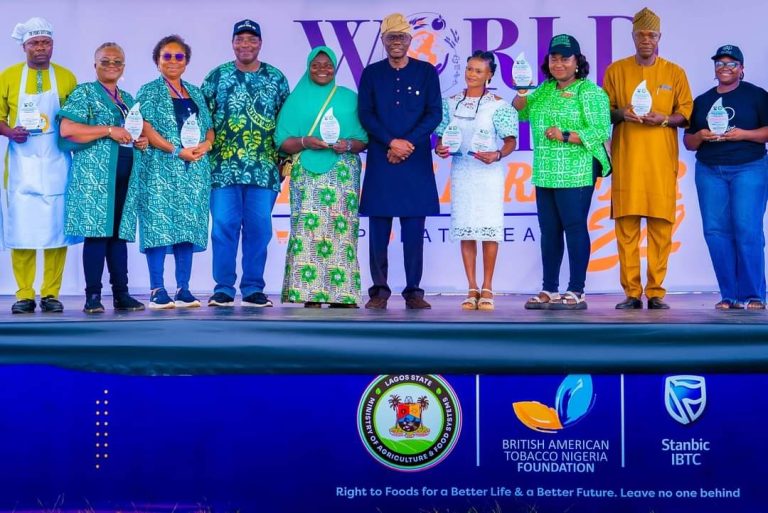
Highlight of the event was the presentation of awards to the outstanding stakeholders by the governor where the Apapa Local government won the Best LGA, while Best Crop Farmer went to Miss Olaitan Olagunju. Erikorodo Poultry Estate received double honours with Best Farm Estate and Best Livestock Farmer.
Others include: Best Fish Farmer: Epe Local government
Best Artisanal Farmer: Apapa LGA
Best Agro Processor: Bennis Delight
Overall Best Farmer: Miss Olaitan Olagunju
Best Farm Settlement: CDS/NDE Agbowa
Best Forester: Apoti-Eko
World Food Day is celebrated on October 16 every year as set aside by Food and Agriculture Organisation of the United Nations.
Every year, World Food Day is celebrated across the world on October 16, highlighting the global campaigns to end hunger and make sure that every individual has access to nutritious food.
The Food and Agriculture Organisation started this global event to start a fight against hunger, raise awareness about healthy diets, and promote action against malnutrition and food security.
The objective of World Food Day is to eradicate hunger, ensure food security, boost agricultural productivity and support a sustainable food system.
It is a global initiative bringing governments, organisations and individuals to tackle the pressing issue of hunger and malnutrition.
The Food and Agriculture Organisation (FAO) came into existence in 1945 and World Food Day came into existence in 1979 when the 20th FAO Conference declared October 16 as World Food Day.
Over 150 countries join the movement, observing this day to raise awareness about hunger, malnutrition, and food-promoting sustainable solutions for a zero-hunger world.

