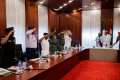

CHINA, NIGERIA TO STRENGTHEN TIES.
President Xi Jinping has declared his readiness to work closely with President Bola Tinubu to fully unleash the exemplary roles of China-Nigeria diplomatic friendship and advance China-Africa cooperation.
This was disclosed during their meeting at the Great Hall in Beijing, where Tinubu was on a state visit at Xi’s invitation.
The meeting precedes the 2024 summit of the Forum on China-Africa Cooperation (FOCAC) scheduled for 4th to 6th September in Beijing.
Xi stated that since establishing diplomatic ties half a century ago, China and Nigeria have treated each other with mutual understanding, seeking collective strength, unity, and win-win cooperation.
Xi proposed elevating bilateral ties to a comprehensive strategic partnership, citing the upcoming FOCAC summit as an opportunity to advance China-Africa relations.
He expressed readiness to work with Tinubu to fully unleash the exemplary role of China-Nigeria cooperation.
Tinubu expressed appreciation for the invitation, noting that the visit marked his second to China, first as governor of Lagos and now as president.
He acknowledged the long-standing China-Nigeria relations and the potential for strengthened trade and economic development.
The meeting culminated in the signing of a Memorandum of Understanding (MoU) on Belt and Road Initiative projects, news exchange cooperation, and television cooperation, among others.
President Tinubu was accompanied by Minister of Foreign Affairs Yusuf Tuggar, Sen. Uba Sani, Governor of Kaduna, and Gov. AbdulRahman AbdulRasaq of Kwara, among others.
================================
FEDERAL GOVERNMENT, CHINESE COMPANY SIGN TWO MOU ON RENEWABLE ENERGY.
The Federal Government has signed two Memorandum of Understanding, MoUs, with a Chinese Company, Mutual Commitment Company, MCC, limited on renewable energy.
The MoUs were facilitated and signed in Beijing at the African-China Co-operation Summit by the Rural Electrification Agency (REA), an agency of the Ministry of Power.
This is contained in a statement issued by Mr Bolaji Tunji, Special Adviser on Strategic Communication and Media Relations to the Minister of Power in Abuja.
The Minister of Power, Adebayo Adelabu and the Managing Director of REA, Abba Aliyu were present at the ceremony.
Speaking at the event, Adelabu said the MoUs signing were important and would go down as a memorable day for Nigeria.
He congratulated the REA and the National Power Training Institute of Nigeria (NAPTIN) for the achievement.
”The MoU will go a long way towards achieving Nigeria’s vision for the renewable energy sub sector of the electricity sector value chain.
”I know Nigeria and China have lots of things in common, one of which is the high population of both countries.
”And countries with high population, have so much pressure. The first pressure is that of energy access and the second, is job creation.
”So when you take steps to achieve both, it is a thing of joy.
”I am particularly happy that this is happening during the tenure of President Bola Tinubu, as it is in line with achieving the Renewed Hope Agenda of the administration for the country, ”he said.
The minister reiterated that President Tinubu had prioritised the power sector as the driver of all other critical sectors of the economy and giving all the support to ensure that he delivered on his electoral promises.
He noted that energy access and expansion was government’s major priority because nothing could be achieved without strong, stable, functional and reliable electricity sector.
”We have relied so much on centralisation of our power sector for so long that it is not taking us anywhere, as almost 40 per cent of Nigeria’s population lack access to energy with its attendant consequences.
”So moving away from centralisation, we have decided to adopt the distributed power model to ensure that every Nigerian has access to energy.
”A lot of our population resides in the rural areas, a lot of our institutions-educational and tertiary health institutions are isolated and they are still facing epileptic power supply,” he said.
Adelabu said the federal government also found out that the adoption of distributed energy model would expand the energy net for Nigeria’s rural dwellers, the rural businesses, universities and tertiary health institutions.
He said this was the reason the focus was now on renewable energy which is believed to be scalable and could exist in isolation of national grid that was currently facing lots of pressure.
According to him, as Nigeria continues to expand energy access, the country also wants to achieve transition to cleaner sources of energy that are sustainable and environment-friendly.
”Which is why we have both long-term and medium -term target to achieving net zero carbon emission by year 2060 and also to enable us achieve 30 per cent of our energy generation coming from renewable energy by year 2030.
”So renewable energy is currently a major focus for us in the power sector,” he said.
He added that the two MoUs would achieve the vision for the renewable energy sub segment of the power sector.
”A step like today’s, will enable us move up on our level of electrification. This will consequently lead to growth in our Gross Domestic Product (GDP) because of the economic activities that will be created.
”This will also save us foreign exchange expenditure on importation and create jobs for our people, if we assemble these things locally,” he further said.
Speaking earlier, the managing director of REA reiterated the importance of the ceremony as it was capable of delivering on the presidential mandate of building local capacity and creating more job opportunities.
Aliyu said the REA would track the MoUs and ensure the delivery of the commitment within the tenure of the present administration.
”We will also track the economic factor that this initiative will drive, the level of GDP contribution, the employment opportunities provided and the socio-economic activities that will crystallise,” he said.
Aliyu also said the MCC was presently engaged in Nigeria with the construction of 12mw and 3mw power plants in Maiduguri and Kaduna, respectively.
In the same vein, the Vice Chairman of MCC, Yan Zhezhu expressed appreciation on the power minister’s commitment to Nigeria’s energy growth.
”We are not new to Nigeria, having started in Oyo State a long time ago. Presently, we have ongoing projects in Maiduguri and Kaduna and we appreciate the cooperation we have so far received.
”Our projects have seen us working with States and the Federal Government in Nigeria and we are committed to do more,” he said.
WHO ISSUES ANTIBIOTIC PRODUCTION GUIDELINES TO COMBAT RESISTANCE RISK.
The World Health Organisation (WHO) have expressed concern about antibiotic production in many countries and issued recommendations for the safe production of antibiotics for the first time.
WHO reported that too many active substances from pharmaceutical factories often end up in wastewater and the environment, which could promote the spread of antibiotic-resistant bacteria.
If these bacteria infect humans and cause infections, there are hardly any effective treatments against them.
Antibiotic resistance also develops from the overuse of antibiotics or the premature termination of a treatment cycle.
WHO wastewater specialist Kate Medlicott said the recommendations are aimed particularly at producers. They must rigorously control and ensure their wastewater.
She said the regulatory authorities should also place higher environmental requirements on the approval of pharmaceutical productions than before.
WHO also recommended full transparency so that investors, buyers and patients could appreciate the environmental protection efforts of pharmaceutical companies.
The organisation also advised patients to be better informed about disposing unused tablets.
“Medication residues do not belong in the toilet or sink/drain,” the German Environment Ministry (BMUV) states on its website.
In many places, old medications can be disposed of with general waste. Some pharmacies also accept unused medications and dispose of them properly.
CONGOLESE ATTEMPTED JAIL BREAK CLAIMS OVER ONE HUNDRED LIVES.
Congolese Interior Minister, Jacquemain Shabani says 129 people have been killed in the Democratic Republic of Congo in an attempted prison break.
On his X account, Shabani said authorities shot dead 24 inmates of the Makala prison in the capital Kinshasa, while dozens of others were suffocated or trampled to death.
According to the minister, some female prisoners were raped during the chaos on Monday night.
He said at least 59 people were also injured. The police and army were able to bring the situation under control.
Shabani said the number of victims is preliminary.
The damage to property was considerable. Administrative buildings, the infirmary and the food depot had been completely burnt down, the minister added.
Security forces held an emergency meeting on Tuesday to discuss the case.
Prison breaks are a frequent occurrence in the conflict-torn Central African country.
Hundreds of inmates often manage to escape together.
ANGOLA, RUSSIA DISCUSS DEFENCE INDUSTRY COOPERATION PROJECTS.
The Russian-Angolan defence industry commission discussed a number of joint projects at the latest meeting.
The African nation’s ambassador to Russia, Augusto da Silva Cunha said on sidelines of the Eastern Economic Forum.
The Ambassador said the commission met late last year or early this year, if I remember correctly. as far as I know, several projects that are due to be implemented were discussed at that meeting.
Moscow and Luanda had a long history of defence industry cooperation.
They signed an intergovernmental agreement on technical-military cooperation in 2006.
The Eastern Economic Forum began on Tuesday and will run through Friday.
It is being hosted by the Far Eastern Federal University in Vladivostok.
Sputnik is the general information partner of the EEF 2024.
RUSSIA-MONGOLIA MILITARY COOPERATION INCLUDE ARMS, SOLDIER TRAINING.
Military-technical cooperation between Russia and Mongolia includes supply of weapons to Ulaanbaatar and the training of military personnel; currently Russia has trained 340 Mongolian soldiers.
Russian Deputy Defence Minister, Alexander Fomin said the supply of weapons and military equipment, repair, maintenance, modernisation.
Fomin outlined the areas of cooperation, saying they are cooperating on the military-technical line and in the military as well.
He said One of the training sites for Mongolian military personnel is the presidential cadet school in Kyzyl.
CHINA UNVEILS SPECIAL POLICY DOCUMENT TO PROTECT MIGRANT CHILDREN.
China has rolled out its first-ever national action plan specifically tailored to enhance the care and protection of migrant children.
The Ministry of Civil Affairs announced on Tuesday.
Jointly released by 21 departments, the plan establishes a basic checklist of services accessible to migrant children in their places of residence.
The list details 19 items across six key areas, including nursing, education, medical care and housing.
The plan also requires local authorities nationwide to create and release a localised checklist based on the national basic list.
The localised checklist should provide detailed information on the targeted subjects and specific services, ensuring that coverage and level of implementation are not lower than the requirements of the basic list.
A monitoring and screening system targeting migrant children will be set up to actively offer help and regular visits to those facing difficulties in family life, physical disabilities and lack of guardianship.
“China would beef up efforts to establish a grassroots network for the care and protection of migrant children with a focus on building city and county-level institutions for the assistance and protection of such minors.
“As well as the establishment of stations in townships and neighborhoods for their protection.
“Efforts would also be made to plan and layout the public service facilities for children, as well as increase the number of service centers for children in communities.”
Migrant children, who accompany their migrant worker parents and reside in various locations for extended periods, often face challenges in accessing essential public services such as education, healthcare and social welfare.
MORE THAN ONE HUNDRED THOUSAND GAZA CHILDREN RECEIVE FIRST POLIO VACCINE.
World Health Organisation (WHO) says over 161,000 children fewer than 10 have been given a first vaccine dose against polio virus in central Gaza.
The vaccine was the first launch of UN-led mass vaccination campaign in the embattled Palestinian territory.
The number of children reached in central Gaza during the first two days of the campaign launched on Sunday exceeded expectations, with the WHO initially hoping to reach 156,000 in that period.
However, more children than expected were currently living in central Gaza, as many are constantly being displaced amid the fighting, the WHO said.
Thousands of Gazans are repeatedly forced to relocate as Israel continues to target Palestinian militant group Hamas across the Gaza Strip after almost 11 months of war.
Due to the volatile situation in Gaza, it was difficult to ensure that all children are reached by the vaccination campaign, the WHO said.
The organisations also announced that efforts in central Gaza, originally set to last three days, would likely be extended by an additional day.
The UN pressed for the start of a Gaza-wide polio campaign after the first case of polio was recorded in the territory after 25 years.
Israel and Hamas have agreed to limited daily pauses in fighting from 6 am to 2 pm (0300 – 1100 GMT) to allow for the campaign to go ahead, though there were reports of overnight Israeli military strikes on Monday.
According to the UN, it was too dangerous for some families to go to the vaccination centres, and it was also difficult for mobile vaccination teams to reach these families due to the violence.
Following efforts in central Gaza, vaccination teams are set to inoculate some 340,000 children under the age of 10 against the type 2 polio virus in southern Gaza.
This would follow a three-day campaign targeting another 150,000 children in northern Gaza.
All children will need a second dose in four weeks for the vaccine to be effective.
According to the WHO, more than 90 per cent of children in Gaza need to be reached to prevent an outbreak.
SWITZERLAND REOPENS IRAQI EMBASSY AFTER OVER THIRTY YEARS.
Switzerland has reopened its embassy in Iraq after 33 years.
The embassy in Baghdad was closed during the 1991 Gulf War and unlike many other European missions there, it never reopened until now.
The security situation has improved to such a degree after years of conflict that it is now safe to again have a presence in Iraq, the Swiss Foreign Ministry said in a statement on Tuesday.
Iraq is playing an increasingly important role as a bridge-builder and mediator in the Middle East and one of the aims of the embassy is to strengthen bilateral relations, the statement added.
“In recent years, Iraq has repeatedly campaigned for peace and security in the region,” it said.
It says with its energy resources and economic diversification, Iraq offers interesting long-term export and investment opportunities for Swiss companies.
ISLAMIC STATE MILITANTS DEATH TOLL AFTER IRAQI AIRSTRIKES RISE TO SIXTEEN.
Iraqi security forces on Tuesday found two more bodies of Islamic State (IS) militants who were killed in a recent military operation in the western province of Anbar.
Iraqi forces carried out an airdrop operation at 4:00 a.m. local time (0100 GMT) on Tuesday targeting IS hideouts in the Anbar desert, where they found the two bodies bringing the death toll of IS militants to 16.
According to a statement from the Security Media Cell, the Iraqi security forces used helicopter gunships to destroy three trucks used by IS militants in the desert on Tuesday.
On Aug. 29, Iraqi forces, backed by U.S.-led coalition forces, carried out airstrikes on four well-camouflaged hideouts and engaged in clashes with IS militants who had fled the airstrikes, killing 14 of them, including important IS leaders.
The security situation in Iraq has improved since the defeat of the IS in 2017.
However, IS remnants have sneaked into urban centres, deserts, and rugged areas, carrying out frequent guerilla attacks against security forces and civilians.

