Nigerians poured into the streets in major cities across the nation to protest against economic hardship despite the government’s last-minute push to prevent the demonstration.
The Lekki Tollgate, now symbolic for civil demonstrations following the #EndSARS nationwide protests against police brutality in 2020, was initially deserted on Thursday morning as protesters marched against hunger and hardship in different parts of Nigeria.
However, around 11 am, protesters emerged at the Lekki Tollgate bearing placards with different inscriptions that conveyed their dissatisfaction against the current administration of President Bola Tinubu.
Demonstrators gather during the End Bad Governance protest at Ikeja, Lagos, on August 1, 2024.
Chanting solidarity songs, the protesters lamented the hunger in the country and urged the government to do something as quickly as possible.
Scores of security agents including policemen, soldiers, officers of the Nigeria Security and Civil Defence Corps (NSCDC) and the Lagos State Neighbourhood Safety Agency were on ground at the iconic tollgate.
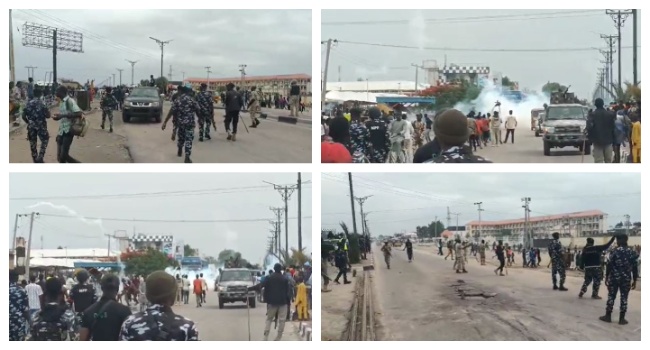
The security agents informed the demonstrators, mostly youths, of a court order restricting their gathering to the Gani Fawehinmi Park in Ojota and the Peace Park in Ketu, both areas in the Lagos mainland part of the state.
The pocket of youths who converged on the tollgate rejected the relocation to Lagos mainland and continued their demonstrations till they were dispersed by police teargas.
Propagated on social media, the nationwide protests against economic hardship started on Thursday, August 1, 2024, and is scheduled to stretch till August 10 across all states of the Federation as well as the nation’s capital Abuja.
Prices of food and basic commodities have gone through the roof in the last months, as Nigerians battle one of the country’s worst inflation rates and economic crises sparked by the government’s twin policies of petrol subsidy removal and unification of forex windows.
The police, military and the Department of State Services had warned against Kenya-styled protests. Politicians, who surmised that the planned rallies might end up like the EndSARS demonstrations of October 2020, have continued to appeal to youths to shelve the planned rallies but the young people have been unfazed.
Protesters across several states in the nation took to the streets today, to express their discontent at the economic hardship and growing hunger
In all of this, these aggrieved demonstrators decided to drive their point home by reciting the old national anthem
Tagged #EndbadGovernanceinNigeria, the protest movement won support with an online campaign, but officials had warned against attempts to replicate recent violent demonstrations in Kenya, where protesters forced the government to abandon new taxes.
President Tinubu, who signed the bill to change the national anthem to a new national anthem,” Nigeria, we hail thee”, on May 29th 2024 justified his reasons for changing the anthem by stating that fosters harmony and unity among the citizenry.
“As long as we are Nigerians and one family, we remain and protect our diversity and love one another as brothers and sisters,” Tinubu said.
However, in Port Harcourt, protesters filled the streets chanting the old national anthem in a stirring expression of their dissatisfaction with the current state of the nation.
They argued that the ”original anthem”, despite being replaced, better reflects their struggles and aspirations.
Similarly, in Lagos, protesters in Ojota joined forces with their southern counterparts, emphasizing a nationwide sentiment that ”Nigeria We Hail Thee” does not reflect the people’s identity or current realities.
Many Nigerians are divided, over the role of the new anthem in bringing a seemingly fractionated closer.
Tension was palpable in parts of Nigeria on Thursday as the much-touted #EndBadGovernance protests finally took place in almost all the 36 states of the Federation and the Federal Capital Territory (FCT), Abuja.
In a bid to curb the looting, violence and other after-effects of the protests, the Kano, Borno, Yobe and Nasarawa state governments, imposed curfews in volatile local government areas (LGAs) in their states.
While Kano and Borno state governments imposed state-wide 24-hour curfews, Yobe restricted movement in three LGAs while Nasarawa imposed movement in one charged LGA.
Some of the demands of the protesters include the restoration of petrol subsidies and the forex regime. They also want the government to address food shortages, unemployment and wasteful spending by those in power. Other demands are immediate reforms of the electoral umpire INEC and anti-graft agency EFCC with renewed vigour in the fight against corrupt politicians.
As the protests gained momentum away from the initial lethargy and hesitation of the participants, policemen were seen dispersing the demonstrators, mostly youths, using tear gas, even as civil society organisations (CSOs) condemned the action of the police.
Human rights lawyer Ebun-Olu Adegboruwa berated security agents for “provoking” peaceful protesters across the country.
In a statement, the lawyer to one of the organisers of the protests The Take It Back Movement, warned that confrontation by security agents could escalate the protests and cautioned the men in uniform to be professional.
“The situation has so far been largely peaceful, especially in Lagos and Abuja. Pockets of skirmishes in some parts of the nation were said to be due mainly to the provocation of the security agencies. Notwithstanding that, the protests were largely successful, well coordinated and on target.”
He said the “government should urgently identify and hold accountable any police or law enforcement officer that may have been found culpable to violate the rights of the peaceful protesters, especially in locations where it has been reported that protesters were wounded and shot dead”.
Organised Civil Society knocked the police for tear-gassing “defenceless protesters” in Lagos, Abuja, Kaduna, Bauchi, and other states in the country.
He said three peaceful protesters tear-gassed by the police fainted in Abuja with many others injured.
One of the lawyers of the protesters Deji Adeyanju also accused the police of frustrating and harassing peaceful protesters in Abuja.
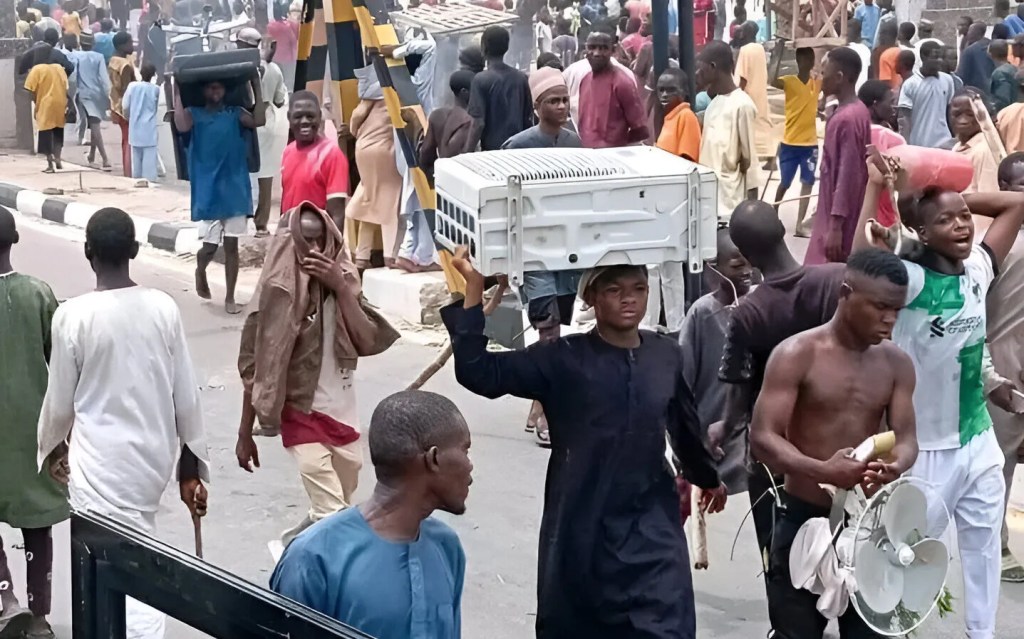
The protests turned awry in some states when hoodlums took advantage of the demonstrations to loot and maim, Some of the flashpoint states are Kano, Borno, Yobe and Nasarawa.
Hoodlums who took advantage of the demonstrations looted the newly built Nigeria Communication Commission (NCC) Industrial Park in Kano. The ICT centre, scheduled for commissioning next week, was thereafter set ablaze. A forlorn-looking Communications Minister Bosun Tijani condemned the attack, lamenting that hundreds of millions were lost in the unrest.
The scene of the vandalised Nigeria Communication Commission (NCC) Industrial Park in Kano State.
Police tear-gassed the protesters as the demonstrations escalated. The unrest in Kano saw not only the NCC Industrial Park targeted but also parts of the Audu Bako Secretariat, including the state high courts, looted and set on fire. Other establishments, such as supermarkets and mosques, were also attacked by the rioting youths.
In response to the escalating violence, Kano State Governor Abba Yusuf declared a 24-hour curfew.
“We are deeply concerned by the turn of events and are taking all necessary measures to restore order. I urge all residents to remain indoors as security agencies work to enforce the curfew,” Governor Yusuf said.
In faraway Borno State in Nigeria’s northeast geopolitical zone, 19 people were killed and several others critically injured when an improvised explosive device (IED) was detonated in the Kawuri area of the state.
The police, in collaboration with other security agencies, immediately imposed a 24-hour curfew.
“In line with our constitutional mandate towards the restoration of law and order, His Excellency, the Executive Governor of Borno State, Prof. Babagana Umar Zulum, in consultation with heads of security in the state, finds it expedient to declare a 24-hour curfew in the state with immediate effect,” the authorities said.
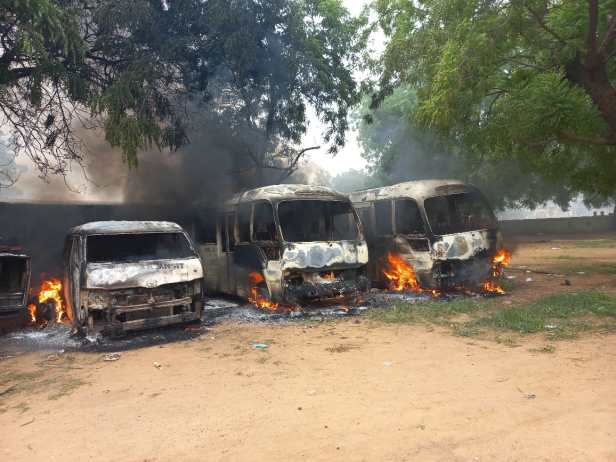
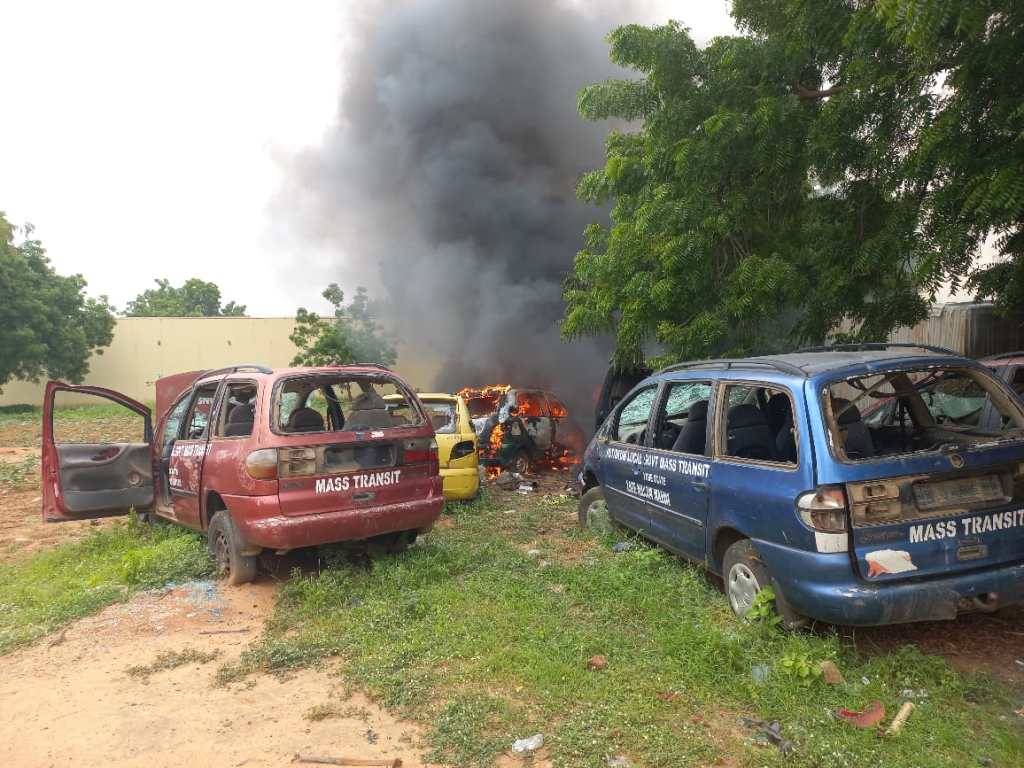
Also in the northeast zone, seven mass transit buses were burnt in Potiskum, the headquarters of Potiskum Local Government Area of Yobe State amid the #EndBadGovernance nationwide protests on Thursday.
The buses were set ablaze on the premises of the local government secretariat in Potiskum on Thursday.
The state government imposed a 24-hour curfew in Potiskum, Gashua, and Nguru towns where some hoodlums are taking advantage of the protest to vandalise and loot government and private properties.
Dairy Abdulsalam, the Special Adviser to Governor Mai Mala Buni on Security Matters, urged the general public to abide by the curfew order and stay at home for peace to reign in the affected areas and the state at large.
According to him, the security agencies have been directed to ensure enforcement and full compliance with the curfew order.
The situation was not different in Nasarawa State in northcentral Nigeria where a dusk-to-dawn curfew was imposed in the Karu Local Government Area (LGA) after the #EndBadGovernance protests turned violent.
Just like Kano, Borno and Yobe states, the government declared curfew following the destruction, looting, stealing, highway blockade, and vandalism that trailed the demonstration in the Mararraba area, the border between Nasarawa State and the Federal Capital Territory, Abuja.
The media aide to the Karu LGA Chairman, Danbaba Magaji, disclosed this in a statement on Thursday.
“The Executive Chairman of Karu Local Government Council, James Thomas, after due consideration, has imposed a curfew across Karu LGA from 6 pm to 6 am from today until further notice,” the statement read.
Meanwhile, the Inspector General of Police (IGP), Kayode Egbetokun, immediately placed his men on red alert across the Federation. He said a policeman was murdered while on duty, others injured and police stations razed.
He lamented that events in major cities on Thursday were “mass uprising and looting, not protests”.
“Police stations have been destroyed. There have been attempts to take over government houses,” Egbetokun said at a press briefing in Abuja, adding that looting of public and private warehouses and facilities was widespread.
“In places like FCT, Kaduna, Kano and Gombe, among others, we recorded incidents of unprovoked attacks on our security personnel where one policeman has been reported murdered and others seriously injured.
“In light of the current situation, the Nigeria Police Force has placed all units on red alert. Our officers are fully mobilised and prepared to respond swiftly and decisively to public safety and order,” the IGP said.
The newly built Nigeria Communication Commission (NCC) Industrial Park in Kano has been looted by hoodlums amidst a wave of nationwide protests against economic hardship.
The ICT centre, scheduled for commissioning next week, was also set ablaze during the unrest.
The protests, which began on Thursday, have escalated in several parts of the state, where police have reportedly used teargas to disperse demonstrators. The unrest in Kano saw not only the NCC Industrial Park targeted but also parts of the Audu Bako Secretariat, including the state high courts, looted and set on fire. Other establishments, such as supermarkets and mosques, were also attacked by the rioting youths.
Eyewitnesses described chaotic scenes at the ICT centre where protesters were seen carting away desktop computers, chairs, keyboards, and other valuable appliances before setting the facility on fire.
In response to the escalating violence, Kano State Governor Abba Yusuf has declared a 24-hour curfew across the state.
“We are deeply concerned by the turn of events and are taking all necessary measures to restore order. I urge all residents to remain indoors as security agencies work to enforce the curfew,” Governor Yusuf said.
The Kano State Police Command has begun cracking down on those responsible for the looting and arson. The police spokesman in the state Abdullahi Kiyawa announced on his Facebook page that several arrests have been made and stolen items recovered.
“We are committed to bringing the perpetrators of these criminal acts to justice. The safety and security of our citizens and property remain our top priority,” Kiyawa said.
The protests, which started as a peaceful demonstration against worsening economic conditions, have taken a violent turn in several cities across the nation. In many areas, protesters have clashed with security forces, leading to casualties and widespread damage to public and private properties.
As tensions remain high, the government has called for calm, urging the youth to express their grievances through peaceful means rather than resorting to violence and destruction.
A dusk-to-dawn curfew has been imposed on the Karu Local Government Area (LGA) of Nasarawa State after the #EndBadGovernance protests turned violent.
Just like Kano, Borno and Yobe states, the government declared curfew following the destruction, looting, stealing, highway blockade, and vandalism that trailed the demonstration in the Mararraba area, the border between Nasarawa State and the Federal Capital Territory, Abuja.
The media aide to the Karu LGA Chairman, Danbaba Magaji, disclosed this in a statement on Thursday.
“The Executive Chairman of Karu Local Government Council, James Thomas, after due consideration, has imposed a curfew across Karu LGA from 6 pm to 6 am from today until further notice,” the statement read.
Giving reason for the curfew, the authorities said it “was imposed as a precautionary measure to ensure the full security of Karu LGA.”
“The curfew will restrict the movement of people, Okada and Keke riders, all shop owners, and motorists in Karu LGA,” the statement said.
Thousands of mostly young people poured onto the streets across Nigeria on Thursday to protest against the country’s worst cost-of-living crisis in a generation, prompting police to fire tear gas to disperse the crowds.
Many businesses across the country shuttered Thursday amid fears the protests could be a replay of the deadly 2020 demonstrations against police brutality in the West African nation — or a wave of violence similar to last month’s protests in Kenya, where a tax hike led to chaos in the capital, Nairobi.
Carrying banners, bells and Nigeria’s green-and-white flag, the protesters chanted songs as they listed their demands, including the reinstatement of gas and electricity subsidies whose removal as part of the government’s reform efforts to grow the economy has had a knock-on effect on the price of just about everything else.
Seven mass transit buses were burnt in Potiskum, the headquarters of Potiskum Local Government Area of Yobe State on Thursday amid the #EndBadGovernance nationwide protests.
The buses were set ablaze on the premises of the local government secretariat in Potiskum on Thursday.
The Spokesman for the Yobe State Police Command, Dungus Abdulkarim, confirmed the incident at Potiskum, saying the perpetrators will be brought to book.
Propagated on social media, the nationwide protests against economic hardship started on Thursday, August 1, 2024, and is scheduled to stretch till August 10 across all states of the Federation as well as the nation’s capital Abuja.
Meanwhile, the state government has imposed a 24-hour curfew in Potiskum, Gashua, and Nguru towns where some hoodlums are taking advantage of the protest to vandalise and loot government and private properties.
Dairy Abdulsalam, the Special Adviser to Governor Mai Mala Buni on Security Matters, urged the general public to abide by the curfew order and stay at home for peace to reign in the affect areas and the state at large.
According to him, the security agencies have been directed to ensure enforcement and full compliance with the curfew order.
Organised Civil Society on Thursday knocked the Nigeria Police Force for tear-gassing “defenceless protesters” in Lagos, Abuja, Kaduna, Bauchi, and other states in the country.
In a statement, the United Action Front of Civil Society said three peaceful protesters tear-gassed by the police fainted in Abuja with many others injured.
The CSO leader Olawale Okunniyi alleged that pro-government protesters forced anti-hunger protesters out of the Moshood Abiola Stadium, Abuja, the venue designated by the government.
“The anti-hunger protesters sensing danger and possible violent clash, decided to quietly move in peaceful procession to the Eagle Square, where they had earlier designated to hold their peaceful protest.
“On getting to the Eagle Square, security agents swooped on them and unleashed mayhem on peaceful [rotesters with tear gas canisters, injuring several unarmed and defenceless protesters with three protesters reported to have fainted.”
The group strongly condemned the “resort to violence by the police in Abuja, Lekki, Kaduna and other centres in the country contrary to the assurances given to us by the Inspector General of Police, Kayode Egbetokun during our consultative meeting with him on Tuesday”.
“We find this show of force and reckless use of force unacceptable and barbaric and therefore call on the IGP to immediately call his men to order before the situation degenerates beyond control,” the statement said.
Propagated on social media, the nationwide protests against economic hardship, tagged #EndBadGovernance, started on Thursday, August 1, 2024, and is scheduled to stretch till August 10 across all states of the Federation as well as the nation’s capital Abuja.
Prices of food and basic commodities have gone through the roof in the last months, as Nigerians battle one of the country’s worst inflation rates and economic crises sparked by the government’s twin policies of petrol subsidy removal and unification of forex windows.
The police, military and the Department of State Services had warned against Kenya-styled protests. Politicians, who surmised that the planned rallies might end up like the EndSARS demonstrations of October 2020, have continued to appeal to youths to shelve the planned rallies but the young people have been unfazed.
The Nigeria Police Force (NPF), in collaboration with other security agencies, have imposed a 24-hour curfew in Borno State following a recent tragic incident.
The announcement comes in response to the detonation of an improvised explosive device (IED) in Kawori, which resulted in the deaths of 16 people and left several others critically injured. The decision was taken to prevent further unrest and maintain public order in the state.
In a press release, ASP Nahum Kenneth Daso, the Police Public Relations Officer for Borno State, conveyed the directive from Governor Babagana Umar Zulum.
The statement emphasized the state’s commitment to preserving law and order, highlighting the gravity of the situation and the need for immediate action.
“In line with our constitutional mandate towards the restoration of law and order, His Excellency, the Executive Governor of Borno State, Prof. Babagana Umar Zulum, in consultation with heads of security in the state, finds it expedient to declare a 24-hour curfew in the state with immediate effect,” the statement read.
According to the authorities, the curfew aims to prevent further incidents and ensure the safety of the residents. The people of Borno have been urged to remain calm and law-abiding, even as the security operatives say that the situation is under control and that any further developments will be communicated promptly.
The curfew restricts movement throughout the state, and security forces have been deployed to enforce the order strictly.
Simultaneously, in Zamfara State, joint security forces comprising the Nigerian Police and the Army intervened to disperse protesters in the capital, Gusau.
The demonstrators had reportedly mounted a roadblock along the Government House, protesting against various grievances, including perceived government inaction on issues of insecurity and governance.
The situation escalated when the protesters refused to disperse despite warnings from the authorities. In response, the police said it used teargas to break up the gathering, while the army deployed an armored vehicle to restore order.
The security forces say they successfully cleared the area, and normalcy has since been restored.
The police and other security agencies have reiterated their commitment to maintaining peace and order in the face of the protest. They have also called on the public to cooperate with the authorities and avoid any actions that could lead to further violence or disruption.
As the situation continues to develop, both in Borno and Zamfara, the authorities say they remain vigilant and ready to respond to any incidents that may arise. The public is encouraged to stay informed through official channels and comply with all directives from law enforcement agencies.

