
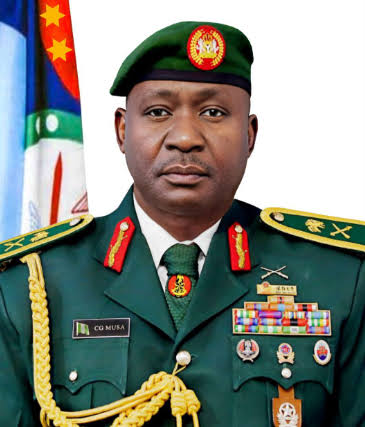
As Nigeria battles with insurgency in the North-East, the Chief of Defence Staff, General Christopher Musa, has says the deradicalisation of repentant criminals are working well.
The Operation Safe Corridor is a programme introduced under former President Muhammadu Buhari. It has run for several years and seen no fewer than 4,000 ex-Boko Haram members go through the programme.
Speaking on Nigeria’s 25th Democracy Day in Abuja, the CDS said the military’s strategy in combating terrorism and other crimes is yielding the positive results.
“It is working very well. I was the commander when it started, we were the ones that started it and every process that we did, we worked together with the state because the state had the authority on ground,” he said.
“Before it started and they were willing to surrender, the states were the ones that took the mantle and we followed up. Everyone that surrendered came first to the security forces that were closest to them. They were disarmed, we got the DSS to profile them.
“The state government provides the administration of those people and we took them to their camps. We were able to separate them and realised that not all of them were combatant. Some were forced, some were used as labourers.
“The main ones that were the actual operators were kept separately, working together with the victims.”
During the show, Musa said the Nigeria military is winning the war against Boko Haram/ISWAP terrorists in the country, stressing that more than 120,000 terrorists have surrendered to troops in the theatre of operations in the North-East.
According to him, he was in charge of Operation Hadin Kai for 19 months, and during the period he held sway, no fewer than 70,000 terrorists dumped terrorism to embrace a new life.
“I was the theatre commander Operation Hadin Kai for 19 months. By the time I left there, we had over 75,000 (terrorists) that have surrendered,” he said.
“Now we have over 120,000 to tell you that we are succeeding. For us to know that it is total, one of the areas where we have challenge is the area of good governance.”
He also identified lack of good governance as recipes to criminal activities, calling on the government to provide employment, food as well as other basic necessities of life to discourage people from embracing crimes.
He explained that the military neutralises over 600 bandits and terrorists across the theatres of operation on a weekly basis.
“On a daily basis, all the theatre operations we have, we take out over 600 bandits, terrorists. I tell you over 2000 are coming in on a weekly basis.
“Why is that so? We have relation they can come from everywhere. If you move into rural areas, we don’t have roads. Where my men have the greatest challenge is IEDs because there are no road infrastructure.”
When asked if it is time for the military to leave the North-East after nearly two decades of operations, Musa said: “It is an ongoing operation, we are doing the best we can together with the police.”
Boko Haram and rival jihadist group Islamic State West Africa Province (ISWAP) also regularly carry out abductions in northeast Nigeria.
Some jihadist groups have established a presence outside the region including in Niger state.
The Nigerian army says it regularly carries out operations against gunmen in the region and rescues kidnap victims.
Many communities in northwest Nigeria have formed self-defence vigilante forces to fight off bandits in remote areas with little state presence.
Musa, on Wednesday, shared insights about the challenges facing the military and police and what it would take to secure the country.
General Musa, who battled insurgents in the North-East for months before becoming Chief of Defence Staff, believes understanding, cooperation, and good governance were critical to securing the nation.
“We are dealing with asymmetric warfare, which is a new kind of warfare,” he added, explaining that understanding that was crucial to winning the war.
“Conventional warfare is between countries. Now, (with) asymmetric warfare, you are dealing with non-state actors; people you don’t know. Your own (people).”
As a result, the military is in a bind over who is an innocent civilian and who is a terrorist.
For example, he said, “Sometimes when we go for cordon and search operations, the same village you get into, they (the people) hide the weapons, you search them, they don’t have any weapons and you proceed, then they dig up their weapons and fire at you from the rear.
“It is difficult because you don’t even know who is your enemy.”
To overcome this challenge, the military had to work towards solving one of its biggest challenges, reversing a lack of understanding by the people.
“I am happy it is changing and if you see what the armed forces and the police are doing now, we are being very people-centric in our approach because we understand that asymmetric has to do with the people.
“Wherever we are guiding, wherever we are protecting, wherever we are operating if we don’t have the buy-in of the people, then there is a big challenge and that is the problem.”
The military has also had to contend with deep-rooted ideology.
“My advice always is no country should allow asymmetric warfare to commence. It is difficult to eradicate. Why? You are dealing with ideology.
“And once you have that idealogy built in, it is difficult because (when) you see the person, you don’t know what he is thinking about.
“We have seen people that we have told them (they are wrong), they are still telling us that we are wrong and they are right. So, we need to come together as a country to be able to tackle this.”
Has the war been won?
Although General Musa believes significant progress has been made and major wins recorded in the battle to secure Nigeria, he believes there is some way to go before it is over.
“The only time you know that you’ve won the war is when there is total restoration of civilian authority,” he said.
“For us to know that it is total (victory), one of the areas where we have challenges is the issue of good governance. Asymmetric warfare has a direct flux to good governance.”
This, he explained, is because if the people can’t eat and have no jobs, they become easy recruits or support for insurgents.

