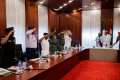

AFRICAN UNION FOREIGN AFFAIRS DISCUSS WARS, DISINTEGRATION OF REGIONAL BLOCS.
The Executive Council of Ministers of Foreign Affairs of the African Union was held in Addis Ababa from Wednesday to Thursday.
The Council of ministers coordinates and takes decisions on policies in areas of common interest to Member States.
The resurgence of military coups, pre- and post-election violence, humanitarian crises linked to war and the effects of climate change, were highlighted.
African Union Commission chair Moussa Faki Mahamat reckoned that “they pose a serious threat to tarnish the signs of the emergence of the Africa of which we are proud.”
Comoros Minister of Foreign Affairs and International Cooperation, and Chair of the Executive Council, also underscored terrorism, violent extremism, and unconstitutional changes of government as a challenge to the democratic processes on the continent.
“We have spared no effort to find a lasting solution to the various crises that are currently affecting the continent,” Dhoihir Dhoulkamal said.
“In Cairo, Addis Ababa and Djibouti, the war in Sudan has mobilized energies to bring the positions of the warring parties closer together.”
The emerging cracks on regional integration was discussed in the two-day ministerial session.
Faki sounded the alarm on a “new phenomenon of collapse of institutions of regional and continental governance.”
On January 28th, Mali, Burkina Faso, and Niger jointly announced their “immediate” withdrawal from the Economic Community of West African States.
Officially though, the ECOWAS treaty provides that its member states who wish to quit the bloc shall give its leadership a one-year written notice, at the end of which “such a state shall cease to be a member of the community.”
Blocs in turmoil include the east African community in which Burundi and Rwanda are once again in a standoff.
As the war in eastern DRC continues to displace thousands of Congolese, the Democratic Republic of Congo maintains the M23 rebel group, one of the most active in the region is sponsored by Kigali.
Rwanda has repeatedly denied the accusation.
Ethiopia and Egypt officially joined the bloc this year.
The work by the council of ministers of Foreign Affairs includes preparing the ordinary session of the assembly of the heads of state and government of the African Union.
The 37th AU summit will kick off on Saturday (Feb. 17).
ANTI-WESTERN DEMONSTRATIONS IN DEMOCRATIC REPUBLIC OF CONGO.
Anti-Western demonstrations rocked the Democratic Republic of Congo, with protesters denouncing what they said was silence in the international community over deaths caused by fighting between M23 rebels and the Congolese army.
Demonstrators burnt tyres and the flags of the United States and Belgium near Western embassies and the headquarters of MONUSCO, the UN mission in the DRC.
They said Western countries are supporting Rwanda which is accused of backing the Tutsi-led M23 rebellion in the North Kivu province.
The Congolese government sent police to protect the embassies and UN headquarters but did not denounce the violence against its Western partners.
“The government is in an impasse because it has difficulty differentiating between action and condemnation. I would have liked the two to be combined, but today we realise the government is in a form of impasse, which is why it’s following in the footsteps of the people,” said Kombi.
Fighting between government forces and the M23 in the eastern North Kivu province has escalated recently and is drawing closer to its capital, Goma.
The group launched the offensive in late 2021, capturing swathes of the province and driving over one million people from their homes.
Kigali has denied that it supports the M23, but Western governments, including the United States and Belgium, and the United Nations say the rebel group benefits from Rwandan support.
The eastern part of the DRC has been plagued by violence from local and foreign armed groups for nearly 30 years.
SENEGAL ELECTION DELAY RULED UNLAWFUL
Senegal’s top court has ruled that the decision to postpone this month’s elections is against the country’s constitution.
The Constitutional Court annulled President Macky Sall’s decree and a contentious bill passed by parliament moving the vote to December.
Widespread protests have gripped the West African country, once considered a bastion of democracy in the region.
Opposition figures said it amounted to an “institutional coup”.
Sall had announced he was pushing the election back because of what he claimed were concerns over the eligibility of opposition candidates.
His proposal had been backed by 105 out of the 165 MPs. A six-month postponement was originally proposed, but a last-minute amendment extended it to 10 months, or 15 December.
Sall had reiterated that he was not planning to run for office again. But his critics accused him of either trying to cling on to power or unfairly influencing whoever succeeds him.
Opposition candidates and lawmakers, who had filed a number of legal challenges to the bill, will likely feel vindicated by the court’s decision on Thursday evening.
Khalifa Sall, a leading opponent and a former mayor of the capital Dakar, who is not related to the president, had called the delay a “constitutional coup” while Thierno Alassane Sall, another candidate, also no relation, called it “high treason”.
The court said it was “impossible” for the election to be held on the originally intended date of 25 February – just 10 days time – but urged authorities to organise it “as soon as possible”.
Most candidates have not been campaigning since President Sall issued his 3 February decree, hours before campaigns were meant to kick off.
The court decision comes on the same day as several opposition politicians and civil society members were released from prison, in what some in the country viewed as a move to appease public opinion.
Senegal had long been seen as one of the most stable democracies in the region. It is the only country in mainland West Africa that has never had a military coup. It has had three largely peaceful handovers of power and until earlier this month had never delayed a presidential election.
President Sall has been in power since 2012, with his second term in office due to end this April.
UNITED STATES WARNS KEY UKRAINIAN TOWN COULD FALL TO RUSSIA.
The US has warned that Russia could seize Ukraine’s key eastern town of Avdiivka – the scene of some of the fiercest fighting in recent months.
“Avdiivka is at risk of falling into Russian control,” National Security Council spokesman John Kirby said, citing Ukraine’s ammunition shortages.
Ukrainian President Volodymyr Zelensky vowed to do everything to “save as many Ukrainian lives as possible”.
Russian troops have made gains in Avdiivka, threatening to encircle it.
The town – which has been almost completely destroyed – is seen as a gateway to nearby Donetsk, the regional Ukrainian capital seized by Russian-backed fighters in 2014 and later illegitimately annexed by Moscow.
Russian President Vladimir Putin launched a full-scale invasion of Ukraine on 24 February 2022.
At Thursday’s briefing in Washington, Mr Kirby said Avdiivka could fall largely “because the Ukrainian forces on the ground are running out of artillery ammunition”.
“Russia is sending wave after wave of conscript forces to attack Ukrainian positions,” he said.
“Russian forces are now reaching Ukrainian trenches in Avdiivka, and they’re beginning to overwhelm Ukrainian defences.
PAKISTAN’S JAILED FORMER MINISTER PICKS OMAR AYUB AS PRIME MINISTER NOMINEE.
Pakistan’s jailed former premier Imran Khan has picked one of his party’s leaders as nominee for prime minister.
Omar Ayub Khan will run against the candidate of Imran Khan’s rivals, who have agreed to a coalition.
Khan-backed independents unexpectedly won the most seats in last week’s election, but they did not have enough seats to form a government.
This has led to days of deal-making as the constitution requires the formation of a government by 29 February.
A senior leader of Khan’s Pakistan Tehreek-e-Insaaf party, Asad Qaiser, announced Ayub as his pick for PM after meeting with the former premier in prison.
Members of Pakistan’s National Assembly will elect the new prime minister and 56-year-old Mr Ayub will face off against former premier, Shehbaz Sharif, the nominee of the Pakistan Muslim League-N.
The PML-N led by former PM Nawaz Sharif joined forces last week with Bilawal Bhutto Zardari’s Pakistan People’s Party.
Ayub is on the run from criminal charges over riots sparked by Imran Khan’s arrest in May last year. But that does not disqualify him from seeking the PM post.
If elected PM, Ayub said his top priority is to free political prisoners. He won last week as an independent backed by PTI.
He is the grandson of Mohamed Ayub Khan, a military dictator and Pakistan’s president from 1958 to 1969.

