The Institute of Chartered Secretaries and Administrators of Nigeria has applauded the government for the bold step in removing fuel subsidy, as this would free up funds needed to develop the economy.
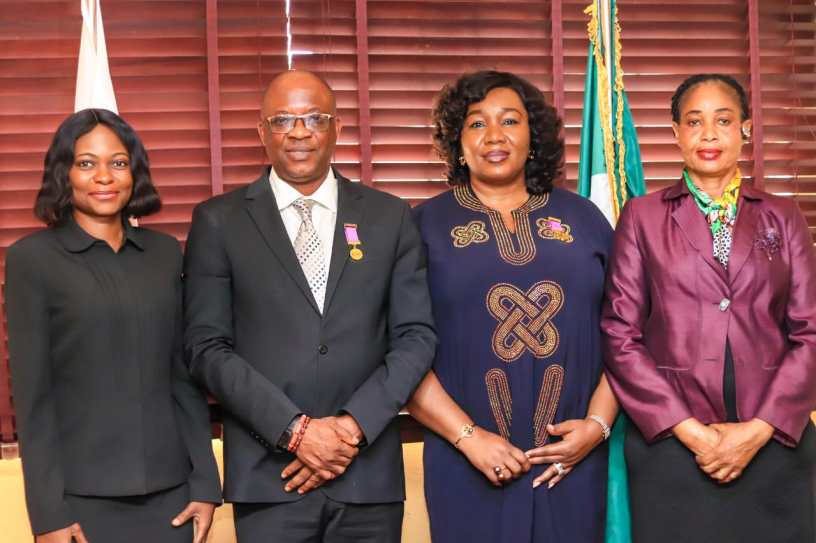
L-R Oladunni Ogunsulire Deputy Registrar Academics, FCIS , Mr. Taiwo Gbenga Owokalade FCIS President and Chairman of Council , Mrs. Lynda Onefeli, FCIS Chairman Publicity Committee , and Mrs. Yvette Okwesi, FCIS member Publicity Committee at the second Presidential Press Parley of the Institute of Chartered Secretaries and Administrators of Nigeria, ICSAN.
It says to attract investment into the sector, the government needs to introduce other policies to complement the fuel subsidy removal to make the sector competitive and attractive given its international nature.
Its President and Council Chairman, Taiwo Owokalade said the consequential savings from fuel subsidy removal, should be channeled into programs that will benefit the people and are in line with the fiscal responsibility legal framework.
Owokalade said this at the Institutes Second Presidential Press Parley 2023, saying fuel subsidy has existed for decades without transparency and accountability, causing the Federal government to spend trillions of naira monthly.
Owokalade lauded President Bola Tinubu for the courage to get rid of the ‘obnoxious’ fuel subsidy policy, noting that the subsidy was a “channel for the perpetration of fraud by some criminal elements.”
He expressed commitment to support the federal government, called on the government to continue to evolve people-oriented policies and programmes geared towards improving the lives of vulnerable Nigerians.
According to him, the move by the current administration on fuel subsidy removal would reduce the country’s dependence on fuel for energy uses, generate newer alternative energy ideas and address the monopolistic nature of the oil and power sectors.
Owokalade commended President Bola Tinubu for his administration’s sweeping reforms in the nation’s foreign exchange market and the abolition of the fuel subsidy regime, saying the actions are expected to enhance currency stability, combat inflation, and tackle corruption in Africa’s most populous nation.
According to him, since Tinubu assumed office he has seen the implementation of a policy reset long sought by investors, experts and global development organisations.
He said the government must urgently put in place measures to protect the rights of people most affected by the removal of the fuel subsidies and prioritise addressing widespread hunger, higher unemployment.
Apart from the reform in the petroleum sector, the Tinubu government also sought to unify the nation’s multiple exchange rates as part of measures to draw investors into the economy.
The Central Bank of Nigeria, announced the unification of all segments of the Nigerian forex market, collapsing all windows into the Investors & Exporters window.
In recent years, experts and global financial institutions have raised concerns about the nation’s opaque exchange rate regime, calling for unifying the numerous windows.
Owokalade added that the newly signed Electricity Act would drive more private sector, state and local governments inclusivity in electricity supply, distribution and generation of the country.
He noted that subsidy removal would trigger new business activities and initiatives in the energy sector, saying government must strive to create the right environment for those businesses to deliver.
He also emphasised the need to empower states and local governments through constitutional reforms, to minimise rural to urban migration and the ‘japa’ trend.
Owokalade tasked the government on the provision of palliatives within a reasonable timeline, to minimise the effect of subsidy removals on individuals and organisations.
The ICSAN president noted that while there were no perfect policies, there was the need for government to engage key stakeholders to perfect its implementation and address the gaps identified.
He added that government must expand activities aimed at engendering growth and development of the private sector and redirecting foreign direct investment into the country to grow the economy.
“The boldness of government to remove subsidy is commended, though we know the initiatives comes with huge consequences because of the heavy dependence of every Nigerian household on fuel.
“We look forward to seeing the real economic template of the government that the private sector can leverage on that would also encourage international investment.
“The era of loosing our businesses and investments to smaller countries would end and Nigeria must take its rightful place as the heartbeat of Africa and even the international arena,” he said.
Owokalade said his administration in the last two years in partnership with the media had achieved great strides in propagating the institute’s activities to drive good corporate governance practices.
He added that his tenure carried on with the institute’s long term strategic plan, increased its membership base, engaged stakeholders to further institutionalise corporate governance in tertiary institutions and the public sector.
The outgoing ICSAN president also pledged continued engagement with the media, through trainings, awards ceremonies amongst other areas, to further propagate the adoption of good corporate governance culture in the country.
“We have partnered with several regulatory bodies, many institutions and international bodies and have signed agreement with Canada, Zimbabwe and the United Kingdom, so that Nigerians domiciled in those areas can continue to enjoy the services we render.
“We would also continue to partner with government to see how we can come out of the negativity in international media space and release advocacy documents to aid government’s policy implementation.
“As my tenure winds down, I want to thank the media for the platform to achieve so much within this period and I know that this would not end with me because the next person would also continue in the same vein,” he said.

