Nigeria is said to require resilient economic policies for strategic implementation of reforms to achieve a well-functioning civil and public service.
This is according to Head of Civil Service of the Federation, Dr. Folashade Yemi-Esan who said the policies must be suitable enough to harness the country’s strong macroeconomic growth, saying the country is faced with a sharp decline in oil prices.
Yemi-Esan, affirmed that the recent progressive decline in oil prices had imposed devastating impact on the economy and public finances.
According to her, the economy would grow better through sustainable developmental policies being deployed by the government, supported by a motivated and efficient public service.
She laid out strategic actions in the implementation of the Federal Civil Service Strategy and Implementation Plan 2021-2025 (FCSSIP25), stating that the reforms are attempts to reconstruct administrative structure, revamps operational machinery and techniques, geared towards improving service effectiveness and efficiency.
According to her, the FCSSIP25, which is aligned to the National Development Plan 2021-2025, is aimed at evolving a crop of skilled, motivated, disciplined, innovative and performance/merit-oriented civil servants.
In her words, the FCSSIP25, is aligned to the mandate of President Muhammadu Buhari and has six pillars, which are: capability building and talent management; performance management system; Integrated Personnel and Payroll Information System (IPPIS) – human resource; innovation; digitalisation of content services and staff welfare–enhancing the value proposition for civil servants.
The move, according to her, is expected to change the negative perception of the Nigerian civil service and lead to effective driving socio-economic development.
She disclosed this in a paper presented through Assistant Director, Staff Training and Welfare, Yusuf Babatunde, at the 46th annual conference of the Institute of Chartered Secretaries and Administrators of Nigeria, ICSAN, titled ‘Public Administration: Entrenching Sound Governance Principles for Macroeconomic Growth.
Followers are most time wrongly blamed for the ills of the country.
They are being blamed for electing corrupt politicians, impostors, thieves and traitors and for collecting rice and vegetable oil to vote leaders into office.
But Professor Sylvester Akhaine of the Department of political science, Lagos State University, LASU, stated that they are not to be blamed.
He spoke on ‘Beyond Governance: The Role of Dedicated Followership in Participatory Democracy.
Akhaine said their docility and lethargy to reclaim their destiny in dramatic ways was a function of their repression by the ruling elite.
According to him, the unity of the subjective and objective factors will lead to the restoration of popular power and fulfilment of the social needs of society under a democracy that is truly participatory.
To him, no one can go beyond governance to address followership without reference to the former, saying the content of the literature on followership encompasses the debate about governance and leadership.
According to him, governance embraces what is now called the new management that involves the deployment of the panoply of tools that goes beyond direct provisions of service to contracting, franchising and deploying new forms of regulation aimed at achieving greater efficiency in the production of public services.
The Federal Government has linked the underperformance of the economy to constraints in revenue generation.
It needed to borrow to bridge the fiscal gap for developmental projects, improve businesses and enhance the standard of the citizens.
This is according to Director-General, Budget Office of the Federation, Ben Akabueze, who expressed concern about the country’s rising debt profile.
He assured government would bring down debt service costs to free sufficient resources for programmes that would enhance development.
Akabueze, spoke through his Technical Adviser, Prof. Olumide Ayodele, on ‘the National Debt Burden: Causes, Effects and Realistic Economic Solutions.
He stated that the focus of the conference was apt and timely to help government address significant fiscal challenges.
Akabueze mentioned that public debt at N32.9 trillion in 2020 rose to N39.6 trillion in 2021 with a total public debt amounting to N41.6 trillion in March 2022, while debt service amounts to $7.7 billion in 2021, an increase from $6.4 billion in 2020.
According to him, because public debt is largely domestic, debt service is a significant proportion of the debts.
He said even though the level of public debt is high in Nigeria, the budget office is of the view that public debt remains moderate and within sustainable limits going by international standards.
On what the government has been doing to manage debt, he said the focus of the government was to maximise domestic borrowing using longer-term instruments and maximise funding from concessional sources, from multilateral and bilateral windows while replacing external borrowing with longer tenure domestic borrowing in a way that would not crowd out private sector investments.
Also, he said government is focusing on the issuance of promissory notes to settle arrears with key reforms to improve revenue collections, which he said are yielding results with significant improvements from non-oil revenue.
According to him, “improvement in revenue collection will reduce deficits significantly and the need to borrow and debt service burden. It is important to ensure the public debt is sustainable, revenue must be enhanced and improving expenditure management and block revenue leakages.
“As of the end of 2021, public debt as a ratio of 23 per cent, is within the 55 per cent threshold recommended by the IMF and World Bank and is far lower than the 70 per cent W/A monetary zone convergence threshold and our self-imposed limits of 40 per cent.
In addition, the exposure of the public debt portfolio to exchange rate risk is also moderate, because external debts account for about 40 per cent of total debt in 2021 and the target ratio for 2023 is 30 per cent.”
He mentioned some measures to urgently avert the crisis on the country’s rising debts, stating that it was critical for immediate implementation of the Steve Oronsaye report towards cutting the cost of governance.
He said government’s target over the medium term was to grow the revenue to GDP ratio from eight per cent to 15 per cent by 2025.
According to him, government is introducing measures to reduce recurrent spending and to limit government-owned enterprises’ expenditure to about 50 per cent.
This, according to him, is to reduce waste and manage expenditure better.
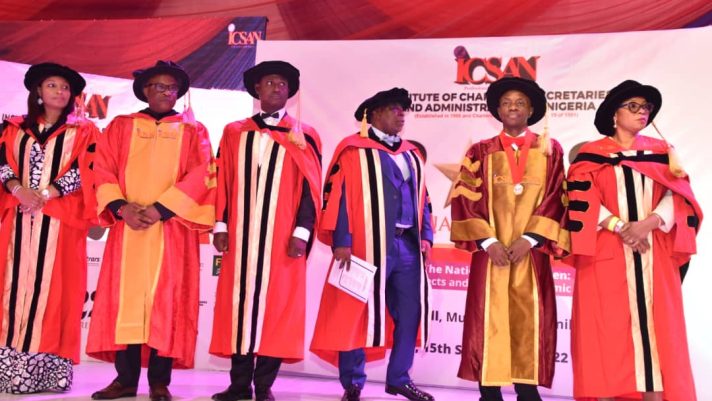
President and Chairman of Council, ICSAN, Taiwo Owokalade, who expressed concern over the nation’s current debt profile, said it prognosticates an inauspicious omen for national progress, development and sustainability.
He said national sustainability could not be talked about if the nation cannot survive except by taxing the resources that should be available for the future.
Owokalade noted that Nigeria was struggling to service the interest on debt and repayment of the principal, saying with the grim statistics portraying such huge fiscal deficits, there was no gainsaying the fact that the matter has come to a head.
According to him, while it is remarkable that incurring debt is not by itself a negative development, the size of the debt vis-à-vis the national income, cum the nature of the projects to which the obtained loans are applied constitute pertinent issues for serious consideration.
He said: “The pertinent questions now are “Is the borrowing spree sustainable? How do we break free from this debilitating burden of debt? What governance model can we adopt to soar above this debt trap and still manage to procure growth and development? One can go on and on with these types of questions which revolve around the perplexing debt conundrum.
“One good thing, as suggested by the theme itself, is that we are not only here to identify the roots and causes of the problem, we are even much more committed to distilling from our discourse and brainstorming today practicable solutions which we can offer to our numerous stakeholders in forms of recommendations.”
NIGERIA’ HEAD OF CIVIL SERVICE SAYS RESILIENT POLICIES NEEDED TO REFORM SECTOR.
 securityandsafetymatters