The National Security Council, NSC, says Nigerians are close to seeking self-help to combat insecurity.
It described the worsening insecurity as a very difficult situation, which may not be resolved by straight, cut-and-dried method.
However, the council assured that the Armed Forces would soon restore normalcy by deploying new strategies against terrorists and other criminal elements.
National Security Adviser, Major-General Babagana Monguno hinted on the new strategies in Abuja, shortly after the Northeast elders called for his sack.
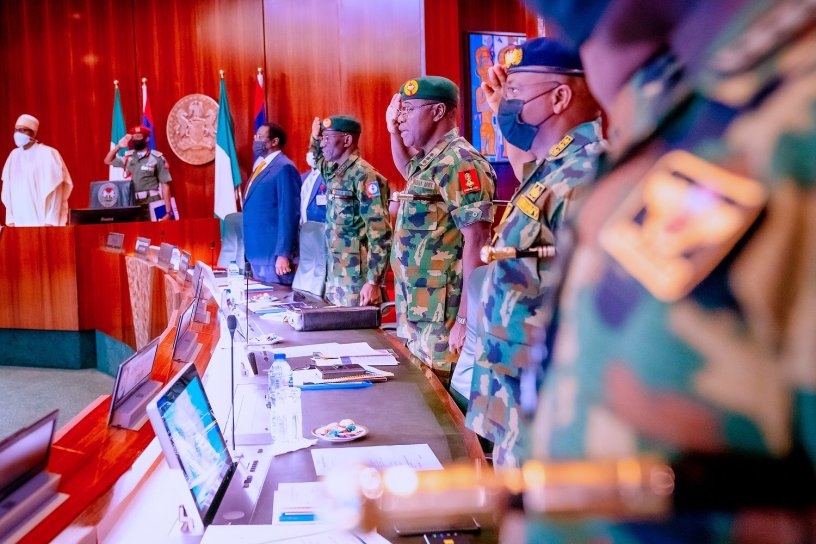
Monguno, who briefed reporters after the five-hour meeting at the Presidential Villa, said: “a whole of society approach” was needed to effectively overcome “asymmetric conflict “ in the nation.
He, therefore, called on Nigerians to help security, intelligence and armed agencies with useful information.
Monguno said: “The council has seen it necessary to inform the general public that fight in this type of asymmetric conflict is a collective effort, it’s not something that should be confined to only the security, intelligence and law enforcement agencies. When we keep saying the whole of society approach, the whole of government approach, to get a whole of nation approach, what it means is that everybody has to partake in this enterprise.
“We are in a very difficult situation and the council understands. Mr President (Muhammadu) understands people’s concerns about the growing insecurity, but I can assure you that there’s no straight, cut-and-dried method of dealing with this thing unless all of us embrace each other.
“I know people are wary, people are tired, people are beginning to gravitate to other places for self-help. The truth is that help is rooted in everyone working for the other person.
“The truth is that no country can ever overcome the difficulties of an asymmetric conflict by virtue of the fact that the enemy of the state is embedded within the population, within the wider society. It is true that the local people are averse, they’re scared, they’re worried and there’s no confidence. That is understandable.
“But without their support, without their cooperation in terms of giving information, it makes it very hard for the operational elements.”.
Monguno also made references to the Kuje Medium Custodial Centre and the killing of Guards’ Brigade personnel in Bwari in the Federal Capital Territory. He said the attacks would have been averted, if civilians had alerted security agencies.
His words: “A few days ago, troops of the Guards Brigade were ambushed and decimated. Had there been a collective effort by way of just snippets of information, we might have averted that incident. That is not to say that the responsibility is for those outside the security domain, it’s a collective responsibility.”
Monguno urged the media and politicians to be sensitive in their utterances, noting that some reports have elements that could aggravate the already volatile situation in the country.
He added: “Equally, the political elite is also urged to take into account the consequences of utterances, especially from people who have established a reputation, people who are considered leaders of thought, and people who are considered to have some kind of influence in society. Whatever goes out may be harmful, not just to the government, if that is the intention, which I doubt may not be a deliberate thing, but at the end of the day, it will affect the wider society.”
The meeting was attended by the Secretary to the Government of the Federation; Boss Mustapha; Chief of Staff to the President, Prof. Ibrahim Gambari; Attorney-General and Minister of Justice, Abubakar Malami; Minister of Interior, Rauf Aregbesola; Foreign Affairs Minister, Geoffrey Onyema; Police Affairs Minister Mohammed Dingyadi and Defence Minister Bashir Magashi.
Chief of Defence Staff Lucky Irabor; Chief of Army Staff Farouk Yahaya; Chief of Naval Staff Awwal Gambo; Chief of Air Staff, Isiaka Amao; and Chief of Defence Intelligence Samuel Adebayo were also in attendance.
Inspector-General of Police, Usman Alkali Director-General of the Department of State Service (DSS), Yusuf Bichi; and Director-General of the National Intelligence Agency (NIA) Ahmed Abubakar also attended the meeting.
 securityandsafetymatters