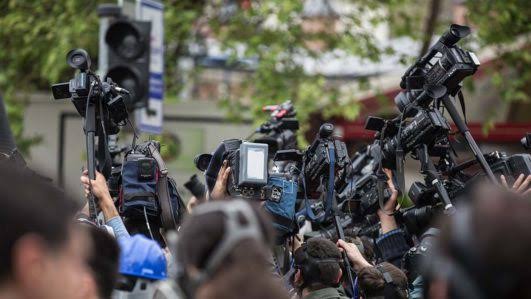
Nigeria dropped to 129 from 120 in the latest ranking of press freedom across 180 countries.
According to the ranking, which is compiled by Reporters without borders, Nigeria is “one of West Africa’s most dangerous and difficult countries for journalists, who are often watched, attacked, arbitrarily arrested and even killed.”
It noted that while the country has a rich and diverse media landscape, the level of government interferences in the news media is significant.
“It can involve pressure, harassment of journalists and media outlets, and even censorship,” the report noted.
“In 2021, the Peoples Gazette news site was blocked after it revealed that privileges were given to the son of a member of the president’s inner circle. Twitter was suspended for seven months after it deleted one of the president’s tweets. Media outlets were ordered to delete their Twitter accounts as a ‘patriotic gesture’.
While Nigeria’s constitution protects freedom of expression and opinion, there are many laws that make it possible to obstruct the work of journalists.
“Several very dangerous laws regulating social media have been proposed in recent years, causing an outcry,” the report said.
Meanwhile, Norway was ranked as the country with the most press freedom, while North Korea’s press was regarded as the least free.
The ranking is calculated by tallying “a quantitative tally of abuses against journalists in connection with their work, and against media outlets” and “a qualitative analysis of the situation in each country or territory based on the responses of press freedom specialists (including journalists, researchers, academics and human rights defenders) to an RSF questionnaire available in 23 languages.
The press is a critical agent for the protection of democracy and development and must be supported to enable them to effectively discharge their constitutional duties as the watchdog of the society, the National Human Rights Commission (NHRC) has said.
It observed that Nigerian journalists fought very hard to achieve the nation’s democratic status and deserve a better deal, unlike the current situation where many of them struggle with poor conditions of service among other challenges, including censorship, harassment, intimidation, and in some cases, assassinations.
NHRC Executive Secretary, Tony Ojukwu, made the remarks on the eve of the celebration of the 2022 World Press Freedom Day which is commemorated annually on May 3.
He asked the society to see journalists as “the oxygen of democracy and agents of change and development,” adding that their constitutional duty which is enshrined in Section 22 of the 1999 Constitution as amended – “to hold the government accountable to the people” distinguishes them as those who perform an essential duty to the nation.
“At this time when Nigeria is at the crossroad of challenge of justice, equity, and fairness to stabilise our democracy, the press must defend democracy by its commitment to holding our governments accountable to the truth always no matter the difficulties of the times.
“It must remain the conscience of the nation, telling the truth at times like this, to save our democracy,” said a statement on Tuesday by the NHRC spokesperson, Fatimah Mohammed.
“This year’s theme for the celebration of World Press Freedom Day – “Journalism under digital siege” is apt as it seeks to bring to the fore, “the impact of the digital era on the freedom of the press, the security of journalists and access to information and privacy”.
The Chief Human Rights Officer stated that it is incontestable that the advent of the internet with the attendant boost in digital communication has benefited humanity in various ways, “but at the same time, it has threatened our right to privacy, since virtually nothing is hidden from the internet radar.
Ojukwu, a Senior Advocate of Nigeria (SAN), said, “It is on this note that I commend UNESCO for championing the proposed World Press Freedom Day Global Conference scheduled to hold between May 2 and 5 in Punta Del Este, Uruguay.
“The conference would be a forum for key players in the internet-related companies, legal experts, journalists, etc to discuss the challenges of digital communications, the impact on press freedom, and the way forward.”
According to the learned silk, the commemoration of the World Press Freedom Day is not an opportunity to witch-hunt any person or institution but is a period to reminisce the fundamental principles of press freedom, gauge the state of press freedom globally, defend the media from attacks on their independence, and to pay tribute to journalists who are either human rights defenders in custody or captivity or have lost their lives in the line of duty.
He, therefore, urged the law enforcement agencies, including the police to, as a matter of necessity, intensify their investigations to unravel the circumstances surrounding the death of some Nigerian journalists, including that of late Vanguard newspaper, Tordue Salem, whose body was reportedly found in Abuja in 2021.
The observance of World Press Freedom Day, which started in 1993 and is celebrated on May 3 annually, is designed to remind governments of the need to respect their commitment to press freedom and to remind journalists of the need to adhere to their professional ethics, defend democracy, justice, equity, and fairness and be committed as human rights defenders.
Nigeria Remains Dangerous And Difficult For Journalists.