The Financial Regulations Council of Nigeria, FRCN, has promised to fix every grey area in the Audit Regulations twenty-twenty.
It’s promise became necessary following the controversial sections in the Audit Regulations twenty-twenty as it affects companies’ mode of financial operations among other issues.
Acting Executive Secretary/Chief Executive Officer, Iheanyi Anyahara, calling on concerted effort by every stakeholder to ensure strict implementation.
According to him, the regulation is putting in place plans for financial literacy for all stakeholders to be fully informed for sound decisions and planning.
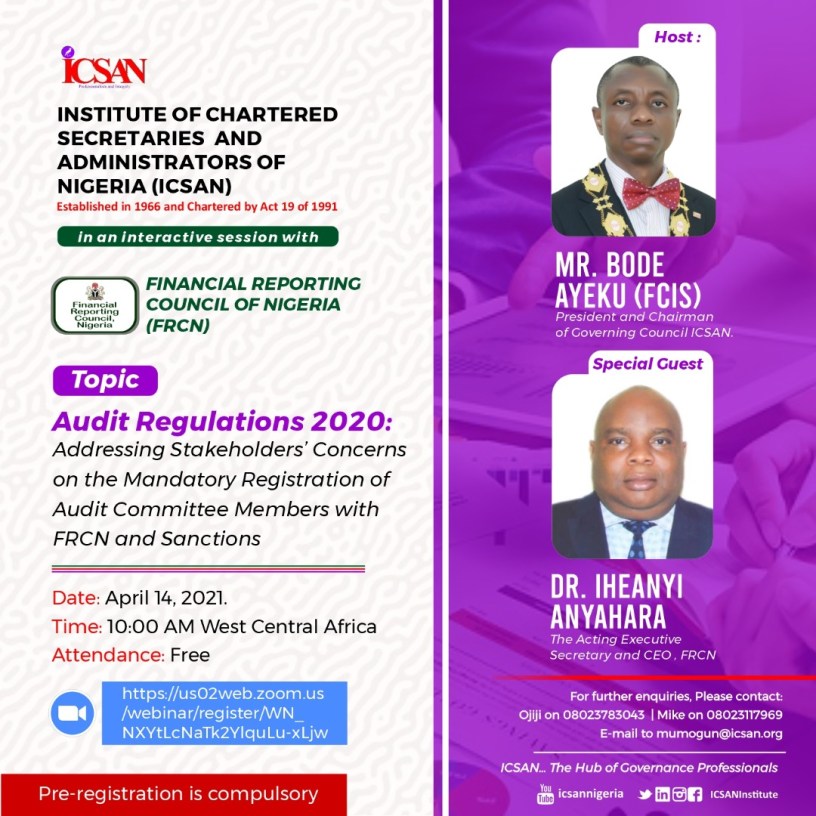
He spoke on the topic: Audit Regulations 2020: Addressing Stakeholders’ Concerns On The Mandatory Registration of Audit Committee Members With FRCN And Sanctions, put together by Institute of Chartered Secretaries and Administrators of Nigeria in a webinar session.
Anyahara also urged strict compliance by companies to the provisions of the regulations, saying, the FRCN was not out to sanction companies but to ensure credible financial reporting to attract investments.
He also revealed plans by the council to commence quality control by 2022 in line with the transition programme.
In his words, the Audit Regulation is an enabler for re- establishing the much-needed trust in financial report, saying there is, therefore, the need for clarion call for strict compliance with the Regulation by all concerned.
According to him, this will engender the need for re- evaluation of remuneration, structure, board level experience, risk management, training, sustainability among others.
“With the pandemic, the council has provided increased transparency for investors and shareholders whose demand are very high.
“Howbeit, assurance by independent qualified professionals to enhance the credibility of corporate financial reporting would need to be pursued vigorously by all affected professionals,” he said.
Anyahara pledged the council’s commitment to ensuring transparency, responsibility, accountability, fairness without fear or favor of anyone.
He added that the council would provide a window to address the issue of qualifications for members of the audit committee.
“We seek for collaboration with all stakeholders for seamless implementation of the Regulation.
“We shall commence quality control review in 2022 in line with the transition Programme.
“We plan to commence training on the implementation of the audit committee by next quarter for audit firms, audit committee members, shareholders, board members, internal auditors and assurance practitioners.
“Our engagement so far are: big four audit firms, shareholders’ association, small and medium practices among others and we are open to work together to build capacity,” he affirmed.
Acccording to him, FRCN is not an oppressive Body Corporate, but one whose mandate is to ensure that corporate bodies complies with the provisions of the council, and the council would do everything in line with the law to carry every stakeholder along but must enforce sanctions when and where neccssary.
He said the council welcomes constructive criticism and suggestions as way forward to ensure credible financial reporting to attract investors when the trust and confidence of shareholders are restored.
‘With the pandemic, the council has provided increased transperency for investors and shareholders whose demand are very high, howbeit, assurance by independent qualified professionals to enhance the credibility of corporate financial reporting would need to be pursued vigorously by all affected professionals.’
He added that the council would provide a window to address the issue of qualifications for members of the audit committee, saying that ‘belonging to a professional financial body is not the only criteria for the committee membership, but an evidence of financial literacy and evidence of been elected into the committee, among others.
‘We seek for collaboration with all stakeholders for seamless implementation of the regulation. We shall commence quality control review in 2022 in line with the transition programme. We plan to commence training on the implementation of the audit committee by next quarter for audit firms, audit committee members, shareholders, board members, Internal auditors and assurance practitioners, our engagement so far are: big four audit firms, shareholders’ association, small and medium practice, among others, we are open to work together to build capacity,’ he stated.
OPENING REMARKS BY ANYAHARA, IHEANYI, PhD OF THE FINANCIAL
REPORTING COUNCIL OF NIGERIA, AT THE INTERACTIVE SESSION ON
AUDIT REGULATIONS 2020 ORGANISED BY THE INSTITUTE OF CHARTERED
SCRETARIES AND ADMINISTRATORS OF NIGERIA ON WEDNESDAY, APRIL
14, 2021
Background
Let me start by appreciating every one of you on this platform today
for sacrificing your time and comfort to be part of this exercise. I see
your effort today as investing towards having more enduring credible
corporate reporting regime that enhances capital formation, growth
and preservation.
Our collaboration with the Institute of Chartered Secretaries and
Administrators of Nigeria (ICSAN) is further being strengthened by this
engagement which the Institute is hosting. I appreciate the
doggedness of the President of the Institute, Mr. Bode Ayeku, who
initiated this engagement and persistent follow up to ensure that the
engagement holds.
Today’s webinar is the 5th in the series since January 25,
, 2021 when the
Audit Regulations were approved by the Honourable Minister of
Industry, Trade and Investment. Many more of the engagement have
been scheduled in the Council’s spirit of transparency and openness.
The equity and credit markets (Capital markets) are among the most
efficient markets the world over but particularly in the economically
developed world. One reason for the efficient operation of these
markets is the public availability of creditable financial statements to
stakeholders and the confidence in these statements by those using
them as a basis for their investment and credit decisions. In the past
decades, events posing potential serious threat to the efficient
2
functioning of these markets have been the growing incidence of
fraudulent financial reporting.
The investing public roundly blame the accounting and auditing
profession. Of course, you are very much aware that there is therefore,
constant beaming of spotlight on the financial reporting supply chain.
According to IFAC 2009, “The financial reporting supply chain refers to
the people and processes involved in the preparation, approval,
audit, analysis and use of financial reports. All the links in the chain
need to be of high quality and closely connected to supply high
quality financial reporting.”
There are two major categories of Financial Reporting Supply Chain
– People; and
– Processes
• People can further be classified into two major groups:
– Internal
• Members of Board of Directors
• Audit Committee
• Chief Executive Officers, Chief Finance Officers,
Internal Auditors, Internal Control
• Preparers
– External
• Auditors
• Actuaries
• Valuers
• Regulators (NAICOM, CAC, SEC, NSE & FRC)
3
• Other Stakeholders (users, analysts, etc)
A further analysis of the parties involved in the financial reporting
supply chain will reveal the significant and critical role the Audit
Committee members play. The Companies and Allied Matters Act 2020
in section 404 (2) requires that “auditors shall in the case of public
company, make a report to audit committee which shall be
established by the public company”. Furthermore, Section 404(4),
CAMA 2020 states “the audit committee shall examine the auditor’s
report and make recommendation thereon to the annual general
meeting as it may deem fit”. Still on CAMA 2020, Section 404 (5)
requires that “all members of the audit committee shall be financially
literate, and at least one member shall be a member of a professional
accounting body in Nigeria established by an Act of the National
Assembly”.
In line with the above, Audit Regulations came into being to further
give effect to the above in line with FRC mandates.
You will all agree with me that regulation of financial reporting in
Nigeria was on self-regulation or at most regulation at the professional
organizational level which has been on persuasive approach. This
approach is no more acceptable globally hence the advent of
Financial Reporting Council or its equivalent globally to provide
independent oversight over financial reporting.
Generally, strong independent public oversight is required because it
helps to create and maintain trust in the work of auditors by providing
safeguards for companies and investors. This, among other things,
account for the enactment of the Financial Reporting Council Act,
2011.
Firstly, a few words about the Financial Reporting Council (FRC)
4
• A regulatory agency of the Federal Government that promotes
trade and investment in Nigeria by ensuring high standards of
financial reporting and corporate governance.
• Maintains independent public oversight of Accounting, Auditing
and Financial Reporting and Corporate Governance of public
interest entities by setting, monitoring and enforcement of
compliance with related standards.
• Advises government on accounting, financial reporting and
corporate governance matters with commensurate powers to
do all things connected with above functions.
The Council has been very resolute and committed in driving its vision
of being the conscience of regulatory assurance in financial reporting
and corporate governance in Nigeria.
By its establishment, the FRC has oversight powers covering:
• Ethics;
• Corporate Governance;
• Accounting Standards;
• Auditing Standards;
• Practice Review and Quality Assurance;
• Audit Reports;
• Other Professionals; and
• All Financial Reporting issues.
As you are aware, one of the objects of the Council as stipulated in
Section 11 (a) of the Financial Reporting Council Act, 2011 is to “protect
investors and other stakeholders’ interest” which is at the heart of every
shareholder and everyone here today, I presume. Therefore, I make
5
bold to say that we are partners in progress and therefore should work
closely to see that the Audit Regulations 2020 are effectively
implemented.
THE JOURNEY TO THE AUDIT REGULATION
The Financial Reporting Council of Nigeria (“FRC” or “the Council”), in
line with one of her strategic priorities to advance its agenda for the
sustenance of a stronger regulatory regime for statutory audits and
related services in Nigeria, inaugurated an Audit Regulations Working
Group (WG) in October 2018 to advise and assist the Council on
technical matters relating to the regulation of audit and assurance
services.
The membership of the group comprises of 14 members drawn from
the following relevant stakeholders:
✓ The Big 4 Audit Firms;
✓ Medium size Audit Firms;
✓ Forum of Small and Medium Size Practitioners (SMPs);
✓ Office of the Auditor General for the Federation;
✓ Nigerian Accounting Association (NAA);
✓ Attorney-General of the Federation/ Minister of Justice;
✓ Securities and Exchange Commission;
✓ Institute of Chartered Accountants of Nigeria (ICAN); and
✓ Association of National Accountants of Nigeria (ANAN).
The purpose of the Working Group (WG) is to provide Technical
Assistance to the Council in its development of rules and regulations
for statutory audits in Nigeria (Audit Regulation). Accordingly, the
Working Group is to assist the Council with the following tasks:
• Assess the current state of audit regulation in Nigeria and identify
relevant gaps, as compared with the audit regulation
environment in the EU, US and key economies in the African
Continental Free Trade Area (AfCFTA).
6
• Develop requirements for (i) registration, (ii) withdrawal of
registration and (iii) maintenance of up to date register of
auditors;
• Develop requirements for regulation of other accountants and
professionals providing assurance services in the financial
reporting and auditing process;
• Develop guidelines for the practice reviews and inspections
provided for in Sections 60 and 61 of the FRC Act 2011 and for
monitoring, compliance with the Audit Regulations, including any
required arrangements for delegation of such supervisory tasks to
Recognised Supervisory Bodies; and
• Develop requirements for the conduct of the different types and
aspects of audit and assurance engagements.
OBJECTIVES OF THE AUDIT REGULATION 2020:
The following are the objectives of the Audit regulation:
✓ To provide legal and regulatory framework for minimum practice
guideline for auditors in Nigeria and to give effect to the
provisions of the Act;
✓ To ensure that all activities of Registered Auditors and other
professionals in the financial reporting process are regulated with
a view to sustaining best ethical practices capable of promoting
quality audit services;
✓ To regulate and ensure that all registered auditors carry out their
professional duties in a manner to earn the trust of clients and
promote the image of the profession and the country;
✓ To ensure that Recognised Supervisory Bodies (RSBs) comply with
these regulations through a well-defined delegated
arrangement; prescribes penalties for non-compliance with
these Regulations.
7
✓ The Audit Regulation Working Group (ARWG) was inaugurated
on October 2018 and met severally and presented an Draft
Exposure Draft
✓ The Technical and Oversight Committee of the Board (TOC) met
severally on the documents and approved the Exposure
Draft(ED)
✓ The Audit Regulations ED exposed for 2months
o Several engagements with relevant stakeholders including
meeting the forum of the big 4 Audit Firms
✓ ARWG met and considered the inputs including those from the
big 4 Audit firms
✓ The Technical and Oversight Committee of the Board met and
considered the final document
✓ The Governing Board of FRC considered the document as
recommended by TOC and approved it.
✓ The Board approved document was transmitted to the
Honourable Minister, FMITI
✓ Final Approval by the Honourable Minister of Industry, Trade and
Investments on January 25, 2021.
AUDIT REGULATION 2020: Application and Scope
Audit regulation is applicable in the Federal Republic of Nigeria to
regulate all statutory Auditors, other assurance providers and audit
committees. It however does not apply to Auditors-General. (OAuGF
is a constitutional body and the Supreme Audit Institution of Nigeria by
virtue of Section 85(6) and 125(6) of the Constitution).
The financial crisis has demonstrated that robust and transparent audit
practices need to be embedded in all organisations. Obviously, the
8
Audit Regulation is an enabler for re-establishing the much-needed
trust in financial reports. There is, therefore, a clarion call for strict
compliance with the regulation by all concerned. This will orchestrate
the need for a re-evaluation of remuneration structures; board level
expertise and training; risk management, sustainability, etc. With
pandemic, this regulation providing increased transparency for
investors and other stakeholders, are expected to be in high demand.
However, assurance by independent qualified professionals to
enhance the credibility of corporate reporting will need to be pursued
with vigour by all affected professionals.
Our engagement with members of Shareholders Association is
strategic as we decided to use today’s exercise, to personally and
specially request that your associations devote considerable time to
consider the Audit Regulation for a meaningful and quality
contribution towards effective implementation of the Audit
Regulation. The Audit Regulation is very strategic in the quest to
Nigeria joining the league of global community that have effectively
set up Independent Audit Regulators.
One of the critical concerns on the implementation of the Audit
Regulations is the capacity. We are currently discussing with
development partners in this regard. I am pleased to inform you that
the Council has received positive assurances from some bodies
internationally and locally to deploy resources to assist and such will
be extended to your association. This is an area your associations need
to partner with the Council to build the required capacity.
We appreciate the relevant stakeholders for the tremendous support
the Council has received so far especially since the Audit Regulations
was released. Our engagements so far include, Big four audit firms,
Small and Medium Practice, Shareholder’s Association, Internal
9
Auditors. Some firms have also provided platforms for the Council to
discuss the Audit Regulations with their staff and clients while the two
professional accounting organisations have included the Regulations
in their ongoing mandatory continuing education. We plan to
commence training on the implementation of the Audit Regulations
next quarter especially audit firms, audit committee members,
shareholders, Board members, internal auditors and assurance
practitioners.
We are of the view that the Council collaboration with all stakeholders
with will result in a seamless implementation of the Regulations. Finally,
we shall commence Quality Control Review in 2022 in line with the
transition programme.
The Council therefore solicits for your support in the implementation of
the regulation.
Thank you for your attention and God bless.

