
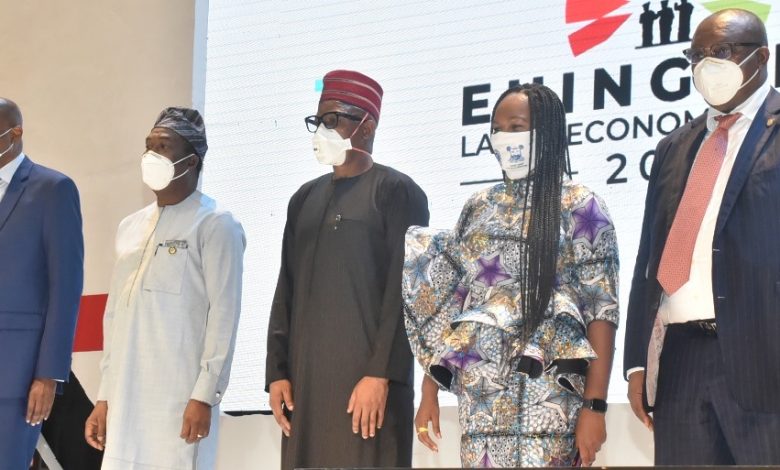
The 8th Lagos State Economic Summit (Ehingbeti) has drawn to a close today, with the organisers and participants departing with actionable resolutions to chart a new course of physical development and economic growth for the State.
Governor Babajide Sanwo-Olu pledged that the learnings and recommendations emanating from the summit would be developed into a policy framework to forge a new action plan and implementation that would bring the envisioned future of Lagos to reality.
The three-day event with the theme: “Greater Lagos: Setting the Tone for the Next Decade”, was largely held on a virtual platform, but some sessions were held physically at the Eko Hotels and Suites, Victoria Island.
Over 11,000 people in 10 countries participated in the event, with an average record of 5,500 participants globally attending sessions daily.
Sanwo-Olu, in his closing address read virtually from Abuja, said government had started to look into the future and was ready to implement resolutions that would make Lagos adaptable to the new culture of business interactions occasioned by technology and unpredictable pandemic.
The Governor said Lagos took lessons from the disruption of economic activities created by the spread of Coronavirus (COVID-19), stressing that the experience would make the State Government deepen its scenario planning capabilities to bolster its resilience against such emergency.
He said: “As we have now successfully come to the end of this eighth edition of the summit, it is imperative to emphasise that the conversation must not end here. We must take the learnings and the conclusions from this Summit and use them to forge a plan of action and implementation that will ensure that the future we are envisioning for Lagos State comes to fruition.
Sanwo-Olu said Ehingbeti, since year 2000 when it was first introduced during the administration of the visionary former Governor Bola Ahmed Tinubu, had become a tool to re-invent Lagos. He said the summit had become a platform for conversations about where Lagosians want the city to be headed, and how to fast-track the journey.
He said the development blueprint of his administration was designed as a road-map to guide the Government on the journey to deliver Lagos of residents’ dreams.
The Governor pledged to strengthen the economic potential of the youth, whom he described as critical stakeholders in delivering development programmes of the next decade.
Sanwo-Olu said the State Government’s investments in youth-focused initiatives, such as Lagos Excel Project, Lagos State Employment Trust Fund (LSSTF), Lagos State Science Research and Innovation Council (LASRIC), were pointers to the readiness of the State to improve youth inclusion in governance and raise their entrepreneurial skills.
He said: “We must now begin to plan for the next summit, even as we also take action on the resolutions of this one. I call on the private sector to be aggressive in seeking out opportunities to partner with and support the Lagos State Government. Ehingbeti speaks to what Governments, the private sector and civil society can come together to accomplish through deliberate bilateral and multilateral partnerships.”
Kaduna State Governor, Mallam Nasir El-Rufai, described Lagos as “the engine room” of the nation, stressing that the State was fortunate to have been governed by visionary leaders, starting from the administration of ex-Governor Tinubu.
El-Rufai said he looked forward to more reforms that would further simplify Ease of Doing Business in Lagos, noting the better the economy of Lagos performed, the better for Nigeria.
He said: “For us in Kaduna State, Lagos is a model that we follow. We look at Lagos as competitive advantage in many areas and try to implement reforms that will bring us closer to what Lagos has been able to achieve. Lagos has been blessed with very good Governors. The reforms initiated by Governor Tinubu are still bringing prosperity to the State.”
There were 146 speakers and panelists who facilitated six plenaries and 20 deep discussion sessions held during the event, which focused on six thematic areas, including making Lagos investment destination, strengthening governance and institutions, Fourth Industrial Revolution opportunities, funding growth and ensuring inclusive human capital development and sustainability, resilience and impacts.
At the end of the summit, the Deputy Governor, Dr. Obafemi Hamzat, outlined 11 key highlights that encompasses the resolutions to be implemented by the State Government before the next summit.
Speaker of the Lagos House of Assembly, Mudashiru Obasa, represented by Hon. Gbolahan Yishau, pledged to support the resolutions with necessary legislative framework to make the Government implement the resolutions.
Panelists commended the Lagos state government for its drive in making the state attractive, secure and an opportunity hub not only in Nigeria but West Africa.
They spoke on sustainability, resilience and impact for a greater Lagos and delved into ways to ensure that the state became more attractive and secure for all.
It was resolved that there was need to harness the power of the youths and to put policies and programmes in place to unleash the potentials of the teeming youth population.
They stressed that policies must be robust and treat the youths as assets and concerted youth-focused capacity building in digital literacy, STEM, the arts, entertainment, sports and other sub-sectors must be created by the government in partnership with the private sector.
The panelists recognised that the youths were different and capable of making their own way in the world – therefore, government must seek to understand them and how to adequately support them.
They noted that there was need to improve the state education system through a thorough overhaul of the curriculum with a view to providing an education that met 21st Century realities, thereby reducing youth unemployment.
All parties stressed the importance of and renewed commitment to improved partnerships and collaboration across national, state and other sub-national governments, the Private Sector, Civil Society and the international community.
These conversations brought together citizens, captains of industry, sector experts, Royal Fathers and traditional leaders.
Others were development partners, the international community, civil society organisations and other critical stakeholders from all over the world.

