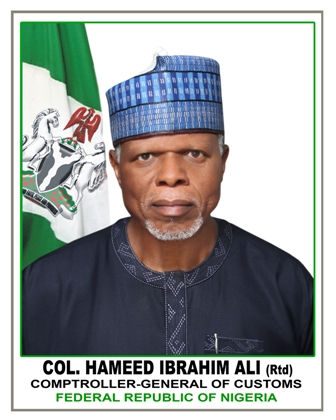
Restructuring, reforms and revenue generation has been cited as key factors responsible for the impressive performance of the Nigeria Customs Service, NCS.
According to its Comptroller-General, retired Colonel Hameed Ali, the three items were the mandates given to him by President Muhammadu Buhari on his appointment.
He said the NCS under his leadership was focusing on aligning the NCS’s operation with international best practice through the mandate.
In his word, the agency developed many standard operating procedures to achieve the mandate, all the officers became accustomed to restructuring.
He, however, described the NCS as a highly technical organisation, governed by laws, including the World Customs Organisation (WCO) laws, Civil Service laws and laws enacted by the National Assembly.
According to him, the approval of certain recommendations by the president also enhanced the remuneration and welfare of the organisation.
The comptroller-general also disclosed that he was working towards providing office and residential accommodation for NCS workers.
According to him, in the next one or two years, officers will no longer stay in rented apartments, especially those working in the borders.
Ali noted that the NCS had also empowered some commands and created enabling environments for them to operate effectively.
On commence implementation of tariff reduction, the Customs Comptroller-General, says Before the end of this month, February, the Nigeria Customs Service is to commence implementation of tariff reduction on vehicles.
According to Ali, the commencement of the policy followed the transmission of the directive to the agency by the Federal Ministry of Finance, Budget and National Planning.
President Muhammadu Buhari signed the Finance Bill, twenty-twenty into law last December, stipulating downward review of Excise Duty on tractors and motor vehicles for transportation.
“The Act has been transmitted to us. We received the minister’s mandate this week, to start working on it, although we have to develop certain regulations and measures on how we intend to implement the law.
“We have to change our codes to fit into the new law. You know that commercial vehicles levy is the only levy that has been reduced from 35 per cent to five per cent.
“So we have to change the codes to fit into the new law and we hope we’ll finish that in two days and the minister will have to look at it and agree that yes that is what we should do.
“I hope not too long from now, by next week or next two weeks, this law will come into effect. We will circulate it to our own commands to begin to operate.”
The customs boss noted that the new law would help the country to have vehicles meant for transportation with reduced duty for the benefit of Nigerians.
He noted that the high duty paid had also resulted to increased smuggling of vehicles into the country.
Ali disclosed that statistics available to the service showed that about 300,000 to 400,000 vehicles coming into Nigeria first stop in Benin Republic before being smuggled into Nigeria.
He said that the reduction of duty, especially on the transport sector would make Nigeria to have strong vehicles for conveying goods and services as well as passengers.
On Border closure, Ali says the Federal Government implemented the border closure policy to send a message to Nigeria’s neighbouring countries.
Ali explained that the closure of borders was not meant to be permanent but that it was carried out to send a strong message to neighbouring countries.
He said in the past, neighbouring countries did not honour or adhere to protocols and Memorandum of Understanding (MoU), signed on border management.
“We just set up a joint border patrol. It is an offshoot of the joint border drill, which was the operation we launched to close our borders.
“The intention was not to close our borders perpetually. It was to send a message to our meighbours that they cannot continue to go against the protocols that are established and acceded to.
“When we abide by certain protocols on movement of goods across our borders, we discovered that those rules are no longer adhered to by our neighbours.
“We made multiple advances. We have reached across, we have signed papers in terms of MoU but none of them worked.
“So we are left with no option than to close our borders and send a message.
“We developed joint border drill to effectively close the borders and manned it and we now had to look at it that we cannot continue to close our borders so what do we do?
“We reopened it and we are now working with our neighbours — our counterparts in Niger Republic and Benin Republic.
“We have to come up with a concept that now gives us the chance to monitor and manage our borders without closing the exits and entrances, so that is how we came up with joint border patrol.”
Ali said that every country involved in the arrangement established its own but that there had been synergy so far among the operators of the joint border patrol.
According to him, officers and men involved in the patrol often share information with one another for effective management of borders.
“If there are movements of illicit persons or goods, they communicate from that end to our end, so also do we do. We share intelligence and information.
“We have also exchanged the list of prohibited items, like those Benin Republic does not want in its country. We make sure we block them here before they cross.
“Also from the other side, there are things we don’t want to see in Nigeria. For instance, poultry products are still prohibited to be imported into the country.
“We are working with coordinators of the joint border patrol. We have created that synergy. The agreement is that on monthly basis, we will continue to get reports on how things are unfolding.
“On daily basis, there will be interaction between them and it is our hope that this will help in reducing the influx of illicit items in or out of Nigeria.
“We have established that and it has started working and we hope that will be the magic in terms of managing our borders.”
The customs boss expressed his optimism that by the time e-customs is unveiled, the NCS will deploy necessary technology to verify goods coming into or going out of Nigeria.
He noted that the technology would also help the NCS to tackle the menace of smuggling.
Speaking on Judiciary, enforcing corruption fight, the Customs boss says the Nigerian judiciary is a critical element in the fight against corruption, noting that enforcement of relevant rules and regulations was also critical in the fight.
He noted that without effective judicial support in the anti- corruption fight, no matter how well a case was investigated, such a case would die.
The customs boss, however, lamented that at the moment, most politically exposed cases were still pending in courts after several years.
Ali said President Muhammadu Buhari had the zeal and commitment to fight corruption but that he had faced severe challenges with the system.
He said the present administration had succeeded in instilling into the conscience of people that corruption was bad.
“Corruption is an area we are still grappling with. It is an area we need to do a holistic views of our system. If the judiciary does not work, there is no way anything can happen.
“So we must overhaul our judiciary and overhaul the enforcement and if these two work efficiently, corruption will be fought.
“One of our strong pillars of our promise is that we are going to fight corruption and of course, you know the president is somebody that has penchant for fighting corruption. He is incorruptible.
“His stance on corruption, especially when he was the head of state made him standout as somebody who fights corruption.
“Our biggest bane is corruption in Nigeria and if we can reduce our corruption level by 30 to 40 per cent, I tell you the progress we will make in this country will be tremendous.
“If you realise, the money that goes out of the system through corrupt practices is humongous and so what we really need to do is to fight this corruption,” Ali said.
The Comptroller-General says the NCS staff college is meant to train people in global best practices, saying the NCS established the college through collaboration with the Armed Forces Command and Staff College.
The college commenced the training of NCS staff in 2016 after Ali’s assumption of office as comptroller-general.
The college was established to boost the skills of officers and men to be more professional in discharging their duties.
According to him, the junior and senior colleges are almost at the same level with the armed forces college which is running some parts of the teaching aspect of Customs Staff College.
“So far, we have turned out about five sets of officers going through the college. That has really improved the standard of performance in customs.
“It is our hope that when we finish training these young ones and by going through the process of the staff college, we will have one of the best customs globally.’’
Describing technology as key to the success of customs activities, he explained that he was not happy that the organisation had not deployed technology in its operations.
“But we are giving it a consent and doing the best we can.
“You hear that NCS does not do what we call 100 per cent examination of containers of goods because we do not have scanners on ground.
“We are working assiduously on that so that our job will be smoother and faster,’’ he said.

