

To address the over billions of naira high incidence of unclaimed dividend in the capital market that Nigeria is currently facing, there is need for keeping and updating the register of members (shareholders) by each company and fostering of regular communication with the shareholders.
According to Institute of Chartered Secretaries and Administrators of Nigeria, (ICSAN), failure to keep accurate and reliable register of members will not only lead to confusion and shareholders disaffection, but also to increase in unclaimed dividends.
Its President, Bode Ayeku, emphasized that it has become imperative for companies to keep the flow of communication with its shareholders in order to make the company stand-out and attract other shareholders.
He recommended that companies should continue to publish the amount of unclaimed dividends in their annual reports, while the ones which were returned to companies should be properly monitored by the Securities Exchange Commission to avoid diversion.
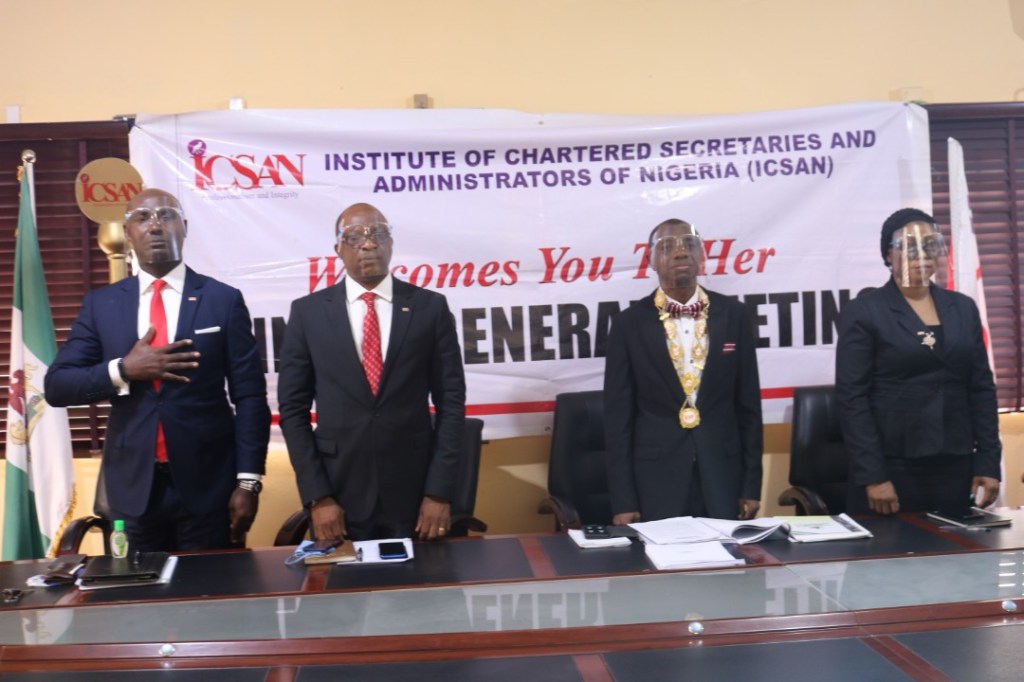
From left – Francis Olawale, FCIS, Honorary Treasurer, Taiwo Gbenga Owokalade, FCIS, Vice President, Bode Ayeku, FCIS, President/Chairman of Council and Taiwo Olusesi, FCIS, Registrar/Chief Executive Officer, all of the Institute of Chartered Secretaries and Administrators of Nigeria (ICSAN) during the 46th Annual General Meeting of the Institute attended by members virtually.
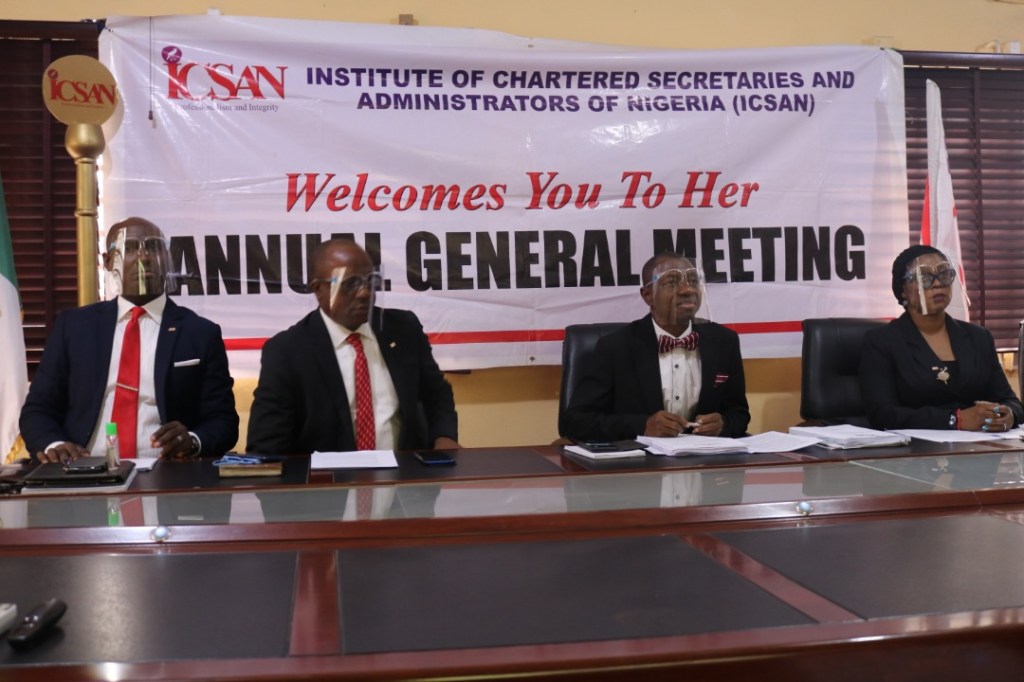
The Institute Boss flaked by his Vice, Taiwo Owokalade, Honorary Treasurer, Francis Olawale, Registrar/Chief Executive Officer Taiwo Olusesi, said this at news briefing after the 46th Annual General Meeting held on 9 July 2020.
He maintained that it is trite that the register of members is such an important statutory document that must be handled efficiently by each company.
Ayeku added that there is the need to focus on retail investors to get the capital market right, and the need for solution on identity management in processing unclaimed dividends.
He advised that Registrars should continue to put more effort to ensuring that the register of members of publicly quoted companies are regularly and appropriately updated from time to time.
In order to reduce the volume of unclaimed dividends in Nigeria, he recommended that the Securities and Exchange Commission, the Central Bank of Nigeria, Institute of Capital Market Registrars (Registrars), Nigeria InterBank Settlement System (NIBSS) and other Capital Market Operators should work together to redesign the current e-Dividend Mandate Form in such a way that a shareholder only needs to complete one Form listing all the companies where he has shares and submit it to just one Registrar where he has shares, for processing and payment of all his unclaimed dividends in all the companies listed. He advised that the Registrar that received the duly completed Form will confirm the identity of the shareholder and process his unclaimed dividend only in the company that the Registrar is managing its register of members within a maximum period of three (3) days. Thereafter, the Registrar will forward the Form to the Registrar of the other company where the shareholder has shares for processing of the unclaimed dividend within three (3) days. This process will continue until the Form is received by the Registrar managing the register of members of the last company listed by the shareholder. Each Registrar would still be entitled to contact the shareholder to get any necessary clarification. However, the timeline for processing should still be respected unless a shareholder is not able to provide the required information.
He noted that the current arrangement where a shareholder is required to download and complete the e-Dividend Mandate Form of each Registrar to process unclaimed dividend under its management, thereby necessitating that a shareholder having shares in five (5) companies with five (5) different Registrars must submit five (5) separate Forms, is not only a waste of time of the shareholders, but slows down the pace of processing unclaimed dividend and making it difficult to record substantial reduction annually. He stated that the recommendation is easy to implement because all the Registrars are using the same e-Dividend Mandate Form (except that each Registrar states its name on its Form) and cannot rationalize the reason for the duplication.
According to him, this approach would immediately eliminate the stress that the shareholders with unclaimed dividends are constrained to endure by visiting many Registrars just for the purpose of processing the unclaimed dividends that the E-Dividend Mandate Management System (EDMMS) has consolidated in the portal created for this purpose by the Securities and Exchange Commission. He stated that since each Registrar, the bank and shareholder can see all the companies in which they have unclaimed dividends through the portal, they should be allowed to complete one Form to claim the dividends thereby accelerating the reduction of unclaimed dividends.
In addition, Ayeku stated that this approach would also ensure that shareholders would only be required to provide just one Banker’s confirmation of signature instead of the current practice where a shareholder is required to provide the confirmation to each Registrar in order to process unclaimed dividends.
To adequately track the progress made to reduce unclaimed dividends, all Registrars should be required to submit monthly returns on the number of unclaimed dividends request received, the number processed up to payment and the duration of the process, number yet to be completed and the reasons, efforts made, challenges and recommendations. The highlights should be uploaded on the website of each Registrar and the Securities and Exchange Commission should review and give further necessary action.
The President of ICSAN noted that the High Court in each state of the federation has a big role to play to reduce the volume of unclaimed dividends. He observed that substantial number of shareholders with unclaimed dividends are dead and their beneficiaries are not able to quickly get the required Letters of Administration or Probate from applicable Probate Registry due to bureaucracy and inability to commit to a timeframe within which they would be issued to the Administrators or Executors after submitting the required documents.
To address cases where the families of deceased shareholders are not able to raise funds to pay the Estate duty and processing fees payable to the government in order to process the Letters of Administration or Probate and the fees to the professionals handling the assignments, he recommended that each Probate Registry should allow such families (nominated Administrators or Executors / Executrix) to give a letter of authority to the Registrar(s) of the company(ies) where the deceased had unclaimed dividends or the bank(s) with funds of the deceased, to deduct and pay as a priority charge, the Estate duty payable to the government within 48 hours of the activation of the Estate Bank account and the professional(s) processing the documents.
With this approach, payment of the amount due to the government and professionals processing the documents would be guaranteed; the beneficiaries of the unclaimed dividends would be able to get the net amount due despite their inability to raise funds for processing and this would also contribute to substantial reduction in the volume of unclaimed dividends.
The implementation of the recommendation would avoid a situation whereby dependants of deceased shareholders are suffering notwithstanding that the deceased had huge unclaimed dividends and funds in bank accounts that cannot be withdrawn due to the inability to get Letters of Administration or Probate.
It is a fact that this approach would substantially reduce the number of dormant bank accounts and idle funds in such accounts because the beneficiaries of the deceased bank customers could not get the required documents from the Probate Registry.
On COVID-19, Ayeku commended the Federal Government’s efforts on the timely response to the first case of Covid-19 in the country, and so far, saying it is commendable that Nigeria speedily detected the case and is addressing the matter with urgency in conjunction with the state governments.
He said the federal governments took proactive steps to curtail the spread of coronavirus throughout the country, as the country experiences a steady increase in the number of confirmed cases which necessitated movement restrictions and lockdowns imposed to adequately respond to the pandemic.
According to him, the situational responses affect businesses, including their interactions with their relevant regulators, saying there is no doubt that the pandemic has proven to be a serious challenge to the global economy, Nigeria inclusive.
Ayeku said the treatment and management of the affected patients in all the treatment centres, continuous updates on every development and the distribution of palliative packages as well as food items, to the vulnerable and less privileged will forever remain indelible in the minds of Nigerians.
He however, seriously thinks that within the challenge, there are opportunities for Nigeria as a nation. He stated that growth will only happen if companies and innovators are encouraged to make use of the window of opportunity presented by the crises orchestrated by the pandemic.
Nigeria indeed has the population and human capital capabilities. Beyond population, Nigeria needs a critical ingredient to make use of the chance to succeed presented by the pandemic. The answer to Nigeria’s quest to defeating the pandemic and turning it to a thing of blessing is in disguise: innovation that is readily supported by the Federal Government and other stakeholders.
Ayeku said the ongoing global lockdown due to the Covid-19 pandemic had brought the corporate world to the point of using digital platforms (virtual meetings) as alternatives to conducting businesses and holding meetings.
This, he stressed, must be done without violating the orders of governments worldwide to help flatten the curve of the spread of the deadly virus.
In determining the venue of a virtual meeting, Ayeku said that there are cases where the law stipulates that a meeting should be held at a particular location. In such cases, the venue of the meeting would be as stipulated by law, even if held virtually.
The ICSAN president also recommended that the board should sensitize the shareholders on the need for an express provision in the Articles of Association authorizing AGMs to be held virtually, where a physical meeting will not be possible.
He gave recommendations to help businesses and the public sector continue to prosper during and after Covid-19 disruptions. He advised business entities to conduct a business impact analysis and implement appropriate business continuity plan with key stakeholders after identifying objectives of the plan and set goals.
This, he explained, would ensure that adequate arrangements aimed at preventing disruptions and strategies to withstand them in case of eventualities, without adverse effects on their operations.
Ayeku called on the governments, regulatory agencies, public and private sector, and the citizenry to collaborate in promoting the ease of doing business.
According to the ICSAN president, the private sector will thrive when there is a conducive environment for business, which would enable the private sector to contribute their quota towards the development of the economy.
Ayeku noted that the fundamental challenge of the organized private sector was in not being able to get the desired conducive environment for business notwithstanding the promise of the government to facilitate the ease of doing business.
 securityandsafetymatters