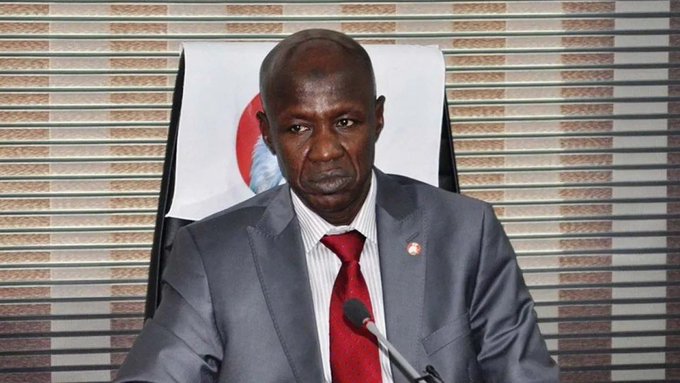
The Presidency on Tuesday declared that the ongoing probe of the acting Chairman of the Economic and Financial Crimes (EFCC), Ibrahim Magu, is an affirmation that nobody under the present administration is above scrutiny.
According to facts made available to State House correspondents by a source in the presidency who pleaded anonymity, the interrogation of the anti-graft agency boss is to give him the opportunity to clear himself of weighty allegations.
The source maintained that the investigation of the EFCC boss was to reinforce the Buhari administration’s commitment to transparency and accountability, adding that the holder of such an elevated office must be above suspicion.
It assured that the administration will not prejudge anyone as it could be counted on to uphold justice and fairness.
The unsigned statement read: “The panel investigating allegations against Ag. EFCC Chairman had been sitting for some weeks now.
“In consonance with the principle of fairness and justice, it was needful that the Ag. Chairman be given opportunity to respond to the allegations, which are weighty in nature.
“Under the Muhammadu Buhari administration, nobody is above scrutiny. Repeat: nobody.
“The investigation is to reinforce transparency and accountability, rather than to vitiate it.
“Accountability for our actions or inactions is an inalienable part of democracy.
“In such elevated position as that of EFCC Chairman, the holder of the position must be above suspicion.
“There’s no prejudgement. Absolutely none. The Buhari administration can be counted on to uphold fairness and justice at all times,” the source said.
Meanwhile, the Department of State Services (DSS) has said contrary to claims that Magu had been arrested, he was only invited by a presidential panel that had been reviewing the activities of the EFCC.
According to the DSS, he was served the invitation to the panel, while on his way to the Force Headquarters, Abuja for a meeting and he was neither arrested nor forced to honour the invitation.
On Monday, the EFCC boss appeared before the panel probing allegations of gross misconduct against him.
The panel is led by Ayo Salami, retired president of the appeal court.
A member of the Presidential Advisory Committee Against Corruption (PACAC), Professor Femi Odekunle has reacted to the alleged arrest of the Economic and Financial Crimes Commission (EFCC) boss, Ibrahim Magu.
In a statement issued, Odekunle said the invitation by the Department of State Services (DSS), is a power play by blocs in the corridor of power.
According to the PACAC, Magu was only invited for questioning regarding some purported memo by the Minister of Justice and Attorney General of the Federation, Abubakar Malami.
He explained that the Presidential Advisory Committee perceives Malami as the arrowhead of the bloc that is not really interested in President Buhari’s anti-corruption fight.
Odeyemi cited the failure of the National Assembly to confirm the appointment of the EFCC boss based on a purported security report by the secret service as one plots by the power bloc.
While citing the AGF’s demand of certain high profile case files from Magu which he is yet to supply, he alleged that Malami has been using his closeness to President Muhammadu Buhari for his personal/power bloc agenda without demonstrating any genuine commitment to the anti-corruption fight.
Stressing further, the professor cited a few cases which includes the formal notice of abandonment in the corruption case involving former Minister of Niger Delta, Godwill Orubebe and a purported secret meeting with Abdulrasheed Maina in Dubai.
The group wants the President Buhari to put an end to the power-play.
The Socio-Economic Rights and Accountability Project (SERAP) has expressed “concerns about reports that the apparently arbitrary arrest of the acting chairman of the Economic and Financial Crimes Commission (EFCC), Ibrahim Magu, may be ‘the outcome of power-play’ at the highest levels of government.”
In a statement issued by the Deputy Director of the agency, Kolawole Oluwadare, the organisation said: “The reported statement by a member of PACAC seems to suggest that Magu’s arrest may be politically motivated and aim to undermine the independence and freedom of action of the EFCC. If true, this would make a mockery of Buhari’s oft-repeated commitment to fight grand corruption and the impunity of perpetrators, which is fuelling widespread and systemic corruption in the country.”
Oluwadare, therefore, urged the authorities to afford Magu his constitutionally and internationally guaranteed fair trial rights.
“Magu must either be charged with a recognizable criminal offence or released immediately and allowed to do his job without fear of reprisals,” the statement read in part.
“Nigerian authorities cannot continue to keep Magu in detention under suspicious circumstances without bringing any legitimate charges against him in violation of national and international law.
“Nigerian authorities must support the independence and freedom of action of anti-corruption agencies and institutions if they are to be able to genuinely fight grand corruption, which has for many years turned public service for many into a kind of criminal enterprise.”
“Nigerian authorities should focus on addressing the impact of corruption such as political violence, and denial of access for millions of Nigerians to even the most basic health and education services, as well as other patterns of human rights violations.
“Improving the independence of anti-corruption agencies and institutions is the most promising way to make tangible progress in the fight against corruption now and in the near future.
“Article 9(1) of the International Covenant on Civil and Political Rights and Article 6 of the African Charter on Human and Peoples’ Rights to which Nigeria is a state party guarantee to everyone the right to liberty and security of person, and that no one should be subjected to arbitrary arrest or detention.
“Similarly, Section 35(1) of the Nigerian Constitution of 1999 (as amended) guarantees to every person the right to personal liberty and that no person should be arbitrarily deprived of such liberty.”

