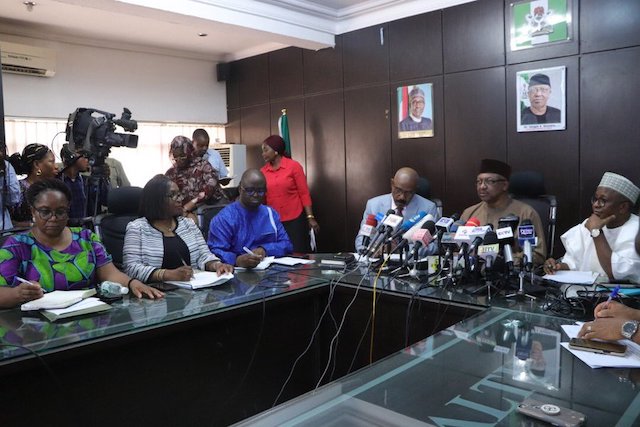
Nigeria’s Minister of Health, Osagie Ehanire has confirmed that the four Chinese citizens quarantined in Plateau state have tested negative to coronavirus (COVID-19).
He gave the update at a press briefing on Monday in Abuja.
The Plateau state government announced on Saturday February 29, that four suspected cases were quarantined.
Ehanire commended the state health officials for taking a precautionary measure by placing the Chinese citizens on supervised isolation for 14 more days.
He said: “None of these cases have any symptoms and they have all been tested at the Nigeria Centre for Disease Control reference laboratory. They are all negative for coronavirus infection.
“We will continue to monitor the global situation with cases spreading quickly in countries as they are doing now.”
Ehanire, on Monday revealed that the coronavirus index case in Lagos is responding very well to treatment at the infectious diseases hospital in Yaba, Lagos State.
The Minister, who spoke at a news conference in Abuja, maintained that all who had contacts with the index case, both in Lagos and Ogun states, are currently being managed, as none of the suspected cases has tested positive to the virus.
He also noted that all suspected cases in Plateau state, where the State’s Ministry of Health quarantined about 40 persons who came in contact with a Chinese miner, are under close monitoring.
Meanwhile, the Minister warned the public against panicking and assured citizens of the Federal Government’s preparedness to contain the virus.
Following the discovery of the first confirmed case of coronavirus disease in Lagos State, the federal government revealed
that as at March first, there was no new confirmed case in the country.
According to the government, out of about fourteen tests that were carried out, only one patient, the Italian citizen who worked
as a consultant in Nigeria, from Milan, Italy, tested positive to the disease.
At a news briefing in Abuja, Minister of Health, Dr. Osagie Ehanire, said the number of identified contacts of the index case in
Lagos and Ogun states were fifty-eight people who were placed under supervised self-isolation.
Concerning the suspected cases in Plateau state, the Health Minister said Plateau state government reported four suspected
cases among Chinese nationals on saturday.
He said none of the cases had any symptoms, saying they had all been tested at the Nigeria Centre for Disease Control
reference laboratory and they all tested negative to coronavirus infection.
Minister of Health, Dr Osagie Ehanire says Federal Ministry of Health will implement the recommendations and summary presented by the Joint UN Mission to Nigeria on Tuberculosis (TB) and Non-Communicable Diseases (NCDs) after the meeting of the UN Mission to Nigeria on TB and NCDs, was held in Abuja with a news conference on the recommendations and the summary of the meeting.
Ehanire, pledged that the Federal Government would effectively implement the recommendations to reduce the burden of TB and NCDs in the country.
According to Ehanire, the magnitude of NCDs and TB problem in Nigeria prompted the ministry to invite the mission to support the efforts of government in the fight against the diseases.
The minister emphasised the commitment of government to implement the recommendations from the mission, saying “we cannot achieve SDGs if we continue to allow TB and NCDs to afflict our people”.
According to the 2019 WHO global report, Nigeria is first in Africa and sixth globally in the 30 high TB-burden countries in the world.
The country is also one of the 14 countries in the world with triple burden of TB, HIV associated TB and multi-drug resistant TB.
In his remarks, Dr Clement Peter, Officer-in-Charge of World Health Organisation (WHO) in Nigeria said the agency would support Nigeria in implementing some of the recommendations.
Peter, represented by Dr Rex Mpazanje, said the implementation of recommendations would help to reduce the burden of the diseases in Nigeria.
Earlier, Diana Weil, Lead, Strategy, WHO, Global TB Programme, WHO Headquarters in Geneva gave the summary and recommendations from the meeting.
Weil said the meeting commended Nigeria’s government for its leadership, strategy, planning and ambitious targets and commitments to end TB and address NCDs.
According to her, addressing the enormous societal and economic burden of the diseases will require increased and sustained domestic financing for primary health and disease priorities.
For his part, Dudley Tariton, Programme Specialist, Health and Development, UN Development Programme (UNDP) said lack of public awareness on these diseases-including among health care workers was a major barrier.
He called for concerted campaigns from the highest level of government, the states and local authorities.
 securityandsafetymatters