Nigeria has boycotted the World Economic Forum(WEF) on Africa 2019 taking place in Cape Town, South Africa following Xenophobic attacks against on its citizens in the last one week.
The Forum, which kicked off on Wednesday, had no Nigerian delegation in attendance.
Other African countries also joined Nigeria in boycotting the event.
Some of the other African countries that have pulled out of WEF are Rwanda, Malawi and DR Congo.
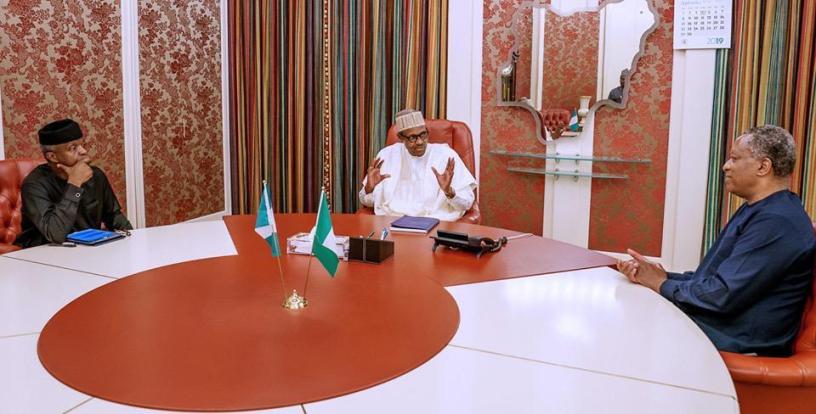
As at the time of filing this report, President Muhammadu Buhari and Vice President Yemi Osinbajo were meeting with the Minister of Foreign Affairs, Geoffrey Onyeama to discuss next step on Xenophobic attacks against Nigerians in South Africa.
Read Also: Buhari, Osinbajo, Onyeama meet over xenophobia
They are exploring possible options, including sanctions against the South African government.
The government is also deliberating over possible actions from within after some Nigerians carried out reprisal attacks against South African businesses in Nigeria, including attacks on one of Africa’s largest food retailer, Shoprite and telecoms giant, MTN, forcing the organisations to scale down operations.
“President Muhammadu Buhari and Vice President Yemi Osinbajo have taken hands-on approach in resolving the Xenophobia issue with South Africa but they want everything done diplomatically,” a source in the Presidency said.
“The boycott of WEF is another strong statement to the South African government and people because the Buhari administration will not stand and fold its arms after attack on any Nigerian citizen. This is the right step in the right direction.”
Minister of Foreign Affairs, Geoffrey Onyeama, on Wednesday, confirmed Nigeria’s boycott of the World Economic Forum scheduled for South Africa.
According to him, President Muhammadu Buhari agreed with Vice President Yemi Osinbajo not to go to South Africa under the climate of xenophobic attacks.
He briefed State House correspondents on Wednesday, stressing that red line has been drawn against South Africa.
On the alleged recall of Nigerian ambassador to South Africa, he said that it is one of the options the government is considering and final decision will be taken after the report of the special envoy sent to South Africa.
Minister of Foreign Affairs, Geoffrey Onyeama, revealed the Federal Government’s position regarding the xenophobic attacks in South Africa.
While giving updates on the government’s stance on the issue, Onyeama said government at every level has condemned the attacks and described it as unacceptable.
Onyeama told newsmen in Abuja that government will not accept the attacks on its citizens, stressing that “enough is enough”.
He said the Nigerian government will address the issue once and for all this time.
The minister said whatever measures needs to be taken to ensure the safety of Nigerians in South Africa will be taken.
Onyeama said Federal Government had been in touch with the South African Government, adding that President Muhammadu Buhari has dispatched a special envoy to meet with President Cyril Ramaphosa.
He stressed that the government has a clear directives about the commitments and guarantees that is required of the South African Government.
Onyeama also said so much has been circulating over social media, many of which are not factual, and as such the situation has somewhat been distorted.
“A lot of things have been circulating all over social media which has not helped matters and some of them have really distorted the situation and because of that it has impacted the government’s response.
“Number one is that the information that we have from the High Commission and the Consul General in South Africa is that no lives have been lost during this crisis,” Mr Onyeama said.
He said stories about Nigerians being killed and being burnt are not the case, stressing that what the government knows is that premises and shops of Nigerians have been looted and properties have been destroyed.
Minister of Foreign Affairs also confirmed that Nigeria will not be participation at the World Economic Forum on Africa to be held in Cape Town, South Africa, from September 4 to 6.
He revealed that the Vice-President Yemi Osinbajo was delegated by Buhari to attend the summit, but explained that the President later asked Osinbajo to withdraw, following the xenophobic attacks.
Buhari is distraught over reprisal attacks
Onyeama in his interaction with newsmen also revealed that President Muhammadu Buhari is worried over the vandalism that has taken place in Nigeria in reaction to the issue.
He said, “Mr President is particularly distraught at the acts of vandalism that have taken place here in Nigeria in retaliation to what is happening in South Africa.
“He believes that we have to take the moral high ground on this matter. we are victims here and we are making that position clear to the international community and the South African Government.
“We here in Nigeria must not fall into the temptation of also resorting to the acts that we are condemning in others. Mr President has pleaded and is likely to make a statement on this addressing the Nigerian people to please desist from acts of vandalism and aggression,”Onyeama stated.
He went on to stress that the acts of vandalism only harms Nigerians who own most of the business being destroyed, adding that beyond who will suffer the brunt, the acts of vandalism is morally wrong.
Onyeama assured Nigerians that the Federal Government is determined, noting that the red line has been drawn and the government will not give in.
Telecoms giant, MTN Nigeria, said it has confirmed attacks on its facilities in three major cities of Lagos, Ibadan and Uyo in Lagos, Oyo and Akwa Ibom states respectively, ostensibly in retaliation for ongoing xenophobic attacks against Nigerians in South Africa.
Its Company Secretary, Uto Ukpanah, in a statement, explained that sequel to the attacks and the premium the firm has placed on its human capital and other stakeholders, all service centres and offices will remain shut.
Ukpanah said: “MTN Nigeria Communications Plc confirms that over the last day, our facilities, customers and some of our stakeholders have been the subject of attacks in retaliation for the ongoing xenophobia situation in South Africa.
Human rights activist, Femi Falana, SAN, on Wednesday asked Nigeria’s Federal Government to sue the South African government and demand compensation for Nigerian victims of the xenophobic attacks in the country.
Falana, in a statement, titled: “Beyond the condemnation of xenophobic attacks by the federal government,” said like its counterpart in Nigeria, the political class in South Africa had failed to address the challenge of poverty and inequality confronting the majority of the black people.
“Even though apartheid was defeated by the people of South Africa over two decades ago, the unjust socio-economic system erected by capitalism had not been dismantled. The crisis has been compounded by wanton corruption and the neo-liberal policies of the government.
“Hence, the South African masses have been denied the dividends of democracy by the African National Congress-led government. In particular, the masses have no access to health, housing, education and employment. Out of sheer frustration, millions of young people in South Africa have decided to subject African immigrants to xenophobic attacks,” he said.
According to Falana, the African National Congress, ANC, must accept responsibility for the misdirected antagonism against poor African imigrants.
He said apart from the official condemnation of the shameful and cowardly attacks, the South African Government should fish out the culprits and prosecute them.
“In addition to the payment of adequate compensation to all the victims of the mindless attacks the Government must teach South Africans about the immense contributions of the people of Cuba and a number of African countries to the struggle waged against apartheid and colonialism in the Southern African region.
“However, since the Cyril Ramaphosa administration is not likely to accede to the demand for compensation the federal government should brief a team of lawyers to seek legal redress for the victims of the attacks in South African courts.
“The Nigerian High Commission in Pretoria should be directed to coordinate the legal defence. In view of the regular harassment of Nigerians in South Africa and a few other African countries, the federal government should make the Declaration to enable individual victims of human rights abuse to access the African Court on Human and Peoples Rights sitting in Arusha, Tanzania,” he said.
The activist said since there was no assurance that Nigerians and other Africans would no longer be subjected to xenophobic attacks, the federal government should boycott the World Economic Forum scheduled to commence in South Africa on September 4.

