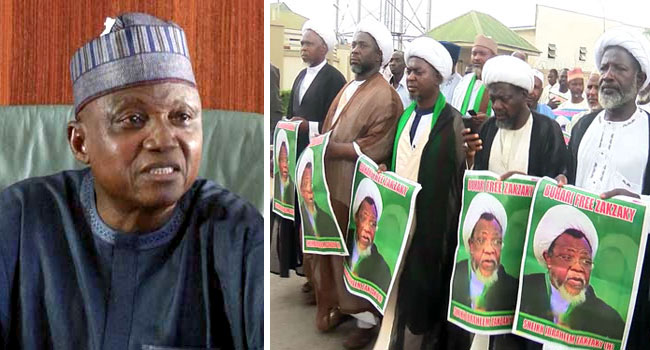
The move by the Federal Government to proscribe the Islamic Movement in Nigeria (IMN) has continued to trigger more mixed reactions across the country.
Senior Special Assistant to the President on Media and Publicity, Garba Shehu insisted that the move was in the right direction.
He likened the recent activities of the Shiite group to the declaration of war on the Nigerian State, following a series of protest which turned violent.
“Looking at the global definition of terrorism and some of the laws that prevail in many countries including the UK, … a ban of associations could be proclaimed if it is established that there is an intention to carry out terrorism.
“In this particular instance, it is not in doubt that the sect has declared war on the state,” said Shehu who is the .
He added, “They (IMN members) are killing law enforcement agents, they are stopping other citizens from enjoying their own right.”
According to the presidential aide, a responsible government has to do something about the security situation of the citizenry.
He stressed that the government has a responsibility to protect the right of its people, saying the Presidency was committed to doing just that.
Shehu, however, faulted the claims that the government has failed to go through due process to obtain a proscription order against the IMN.
He said, “What do you need to do other than go to court? The Attorney General of the Ministry of Justice didn’t just proclaim this thing without going to court; due process means go before a judge and ask for an order, and the order was given.”
The President’s spokesman decried that some people were misinterpreting the action taken by the government against the group.
He explained that the government only obtained an order to proscribe a sect and not stop people from practising the religion of their choice.
Shehu stressed that every Nigerian has a right to freedom of worship as enshrined in the nation’s Constitution.
On how far-reaching the order would be, he said “In Kaduna, it (proscription) worked; these troublesome people were chased out of the state and they no longer have a foothold there.
“They moved over to Abuja and that is why we have them here; so, it (court order) will be enforced.”
“What that means is that the law enforcement agencies in the country have justification to take whatever steps necessary in order to deal with their (IMN) activity if it surfaces,” the presidential aide added.
A Kaduna State High Court has set aside August 5, 2019, to rule on the bail application filed by the leader of the Islamic Movement in Nigeria (IMN), Ibrahim El-Zakzaky, and his wife, Zeenat.
Counsel to the El-Zakzakys, Femi Falana, had filed the application on behalf of his clients on July 18.
They are seeking permission to travel abroad for further medical treatment following the health condition of the Shiites’ leader.
At the resumed hearing on Monday, Falana said his clients were not in court due to their bad health condition.
The Senior Advocate of Nigeria told the court that the health condition of his clients was getting worse by the day.
He added that only a foreign medical treatment was required to stabilise them to enable them face the main trial.
However, the prosecuting counsel Debris Bayero opposed the bail application.
He informed the court that El-Zakzaky’s medical condition can be treated locally, insisting that there was no need for the court to release him on bail to travel abroad.
After listening to the submissions from both counsels, the presiding judge, Justice Darius Khobo adjourned the ruling on the application to August 5.
El-Zakzaky and his wife are facing an eight-count of culpable homicide, unlawful assembly, disturbance of public peace.
The charges were filed against them by the Kaduna State Government and the duo were first arraigned in May 2018.
Ahead of today’s sitting, security was beefed up in the Kaduna State capital and environs, especially at the entrance and exit points of the court complex.
The bail hearing came barely three days after a Federal High Court in Abuja granted the Federal Government the power to proscribe the Shiite group.
But Mr Falana condemned the action which he said was illegal and asked the government to withdraw the order.
The government secured the court order following a series of protests by the Shiites in Abuja to demand the release of their leader who has been in detention for more than three years.
Recent protests by the group turned violent as they clashed with the police in the Federal Capital Territory (FCT).

